
Review: Winter of the Crow – Lights against the darkness
Directed by Kasia Adamik
Starring Lesley Manville, Tom Burke, Zofia Wichłacz
9/10
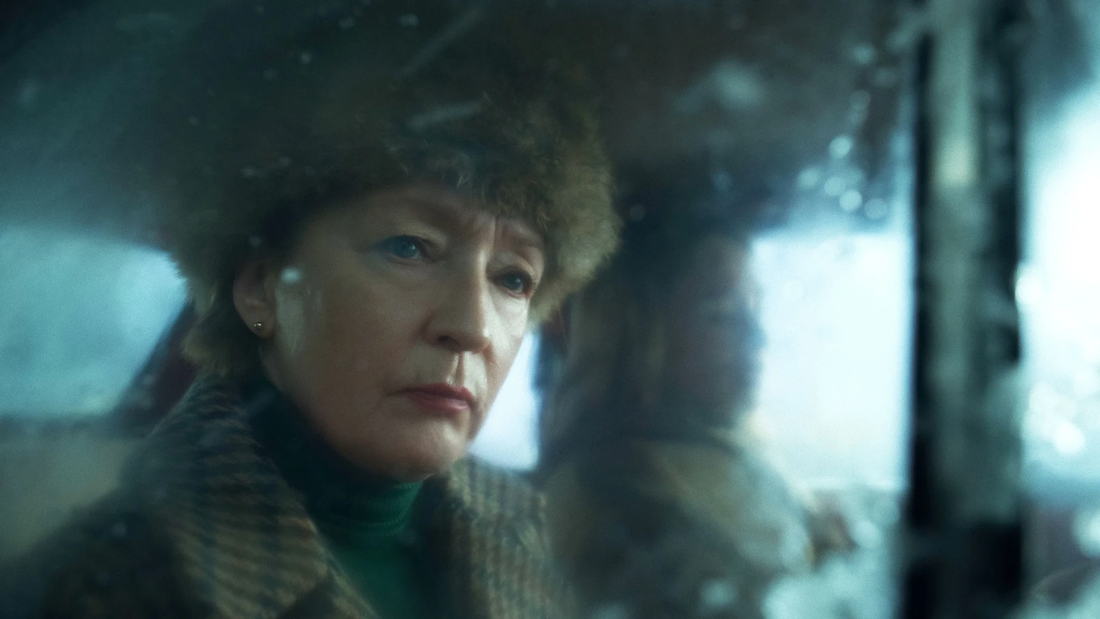
“Alive or dead?” In a Warsaw queue, the question concerns carp, a fish traditionally served at Christmas in Poland. When Professor Joan Andrews (Lesley Manville) returns to it at the British Embassy, an everyday transaction has become a disturbing metaphor: what does it mean to survive without freedom?Winter of the Crow draws its power from these encounters between ordinary life and political terror, inspired by the short story Professor Andrews Goes to Warsaw by Nobel Prize-winning author Olga Tokarczuk.
Joan is a British psychiatry professor arriving in Warsaw in December 1981, but her academic visit is overtaken by the declaration of martial law. Phones fall silent, tanks occupy the streets, and the people responsible for guiding her through an unfamiliar country disappear. Initially, Joan sees the upheaval principally through its consequences for herself. When asked to carry evidence of repression to Britain, she refuses: “This is not my fight.”
That refusal gives her subsequent transformation its significance. Understanding what is happening demands more than professional intelligence; it requires her to recognise a responsibility towards people whose struggle she would rather escape. Her profession gives the film another unsettling dimension: how can you help an individual when the system around them perpetuates their suffering? Her encounter with martial-law Poland exposes the limits of professional expertise when institutions people should be able to trust become sources of fear.
Watching the film at home with my 15-year-old daughter brought that history closer, and our conversation afterwards turned to whether she could leave Poland – or return freely – under such conditions. Growing up in Australia, she found herself imagining choices she had never expected to lose and described the urban imagery as dystopian, yet its foundations belong to the real housing developments of communist Poland. These apartment blocks were homes, places where people built families and communities. Tomasz Naumiuk’s cinematography makes them feel immense and disorienting, while Adamik filters their historical reality through memory and nightmare. The familiar becomes frightening through Joan’s inability to read its rules.
The film feels raw, cold and physically uncomfortable. Its diegetic sound – the noises belonging to the world the characters inhabit – makes that atmosphere especially vivid. The musical score leaves less of an impression; it was the sound of the city itself that draws you into Joan’s unease. The drawings above Marek’s bed offer another powerful encounter with the film’s inner world. Faces, animals, and political caricature occupy a private imaginative space beyond the state’s control. As Joan attends to them, the resistance becomes personal. “Head full of dreams. Imagination can kill communism” – Joan eventually begins to understand what another person’s dreams are worth.
Even the title carries a political echo. WRON, the abbreviation for the Military Council of National Salvation that assumed power under martial law, was popularly nicknamed the “crow.” The birds connect the film’s ominous imagery to an identifiable machinery of repression. But its most moving image is one of connection. Broadcasting over the radio, Alina asks listeners to flash their apartment lights. “They have tanks, but we have each other.” The answering windows make solidarity visible.
The scene recalls a student’s earlier question to Joan: “Do you know what will bring down communism?” “Capitalism?” she guesses. “No, imagination,” he replies. What initially sounds idealistic acquires substance through people’s refusal to surrender their capacity to think, create, and recognise one another. The scene evokes the solidarity that helped bring communist rule in Poland to an end in 1989.
You need no prior knowledge of Polish history to recognise these stakes. Winter of the Crow invites Australian audiences into a conversation across generations about freedom, belonging and the moment someone else’s struggle becomes our concern.
KASIA ELLIS
Winter of the Crow screens at Luna Leederville on Sunday, November 22, at 6:30 pm, as part of the 12th Polish Film Festival. Buy your tickets here.