
Review: You Can See Everything – Seeing is (not) believing
Directed by Nathan Fielder and Lance Oppenheim
Featuring Elizabeth Holmes
8.5/10
We might think we know Elizabeth Holmes. Her unblinking blue eyes, improbable baritone, and spectacular fall from Silicon Valley grace have been scrutinised, dramatised, and dissected across countless screens. Yet now on the big screen, You Can See Everything is less concerned with revealing the woman behind the mythology than interrogating how we manufacture meaning from images of others.
Directors Lance Oppenheim and Nathan Fielder make a fascinating pairing. Oppenheim’s documentaries (Some Kind of Heaven, Spermworld and Ren Faire) explore insular worlds sustained by elaborate personal mythologies, while Fielder’s Nathan for You and The Rehearsal dissect the performances through which we navigate social existence. Anyone expecting a definitive verdict on Holmes has perhaps misunderstood filmmakers more invested in complicating reality than resolving it.
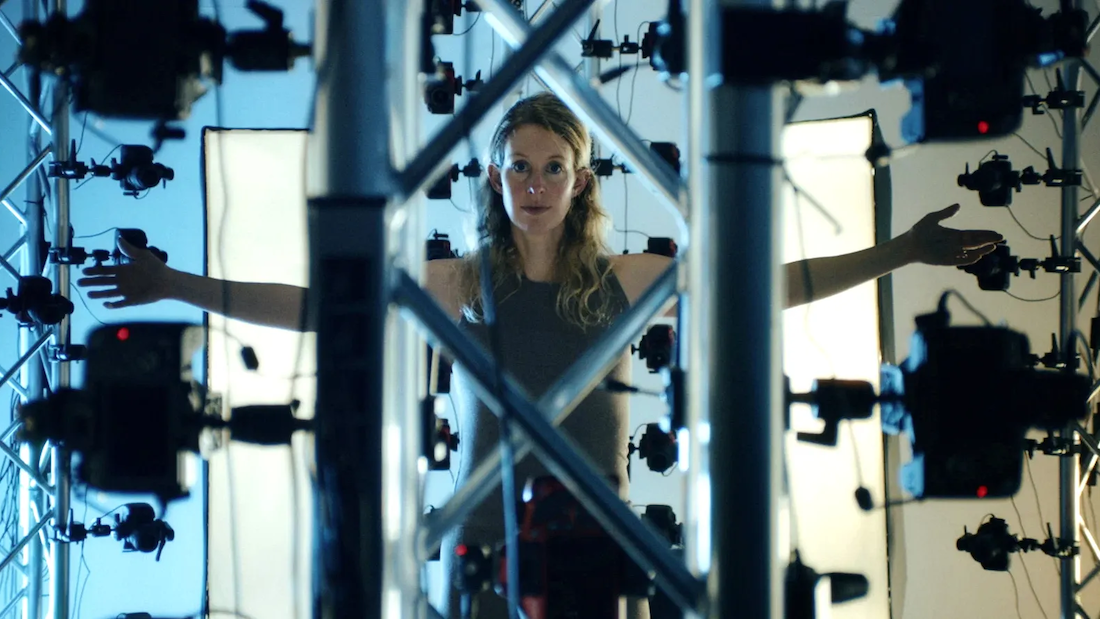
Photographed largely in available light, domestic interiors feel intimate yet faintly artificial, almost like another Fielder set. Faces fill the cinema screen, inviting forensic scrutiny, while the ever-present headphones and monitors undermine the illusion of unmediated access. In one breathtaking hyperreal tableau, Billy Evans sits with an uncanny virtual Holmes, their domestic iguana striding across the kitchen table, a distinctly Oppenheim composition suspending the documentary’s pretence of unvarnished truth.
Holmes is disarmingly wide-eyed, her guileless expressions recalling (for better or worse) Disney’s Dopey, reinforced by an occasionally ponderous, storybook score. Her gestures hover between vulnerability, calculation, and learned social performance. Fielder’s interest in masking and social interpretation, particularly evident in The Rehearsal’s second season, raises another possibility: might behaviours interpreted as manipulation also reflect neurological difference? Can sincerity or deceit ever be diagnosed from a face?
Fielder jokingly likens his business scams on Nathan for You to Holmes’ ventures, a comparison she fails to appreciate—likewise with a penny-dropping moment of Abbott and Costello’s “Who’s on First” sketch. Yet watching Holmes enthusiastically pitch business ideas and Theranos 2.0 reveals the infectious charisma that once captivated investors. We might not ever really get closer to resolving whether she believes her own mythology or truth with a capital T.
When access to Holmes becomes restricted, Amanda Seyfried enters as both herself and her The Dropout incarnation. Fielder’s reconstructions and money-jogging routines collapse observation into performance, although later prison scenes seem to falter without OG Liz as a counterpoint. Here, Seyfried becomes less a window into the woman than a reprise of her fictional counterpart.
Late in the film, seated in firelight like amateur detectives, Seyfried and Fielder interrogate their reconstructed script. When Holmes appears to blame ‘the other woman’, Seyfried bristles: “I didn’t do it to her. She did it to herself!” The question of responsibility extends to Evans, increasingly directing Holmes’ communications and public image without her consent. His apparent manipulation renders her unexpectedly sympathetic, but if he emerges as the convenient villain, perhaps he, too, has done it to himself.
A disclosed sexual assault introduces another vulnerability, while her relationship blurs the lines between genuine affection and coercive control. Fielder’s customary calculated discomfort gives way to an unsettling tenderness in response, his apparent attachment complicating the filmmaker-subject relationship.
Absorbing throughout, You Can See Everything is a formally audacious documentary turning its methods of observation and interpretation upon themselves. Its greatest revelation isn’t Holmes, but our susceptibility to the stories we construct from what we see.
CAT LANDRO