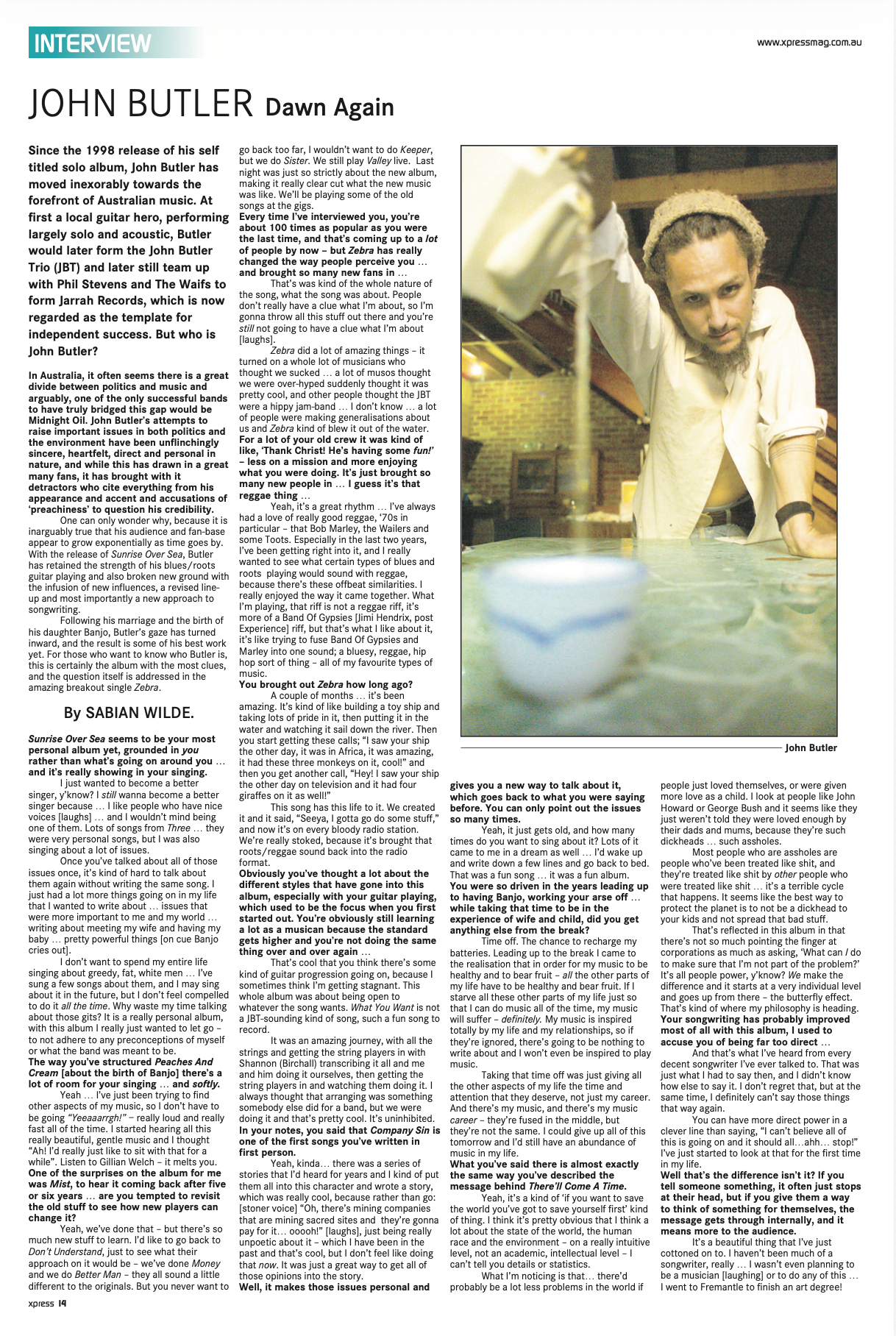
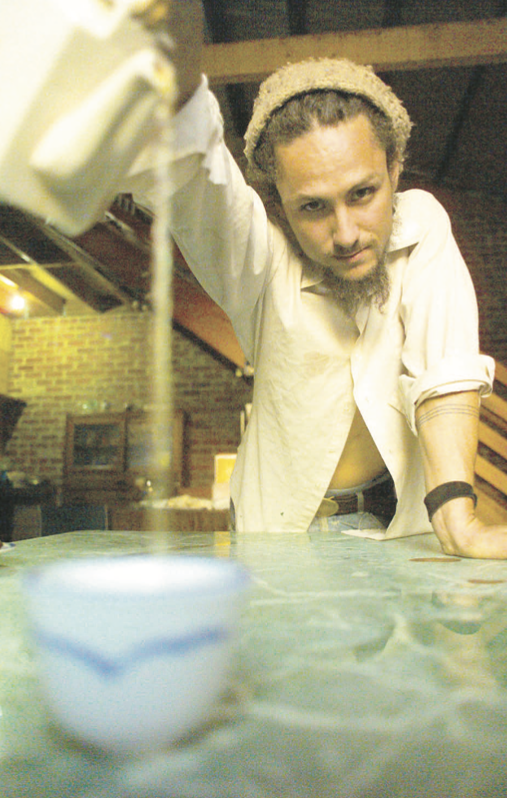
JOHN BUTLER Dawn again
Since the 1998 release of his self-titled solo album, John Butler has moved inexorably towards the forefront of Australian music. At first a local guitar hero, performing largely solo and acoustic, Butler would later form the John Butler Trio (JBT) and later still team up with Phil Stevens and The Waifs to form Jarrah Records, which is now regarded as the template for independent success. But who is John Butler?
In Australia, it often seems there is a great divide between politics and music and arguably, one of the only successful bands to have truly bridged this gap would be Midnight Oil. John Butler’s attempts to raise important issues in both politics and the environment have been unflinchingly sincere, heartfelt, direct and personal in nature, and while this has drawn in a great many fans, it has brought with it detractors who cite everything from his appearance and accent and accusations of ‘preachiness’ to question his credibility.
One can only wonder why, because it is inarguably true that his audience and fan-base appear to grow exponentially as time goes by.
With the release of Sunrise Over Sea, Butler has retained the strength of his blues/roots guitar playing and also broken new ground with the infusion of new influences, a revised line-up and most importantly a new approach to songwriting.
Following his marriage and the birth of his daughter Banjo, Butler’s gaze has turned inward, and the result is some of his best work yet. For those who want to know who Butler is, this is certainly the album with the most clues, and the question itself is addressed in the amazing breakout single Zebra.
By SABIAN WILDE
Sunrise Over Sea seems to be your most personal album yet, grounded in you rather than what’s going on around you … and it’s really showing in your singing.
I just wanted to become a better singer, y’know? I still wanna become a better singer because … I like people who have nice voices [laughs] … and I wouldn’t mind being one of them. Lots of songs from Three … they were very personal songs, but I was also singing about a lot of issues.
Once you’ve talked about all of those issues once, it’s kind of hard to talk about them again without writing the same song. I just had a lot more things going on in my life that I wanted to write about … issues that were more important to me and my world … writing about meeting my wife and having my baby … pretty powerful things [on cue Banjo cries out].
I don’t want to spend my entire life singing about greedy, fat, white men … I’ve sung a few songs about them, and I may sing about it in the future, but I don’t feel compelled to do it all the time. Why waste my time talking about those gits? It is a really personal album, with this album I really just wanted to let go – to not adhere to any preconceptions of myself or what the band was meant to be.
The way you’ve structured Peaches And Cream [about the birth of Banjo] there’s a lot of room for your singing … and softly.
Yeah … I’ve just been trying to find other aspects of my music, so I don’t have to be going “Yeeaaarrgh!” — really loud and really fast all of the time. I started hearing all this really beautiful, gentle music and I thought “Ah! I’d really just like to sit with that for a while”. Listen to Gillian Welch – it melts you.
One of the surprises on the album for me was Mist, to hear it coming back after five or six years … are you tempted to revisit the old stuff to see how new players can change it?
Yeah, we’ve done that – but there’s so much new stuff to learn. I’d like to go back to Don’t Understand, just to see what their approach on it would be – we’ve done Money and we do Better Man – they all sound a little different to the originals. But you never want to go back too far, I wouldn’t want to do Keeper, but we do Sister. We still play Valley live. Last night was just so strictly about the new album, making it really clear cut what the new music was like. We’ll be playing some of the old songs at the gigs.
Every time I’ve interviewed you, you’re about 100 times as popular as you were the last time, and that’s coming up to a lot of people by now – but Zebra has really changed the way people perceive you … and brought so many new fans in …
That’s was kind of the whole nature of the song, what the song was about. People don’t really have a clue what I’m about, so I’m gonna throw all this stuff out there and you’re still not going to have a clue what I’m about [laughs].
Zebra did a lot of amazing things – it turned on a whole lot of musicians who thought we sucked … a lot of musos thought we were over-hyped suddenly thought it was pretty cool, and other people thought the JBT were a hippy jam-band … I don’t know … a lot of people were making generalisations about us and Zebra kind of blew it out of the water.
For a lot of your old crew it was kind of like, ‘Thank Christ! He’s having some fun!’ – less on a mission and more enjoying what you were doing. It’s just brought so many new people in … I guess it’s that reggae thing …
Yeah, it’s a great rhythm … I’ve always had a love of really good reggae, ‘70s in particular – that Bob Marley, the Wailers and some Toots. Especially in the last two years, I’ve been getting right into it, and I really wanted to see what certain types of blues and roots playing would sound with reggae, because there’s these offbeat similarities. I really enjoyed the way it came together. What I’m playing, that riff is not a reggae riff, it’s more of a Band Of Gypsies [Jimi Hendrix, post Experience] riff, but that’s what I like about it, it’s like trying to fuse Band Of Gypsies and Marley into one sound; a bluesy, reggae, hip hop sort of thing – all of my favourite types of music.
You brought out Zebra how long ago?
A couple of months … it’s been amazing. It’s kind of like building a toy ship and taking lots of pride in it, then putting it in the water and watching it sail down the river. Then you start getting these calls; “I saw your ship the other day, it was in Africa, it was amazing, it had these three monkeys on it, cool!” and then you get another call, “Hey! I saw your ship the other day on television and it had four giraffes on it as well!”
This song has this life to it. We created it and it said, “Seeya, I gotta go do some stuff,” and now it’s on every bloody radio station. We’re really stoked, because it’s brought that roots/reggae sound back into the radio format.
Obviously you’ve thought a lot about the different styles that have gone into this album, especially with your guitar playing, which used to be the focus when you first started out. You’re obviously still learning a lot as a musician because the standard gets higher and you’re not doing the same thing over and over again …
That’s cool that you think there’s some kind of guitar progression going on, because I sometimes think I’m getting stagnant. This whole album was about being open to whatever the song wants.
What You Want is not a JBT-sounding kind of song, such a fun song to record.
It was an amazing journey, with all the strings and getting the string players in with Shannon (Birchall) transcribing it all and me and him doing it ourselves, then getting the string players in and watching them doing it. I always thought that arranging was something somebody else did for a band, but we were doing it and that’s pretty cool. It’s uninhibited.
In your notes, you said that Company Sin is one of the first songs you’ve written in first person.
Yeah, kinda… there was a series of stories that I’d heard for years and I kind of put them all into this character and wrote a story, which was really cool, because rather than go: [stoner voice] “Oh, there’s mining companies that are mining sacred sites and they’re gonna pay for it… ooooh!” [laughs], just being really unpoetic about it – which I have been in the past and that’s cool, but I don’t feel like doing that now. It was just a great way to get all of those opinions into the story.
Well, it makes those issues personal and gives you a new way to talk about it, which goes back to what you were saying before. You can only point out the issues so many times.
Yeah, it just gets old, and how many times do you want to sing about it? Lots of it came to me in a dream as well … I’d wake up and write down a few lines and go back to bed. That was a fun song … it was a fun album.
You were so driven in the years leading up to having Banjo, working your arse off … while taking that time to be in the experience of wife and child, did you get anything else from the break?
Time off. The chance to recharge my batteries. Leading up to the break I came to the realisation that in order for my music to be healthy and to bear fruit – all the other parts of my life have to be healthy and bear fruit. If I starve all these other parts of my life just so that I can do music all of the time, my music will suffer – definitely. My music is inspired totally by my life and my relationships, so if they’re ignored, there’s going to be nothing to write about and I won’t even be inspired to play music.
Taking that time off was just giving all the other aspects of my life the time and attention that they deserve, not just my career. And there’s my music, and there’s my music career – they’re fused in the middle, but they’re not the same. I could give up all of this tomorrow and I’d still have an abundance of music in my life.
What you’ve said there is almost exactly the same way you’ve described the message behind There’ll Come A Time.
Yeah, it’s a kind of ‘if you want to save the world you’ve got to save yourself first’ kind of thing. I think it’s pretty obvious that I think a lot about the state of the world, the human race and the environment – on a really intuitive level, not an academic, intellectual level – I can’t tell you details or statistics.
What I’m noticing is that… there’d probably be a lot less problems in the world if people just loved themselves, or were given more love as a child. I look at people like John Howard or George Bush and it seems like they just weren’t told they were loved enough by their dads and mums, because they’re such dickheads … such assholes.
Most people who are assholes are people who’ve been treated like shit, and they’re treated like shit by other people who were treated like shit … it’s a terrible cycle that happens. It seems like the best way to protect the planet is to not be a dickhead to your kids and not spread that bad stuff.
That’s reflected in this album in that there’s not so much pointing the finger at corporations as much as asking, ‘What can I do to make sure that I’m not part of the problem?’
It’s all people power, y’know? We make the difference and it starts at a very individual level and goes up from there – the butterfly effect. That’s kind of where my philosophy is heading.
Your songwriting has probably improved most of all with this album, I used to accuse you of being far too direct …
And that’s what I’ve heard from every decent songwriter I’ve ever talked to. That was just what I had to say then, and I didn’t know how else to say it. I don’t regret that, but at the same time, I definitely can’t say those things that way again.
You can have more direct power in a clever line than saying, “I can’t believe all of this is going on and it should all…ahh… stop!” I’ve just started to look at that for the first time in my life.
Well that’s the difference isn’t it? If you tell someone something, it often just stops at their head, but if you give them a way to think of something for themselves, the message gets through internally, and it means more to the audience.
It’s a beautiful thing that I’ve just cottoned on to. I haven’t been much of a songwriter, really … I wasn’t even planning to be a musician [laughing] or to do any of this … I went to Fremantle to finish an art degree!
This excerpt originally appeared in Issue 890 of X-Press Magazine, published on Thursday, March 4, 2004. Share your memories of this and other classic X-Press content by joining the Rewind Facebook group. Rewind: 40 Years of X-Press Magazine by Bob Gordon is on sale now in hardcover and softcover.