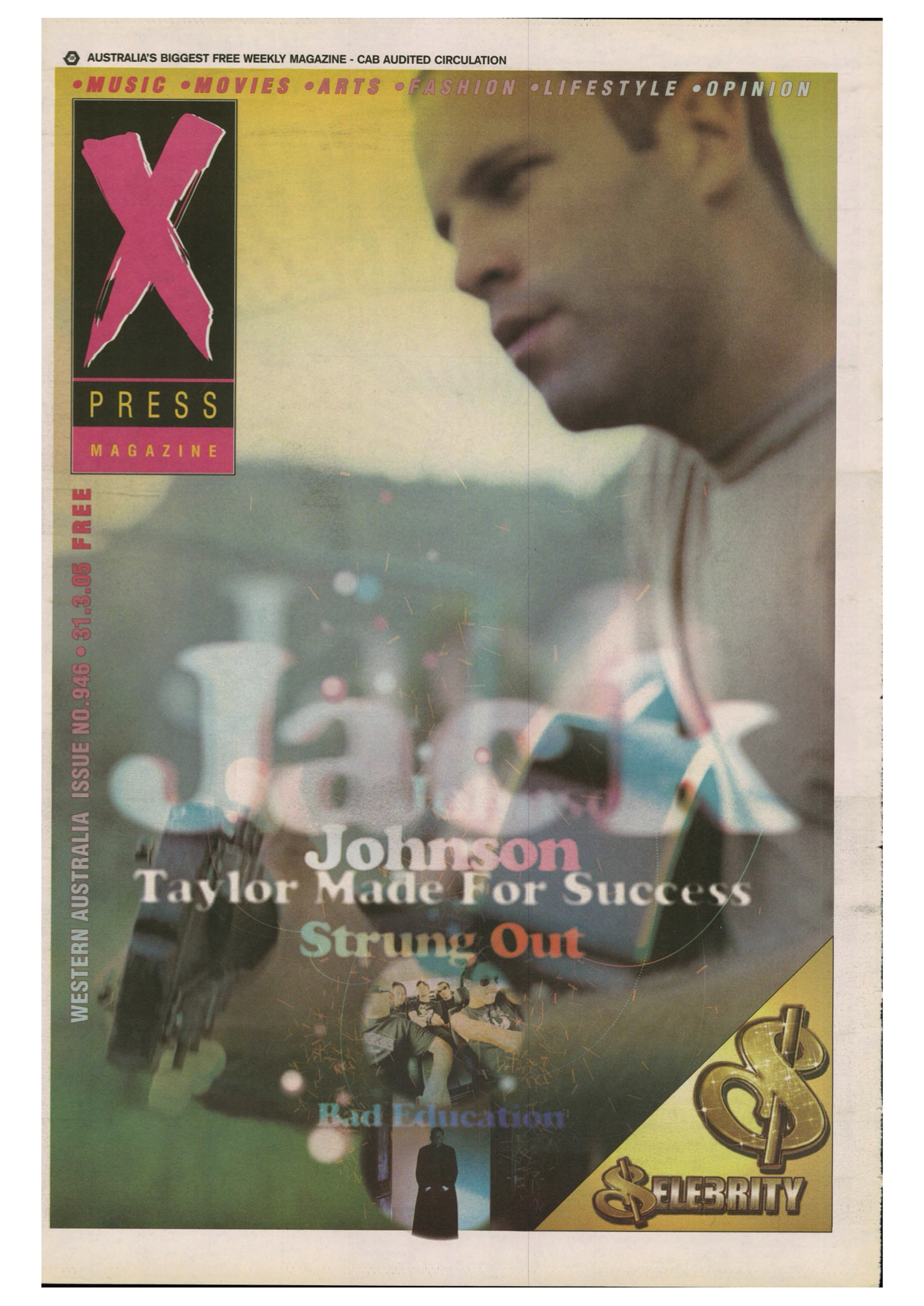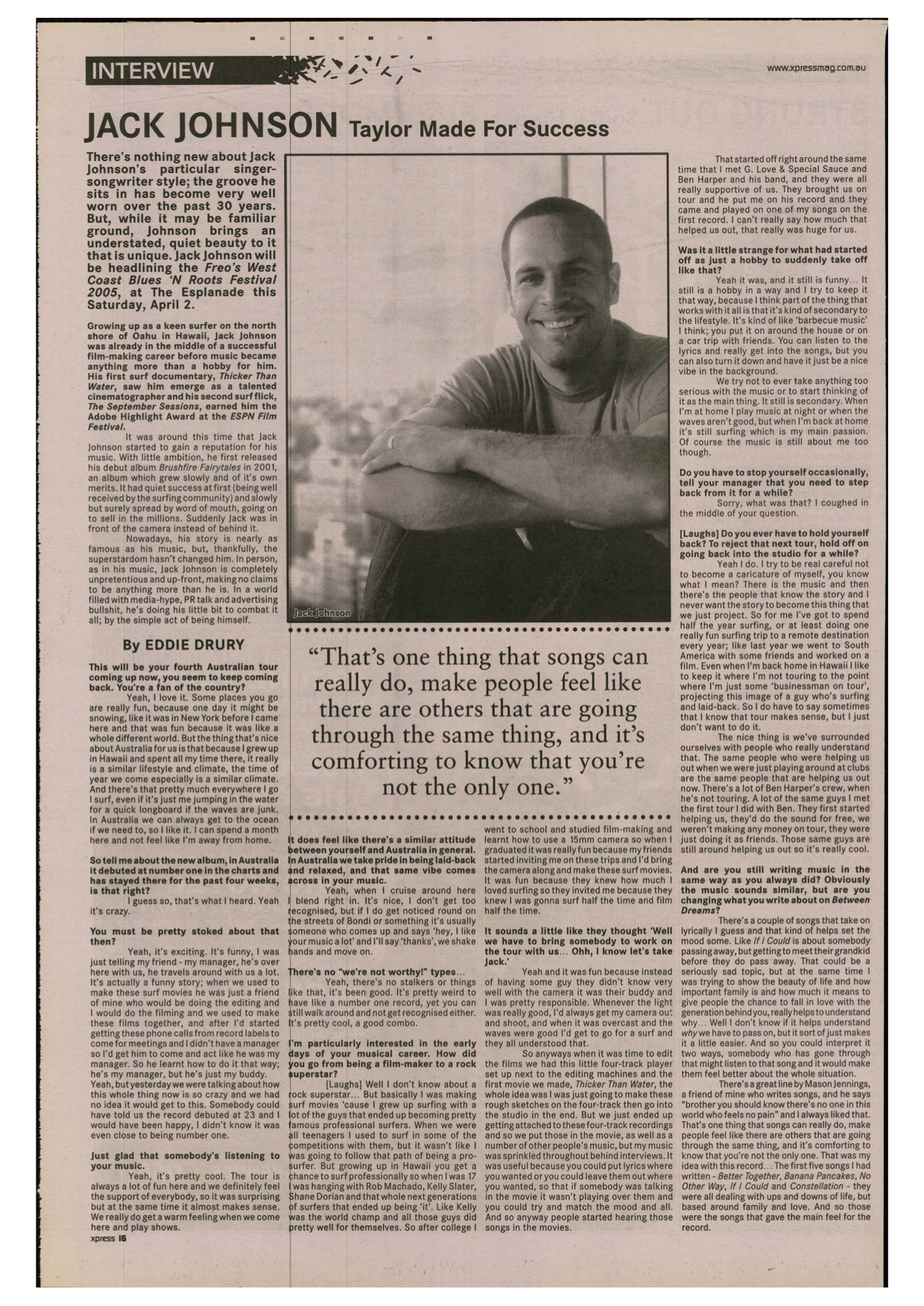
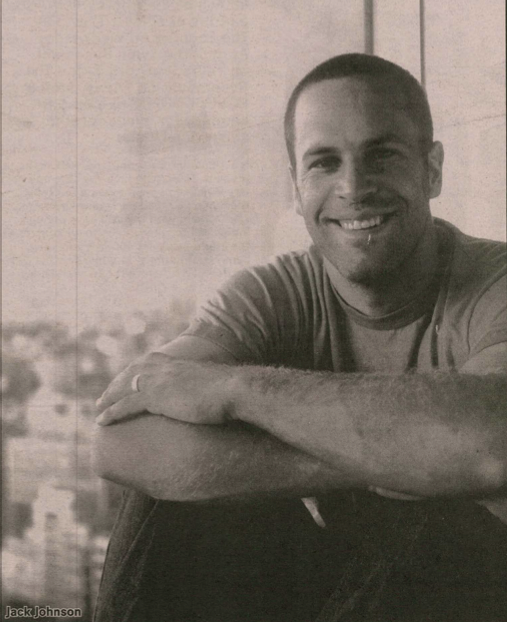
JACK JOHNSON Taylor made for success
There’s nothing new about Jack Johnson’s particular singer-songwriter style; the groove he sits in has become very well worn over the past 30 years. But while it may be familiar ground, Johnson brings an understated, quiet beauty to it that is unique. Jack Johnson will be headlining the Freo’s West Coast Blues ‘N Roots Festival 2005 at The Esplanade this Saturday, April 2.
Growing up as a keen surfer on the north shore of Oahu in Hawaii, Jack Johnson was already in the middle of a successful film-making career before music became anything more than a hobby for him. His first surf documentary, Thicker Than Water, saw him emerge as a talented cinematographer, while his second surf flick, The September Sessions, earned him the Adobe Highlight Award at the ESPN Film Festival.
It was around this time that Jack Johnson started to gain a reputation for his music. With little ambition, he first released his debut album Brushfire Fairytales in 2001, an album which grew slowly and of its own merits. It had quiet success at first (being well received by the surfing community) and slowly but surely spread by word of mouth, going on to sell in the millions. Suddenly, Jack was in front of the camera instead of behind it.
Nowadays, his story is nearly as famous as his music, but, thankfully, the superstardom hasn’t changed him. In person, as in his music, Jack Johnson is completely unpretentious and up-front, making no claims to be anything more than he is. In a world filled with media hype, PR talk and advertising bullshit, he’s doing his little bit to combat it all by the simple act of being himself.
By EDDIE DRURY
This will be your fourth Australian tour coming up now. You seem to keep coming back. You’re a fan of the country?
Yeah, I love it. Some places you go are really fun, because one day it might be snowing, like it was in New York before I came here, and that was fun because it was like a whole different world. But the thing that’s nice about Australia for us is that because I grew up in Hawaii and spent all my time there, it really is a similar lifestyle and climate. The time of year we come especially is a similar climate. And pretty much everywhere I go, I surf, even if it’s just me jumping in the water for a quick longboard if the waves are junk. In Australia we can always get to the ocean if we need to, so I like it. I can spend a month here and not feel like I’m away from home.
It does feel like there’s a similar attitude between yourself and Australia in general. In Australia we take pride in being laid-back and relaxed, and that same vibe comes across in your music.
Yeah, when I cruise around here, I guess so, that’s what I heard. Yeah, I blend right in. It’s nice, I don’t get too recognised, but if I do get noticed around on the streets of Bondi or something, it’s usually someone who comes up and says, ‘Hey, I like your music a lot,’ and I’ll say, ‘Thanks,’ we shake hands and move on.
You must be pretty stoked about that?
Yeah, it’s exciting. It’s funny, I was just telling my friend – my manager, he’s over here with us, he travels around with us a lot. It’s actually a funny story; when we used to make these surf movies he was just a friend of mine who would be doing the editing and I would do the filming, and we used to make these films together. After I’d started getting these phone calls from record labels to come for meetings and I didn’t have a manager, so I’d get him to come and act like he was my manager. So he learnt how to do it that way; he’s my manager, but he’s just my buddy.
Yeah, but yesterday we were talking about how this whole thing now is so crazy and we had no idea it would get to this. Somebody could have told us the record debuted at 23 and I would have been happy. I didn’t know it was even close to being number one.
The new album debuted at number one in the Australian charts and has stayed there for the past four weeks, is that right?
Yeah, it’s crazy.
You must be pretty stoked about that, then?
Yeah, it’s exciting. It’s pretty cool. The tour is always a lot of fun here and we definitely feel the support of everybody, so it was surprising but at the same time it almost makes sense. We really do get a warm feeling when we come here and play shows.
There’s no “we’re not worthy!” types…?
Yeah, there’s no stalkers or things like that, it’s been good. It’s pretty weird to have a number one record, yet you can still walk around and not get recognised either. It’s pretty cool, a good combo.
Just glad that somebody’s listening to your music.
Yeah, it’s pretty cool.
I’m particularly interested in the early days of your musical career. How did you go from being a film-maker to a rock superstar?
[Laughs] Well, I don’t know about a rock superstar… But basically I was making surf movies because I grew up surfing with a lot of the guys that ended up becoming pretty famous professional surfers. When we were all teenagers I used to surf in some of the competitions with them, but it wasn’t like I was going to follow that path of being a pro surfer. But growing up in Hawaii, you get a chance to surf professionally, so when I was 17 I was hanging with Rob Machado, Kelly Slater, Shane Dorian and that whole next generation of surfers that ended up being ‘it’. Like Kelly was the world champ and all those guys did pretty well for themselves.
So after college I went to school and studied film-making and learnt how to use a 16mm camera. When I graduated it was really fun because my friends started inviting me on these trips and I’d bring the camera along and make these surf movies. It was fun because they knew how much I loved surfing, so they invited me because they knew I was gonna surf half the time and film half the time.
Yeah, and it was fun because instead of having some guy they didn’t know very well with the camera, it was their buddy and I was pretty responsible. Whenever the light was really good, I’d always get my camera out and shoot, and when it was overcast and the waves were good, I’d get to go for a surf and they all understood that.
So anyways, when it was time to edit the films, we had this little four-track player set up next to the editing machines. And the first movie we made, Thicker Than Water, the whole idea was I was just going to make these rough sketches on the four-track, then go into the studio in the end. But we just ended up getting attached to these four-track recordings, and so we put those in the movie, as well as a number of other people’s music. But my music was sprinkled throughout behind interviews. It was useful because you could put lyrics where you wanted or you could leave them out where you wanted, so that if somebody was talking in the movie it wasn’t playing over them, and you could try and match the mood and all. And so anyway, people started hearing those songs in the movies.
That started off right around the same time that I met G. Love & Special Sauce and Ben Harper and his band, and they were all really supportive of us. They brought us on tour and he put me on his record and they came and played on one of my songs on the first record. I can’t really say how much that helped us out, that really was huge for us.
Was it a little strange for what had started off as just a hobby to suddenly take off like that?
Yeah, it was, and it still is funny… It still is a hobby in a way and I try to keep it that way, because I think part of the thing that works with it all is that it’s kind of secondary to the lifestyle. It’s kind of like ‘barbecue music’, I think; you put it on around the house or on a car trip with friends. You can listen to the lyrics and really get into the songs, but you can also turn it down and have it just be a nice vibe in the background.
We try not to ever take anything too seriously with the music or to start thinking of it as the main thing. It still is secondary. When I’m at home I play music at night or when the waves aren’t good, but when I’m back at home it’s still surfing which is my main passion.
Of course, the music is still about me too, though.
Do you have to stop yourself occasionally, tell your manager that you need to step back from it for a while?
Sorry, what was that? I coughed in the middle of your question.
[Laughs] Do you ever have to hold yourself back? To reject that next tour, hold off on going back into the studio for a while?
Yeah, I do. I try to be real careful not to become a caricature of myself, you know what I mean? There is the music and then there’s the people that know the story, and I never want the story to become this thing that we just project. So for me, I’ve got to spend half the year surfing, or at least doing one really fun surfing trip to a remote destination every year. Like last year we went to South America with some friends and worked on a film. Even when I’m back home in Hawaii, I like to keep it where I’m not touring to the point where I’m just some ‘businessman on tour’, projecting this image of a guy who’s surfing and laid-back. So I do have to say sometimes that I know that tour makes sense, but I just don’t want to do it.
The nice thing is we’ve surrounded ourselves with people who really understand that. The same people who were helping us out when we were just playing around at clubs are the same people that are helping us out now. There’s a lot of Ben Harper’s crew, when he’s not touring. A lot of the same guys I met the first tour I did with Ben. They first started helping us, they’d do the sound for free, we weren’t making any money on tour, they were just doing it as friends. Those same guys are still around helping us out, so it’s really cool.
And are you still writing music in the same way as you always did? Obviously the music sounds similar, but are you changing what you write about on Between Dreams?
There’s a couple of songs that take on [more serious subjects] lyrically, I guess, and that kind of helps set the mood some. Like If I Could is about somebody passing away, but getting to meet their grandkid before they do pass away. That could be a seriously sad topic, but at the same time I was trying to show the beauty of life and how important family is and how much it means to give people the chance to fall in love with the generation behind you. It really helps to understand why… Well, I don’t know if it helps understand why we have to pass on, but it sort of just makes it a little easier. And so you could interpret it two ways. Somebody who has gone through that might listen to that song and it would make them feel better about the whole situation.
There’s a great line by Mason Jennings, a friend of mine who writes songs, and he says, “Brother, you should know there’s no one in this world who feels no pain,” and I always liked that. That’s one thing that songs can really do: make people feel like there are others that are going through the same thing, and it’s comforting to know that you’re not the only one. That was my idea with this record… The first five songs I had written – Better Together, Banana Pancakes, No Other Way, If I Could and Constellation – they were all dealing with the ups and downs of life, but based around family and love. And so those were the songs that gave the main feel for the record.