
Unearthing Skeleton Girls with director Richard Eames
Revelation Perth International Film Festival has a bunch of hot new films to check out, one of the key ones this year being the locally made Skeleton Girls: A Kidnapped Society. DAVID MORGAN-BROWN spoke to its writer/director/editor/all-rounder Richard Eames about the long journey this film has taken, from his inspirations, the interesting casting process, getting filming done just before the pandemic, and the lengthy post-production stage.
Can you remember how it was that the idea of Skeleton Girls came to you? What was it that was going on in your life or in the world in general that spurred you to write this?
It was an idea that had been gestating for a very long time, certainly for years. And I could never really sort of figure out what form it would take. But it was probably around 2016, actually, when I kind of finished the first draft of it. But I think there was just a lot of stuff happening in the world at that point, and I suppose it was a means for me to try and make sense of a lot of that in a kind of film form.
So whereabouts did you film this movie? Because I think it said in the credits that it was in Leederville?
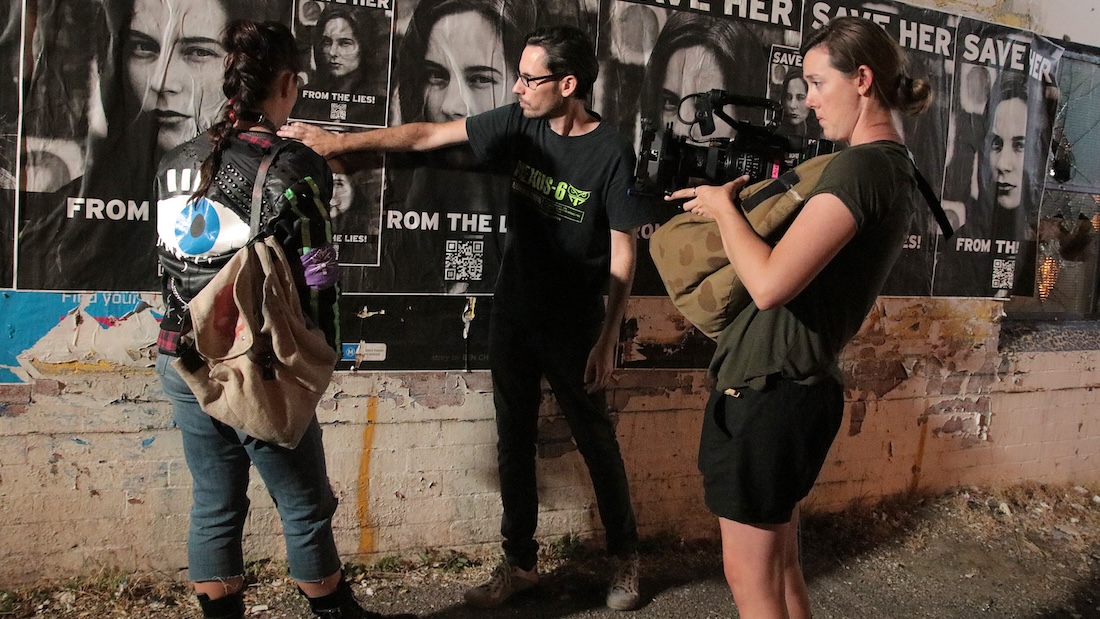
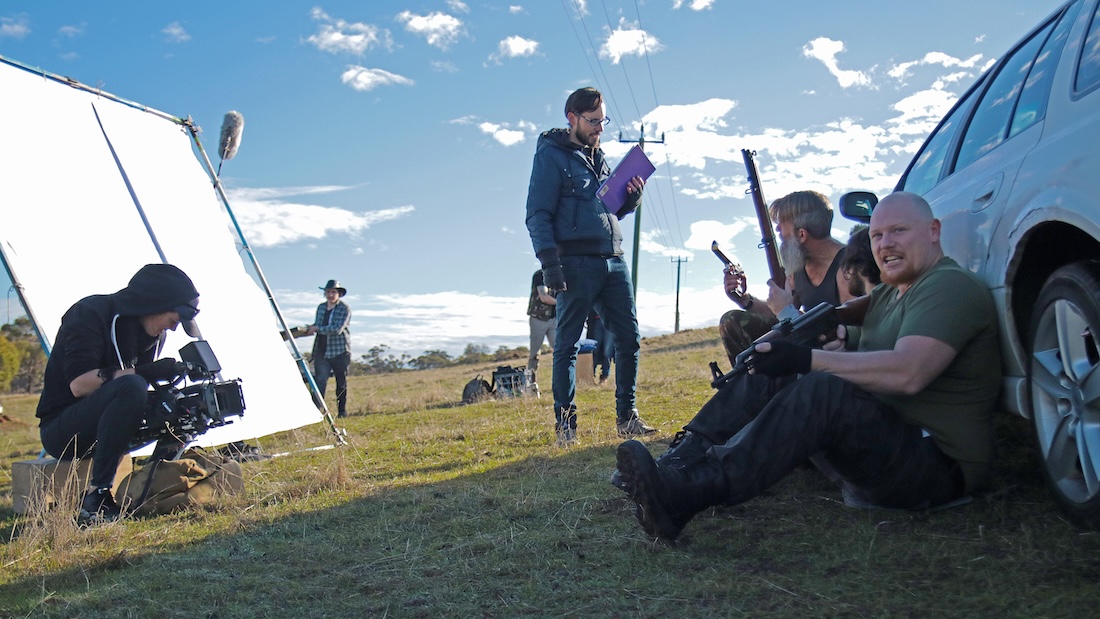
Some of the outdoor scenes at night were around Leederville and West Leederville. Certainly around the CBD a bit, a little bit in Subiaco, even down in Hamilton Hill. That was where we filmed some of the rat nest exterior stuff. We just built a set out there on a bit of land in the middle of Hamilton Hill. And then the last part of the movie takes place out in Toodyay, where there was a really cool kind of farm property up there that a friend of a friend had and let us go out there for a couple of weekends and shoot inside the house and outside in the paddock there. We kind of shot it all over the place a bit.
This looks and feels very much like a modern film. Were you inspired by not just other films but other sorts of mediums, like various new video forms?
I’ve always been interested in the experimental kind of film, and particularly in animation and motion graphics; that is kind of an area that I work in. But I’ve always been a fan of things like photomontage work and collage work. I’ve always tried to think, how can I do something different visually? How could I compose images differently? And often that is now with animation and building out the frame in this sort of ‘cut and paste’ aesthetic as well.
So those are definitely influences. I’m sort of a big fan of Japanese films as well. I’m a big fan of Shinya Tsukamoto (director of Tetsuo: The Iron Man), who certainly has the energy and the raw sort of DIY approach to a lot of his films. And something like Run, Lola, Run as well was another kind of important influence. It has that mixed media aesthetic, which was something I was really going for with this movie.
I’m wondering, when exactly did you get filming done for this movie?
So we started filming in October 2018, and then we shot over probably about a nine-month period, and that got the majority of the film. And then we came back, and I wrapped with the principal cast in March 2020. So it was probably a week before we started going into lockdown. So I was lucky to get the bulk of the film done.
But at that point I was then in post-production, and then because of the animation, there’s a lot of green screen elements as well that I had to sort of pick up. So that wasn’t a part of the principal photography; that was just stuff that I was filming in my house. I was just setting up a green screen in the dining room kitchen area and just picking up all of these bits and pieces that I needed to build these animations through the film.
You’ve got quite a colourful cast for this film. How much did it seem like the actors would put into their own characters?
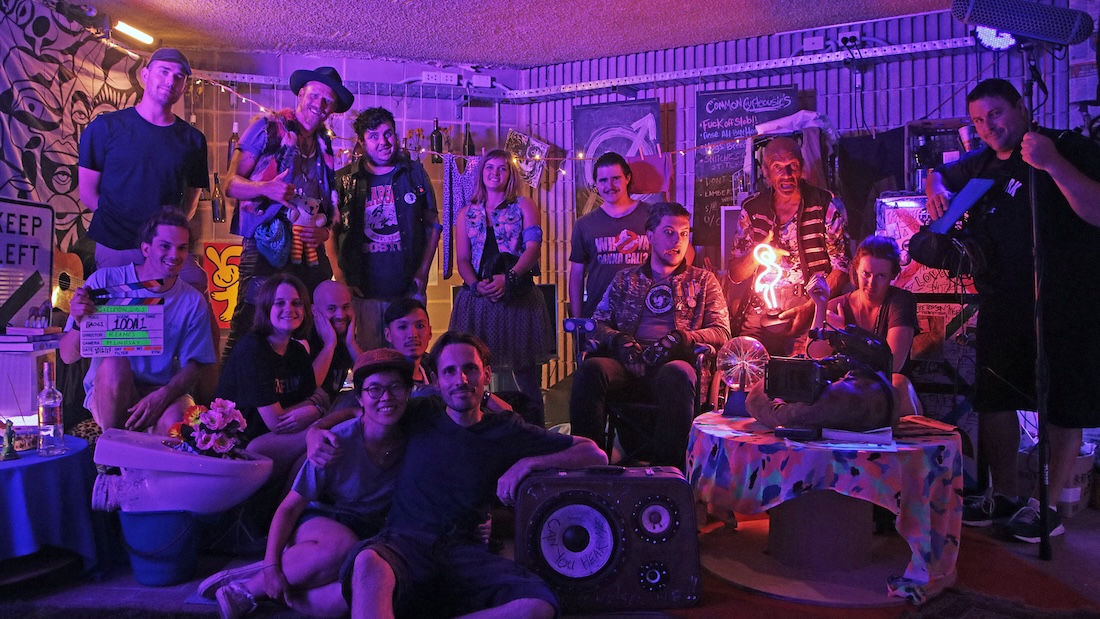
The way I wrote the script, there were a lot of characters and gangs of people. And so that was interesting to cast, trying to cast that because you’re not just casting the individual actor for the character, but it was also how do they work together as a group.
So what I did with the casting was I just took these groups and just condensed the script into one character, had them read just that one part, got a feel for it, and then did a callback with five actors that I felt were good and just sort of saw how they had it, how they went at it. And each of them had a different take on that character.
And then it was a matter of trying to pick the right combination of people. And when I saw them perform together, then I just had to do rewrites to the scripts as well. I just felt it was necessary to kind of lean into what they were bringing to the characters as well. Sometimes that meant switching lines about and changing the characters a fair bit.
That’s always an interesting part of the process: you have this idea in your head of what it is, but then once you have two actors that then sort of bring it to life, you really let them go with it. And I think there’s some really great actors in the film that really took the characters to places that I couldn’t really anticipate for sure.
So what’s going to be next for you? Are you working on any upcoming projects?
I’d still love to make more films here in Perth, but I don’t think I’d be able to make a film like this in the manner that I have. My life has just changed, and my priorities have changed quite a bit. Now I have a young son, so I can’t really go all-in in a way that I did with this film before he was born. So we’ll see.
Whatever I do from here will have to be kind of maybe smaller, maybe on a reduced scale. Like two or three actors in one location, right? And we just did the complete opposite with this movie. It was like two dozen actors and about 50 locations. It was quite over the top. So it’s probably going to be a scaled-down thing and more contained.
Skeleton Girls is showing at Revelation Perth International Film Festival 2025, which runs from Wednesday, July 2 to Sunday, July 13, 2025. For screening times head to revelationfilmfest.org