

Review: Wednesdays at the End of the World at Sailing for Oranges
Wednesdays at the End of the World at Sailing for Oranges
Wednesday, November 19, 2025
For a festival as sprawling as Fremantle Biennale, it felt fitting that one of its most curious offerings—Wednesdays at the End of the World—wasn’t a single performance so much as a mutating cosmology. Earlier chapters in the series had already toyed with philosophical dread and speculative collapse, each instalment featuring at least four local artists with Max Barton, the charming ringleader, at the helm. One might describe Wednesdays as something between interdisciplinary music theatre, a gig-night sermon, and group therapy for the apocalypse-curious. Together they invited us to contemplate endings—personal, geological, cosmic, and cyclical—with sincerity and tenderness; a meditation on the impossible-to-grasp scale of catastrophe—and our stubborn little human hearts within it.
The Biennale edition built on those bones and cracked them open further: bigger cast, bigger stakes, bigger existential headaches, all threaded together with Barton’s narrative flair. Staged upstairs at Sailing for Oranges—in what Barton dryly dubbed a “permanently defunct comedy lounge”—this was easily the most ambitious entry yet.
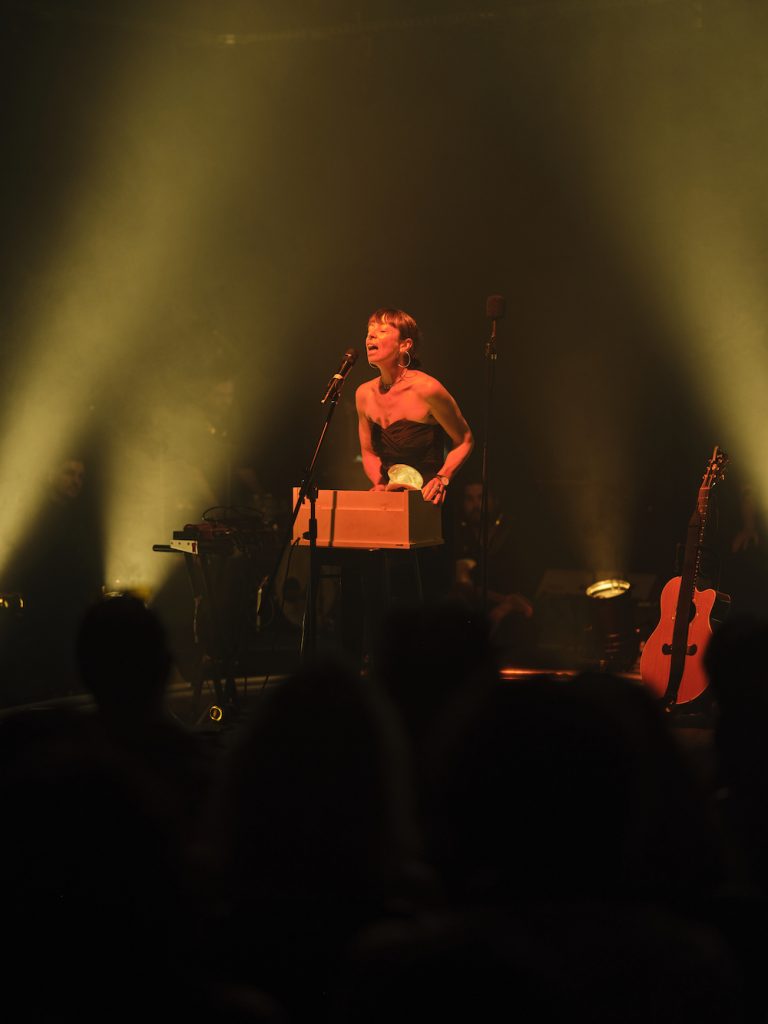
Upon entry, we didn’t simply enter the space; we crossed a threshold. Light smoke curled in the stairwell; warm golden illumination glinted off rows of wireless headphones set out on every chair like offerings at a shrine. The room itself was configured quasi-in-the-round: cushions pressed close to the stage, audience practically breathing the same air as the cast. A single orange glow—half warning lamp, half dying sun—glared ominously onstage.
Barton entered barefoot in black, beanie low, with the earnest charm of a British philosophy student too self-aware to be insufferable. He settled in the centre of the ring stage and casually began with the end of the universe—as one does. He spoke of his father’s ring, an heirloom passed down through generations, before invoking King Solomon and a story no one quite remembered. His wry, “Does my story have any chance of being remembered?” landed with a thud of humility. Thus, a motif emerged: “This too shall pass.” Here, apocalypse wasn’t spectacle; it was lineage, memory, and what survives.
The first headphones-on sequence revealed the show’s most intimate device: a binaural microphone that moved Barton’s voice around your skull in 360 degrees, whispering, circling, weaving between ears like a shared secret. The room suddenly felt amplified—every laugh, titter, and glass clink magnified in echo. Eyes closed, we were guided through meditative images of wind and dawning light, vivid enough to question whether the sensations were imagined or engineered.
The narrative travelled by expanding rings—cosmological and personal. Light became the first sensation of a baby Troodon inside its egg, giving way to Amber Fresh’s Meteor Strike, which leapt from prehistoric tenderness to nostalgic teenage longing. The series’ Douglas Adams-style humour flickered at the edges: the apocalypse as sincere enquiry and playful time-travel experiment.

The house band (Paul Hines, Josten Myburgh and Elliot Smith) then summoned an Age of Deluge—ambient swells and blues-jazz currents. Mararo Wangai channelled a devastating flood with an anthemic Kuti-like resilience, Myburgh’s sax accenting the rising vocal tide. Barton returned in troubadour mode, slipping Paul Simon phrasing into the mix.
Up to this point it wasn’t entirely clear whether every piece had been custom-built for the night (surely Amber Fresh hadn’t pre-written a baby dinosaur monologue), but this was clarified once Sam Bloor and the Mood Punch crew took the reins. Beginning with understated spoken word, their Bad Faith ricocheted between grief and fury, painting Judgement Day as equal parts biblical and personal. Behind Bloor, a virulent guitar and a punishing bassline thickened the air. In the cramped room, the piece became a pressure cooker; Bloor cut directly through the crowd, belting “SAVE YOURSELF!” like the last command before collapse.

The one-two of Mood Punch followed swiftly by POW! Negro kept the energy dark and steeped in dread. Nelson Mondlane’s silky vocals rode industrial eruptions and drum-machine pulses, conjuring flesh melting, systems powering down, and ghosts trapped in circuitry. It was the harshest segment—Shabazz-meets-apocalyptic prophecy.
Another headphone sequence took us inside the human body: a whimsical microbiological realm of stem cells and mutating tissues. Surprisingly sweet—more Magic School Bus than body horror—it reminded us that apocalypse can be quietly domestic and biological.
Mid-set, Lucy Peach’s performance was both a grounding and uplifting centrepiece to the entire show, allusions to incense, pomegranate and the ‘magic’ of conception casting an evocative affirmation for all in the room. Her stage presence and gestures invited audience participation without coercion; we all share these tickets to the end of the world, she reminded us, not as passengers but as witnesses to each other.
Barton re-entered with a leap into a Children of Men-esque future where fertility was mere fantasy and artificial consciousness lived inside our skulls. The Japanese refrain introduced earlier—esha uri, “those who meet must part”—echoed like a structural chord.

Mathas delivered the quirkiest segment: a campfire singalong derailed by a robot malfunction, glitching through the philosophy of planned obsolescence: “Can you 3D-print the duck’s nuts?” The room cracked up at his playful yet cutting view of planned obsolescence—another reminder that comedy is its own survival mechanism.
Barton’s next thread conjured a planet reclaiming itself, intelligence no longer required. Joined by Addison Axe circling the stage in harmonic response, the pair rendered interdependence with striking tenderness.
Finally, Alter Boy closed the night with a stripped-back, devastating performance. Molly Priest signed and moved to a disembodied male voice, using chest thumps and precision to make the music felt rather than heard—far more affecting than their recent maximalism at Strange Ball.

From there, time reversed. The universe contracted. Gravity won. Rings collapsed inward, and intelligence had its final thought. The simulation blinked out.
This instalment of Wednesdays at the End of the World was wildly ambitious—maybe too ambitious, stretching well past its two-hour window and into the 9.15pm show. A tighter trim wouldn’t have hurt. But its blend of humour, grief, sci-fi whimsy and unashamed human vulnerability hits with emotional clarity, free of apocalyptic cliché.
In a Biennale full of monumental works, Wednesdays stood apart for its intimacy: rings within rings, stories within stories, and endings tucked inside beginnings. And as we spilled into the Walyalup night, incense clinging to our clothes and headphones returned, it was hard not to feel that something quietly realigned—that our own small universes expanded, contracted, and shifted just a little.
CAT LANDRO
Photos by Duncan Wright