
Review: War of the Worlds at Venue 360
War of the Worlds at Venue 360
Saturday, August 9, 2025
Since its original rendering, War of the Worlds à la Orson Welles has remained a mythic, shapeshifting beast of a work. Whether we regard the H.G. Wells adaptation as a beloved radio drama or the greatest media hoax of the 20th century, the chance to peek behind the curtain—to witness the levers pulled and gears turning live—was not one to pass up. Thanks to Sarah MacNeill’s Lit Live Perth, audiences lucked out with this very opportunity.
One might ask what value this work holds now, so far removed from its pre-WWII context, when radio reigned supreme. Though you don’t have to look that far: do we not still live in an age where news and entertainment are routinely conflated? Where we expect our day-to-day to be interrupted by a breaking news bulletin? And, more often than not, find it to morph from the outlandish to fake news (and back again) within the hour?
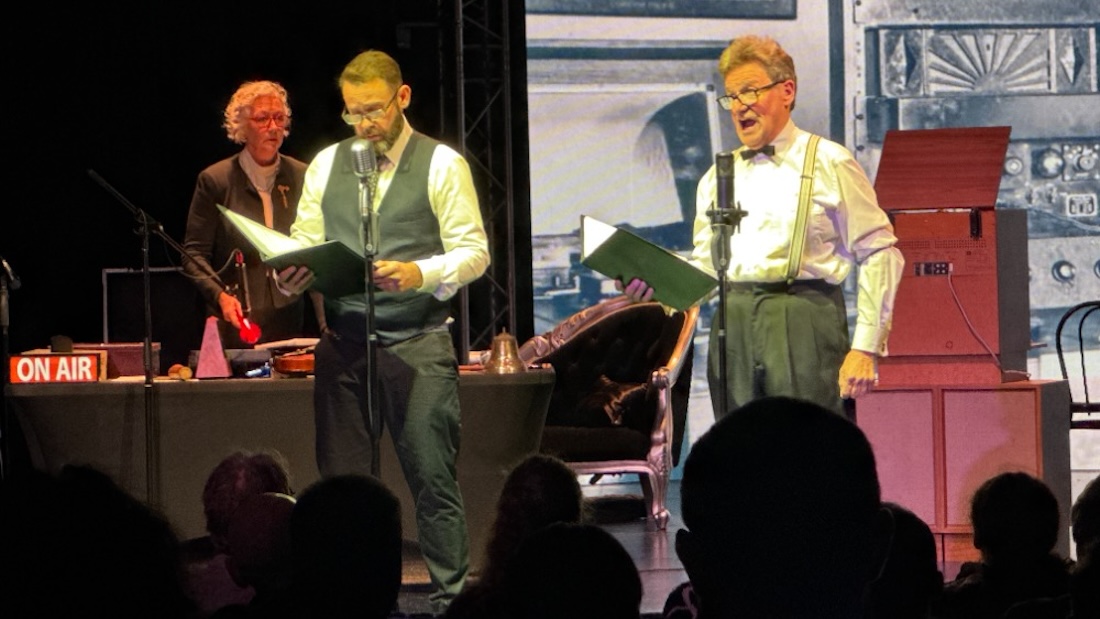
Where Welles’ original production supposedly duped one in twelve of its millions of listeners—prompting reports of mass panic and jammed emergency phone lines—we weren’t to be duped this time around. Instead, we were beckoned closer, with a wink. We chuckled at the absurdity of a toilet cistern front of stage (for amplification purposes, rest assured) and marvelled at the cast’s nimble command of hokey, vintage American accents. Our real hero of the stage, though, was the Foley desk, updated with contemporary paraphernalia including mini handheld fans and a Dustbuster and other bits of domestic detritus repurposed for sonic magic.
Not quite radio, not quite traditional theatre, the production existed in a dynamic, hybrid space—generated and orchestrated live before our eyes. Each actor clutched a script, not in self-conscious affectation, but to emphasise the literature itself: a celebration of text as much as performance.
Like the original, the show began slowly, mimicking an evening of innocuous radio programming. Ramon Raquello’s fictitious orchestra—a joke inside a joke—lulled us into comfort. Then came the interruptions. As absurd news bulletins cut into the music, the energy kicked up several notches, and our audience was well in on the farce. The production’s pace became unexpectedly frenetic, with visual disorientation on stage echoing the cultivated panic of the radio announcers and so-called scientific experts.
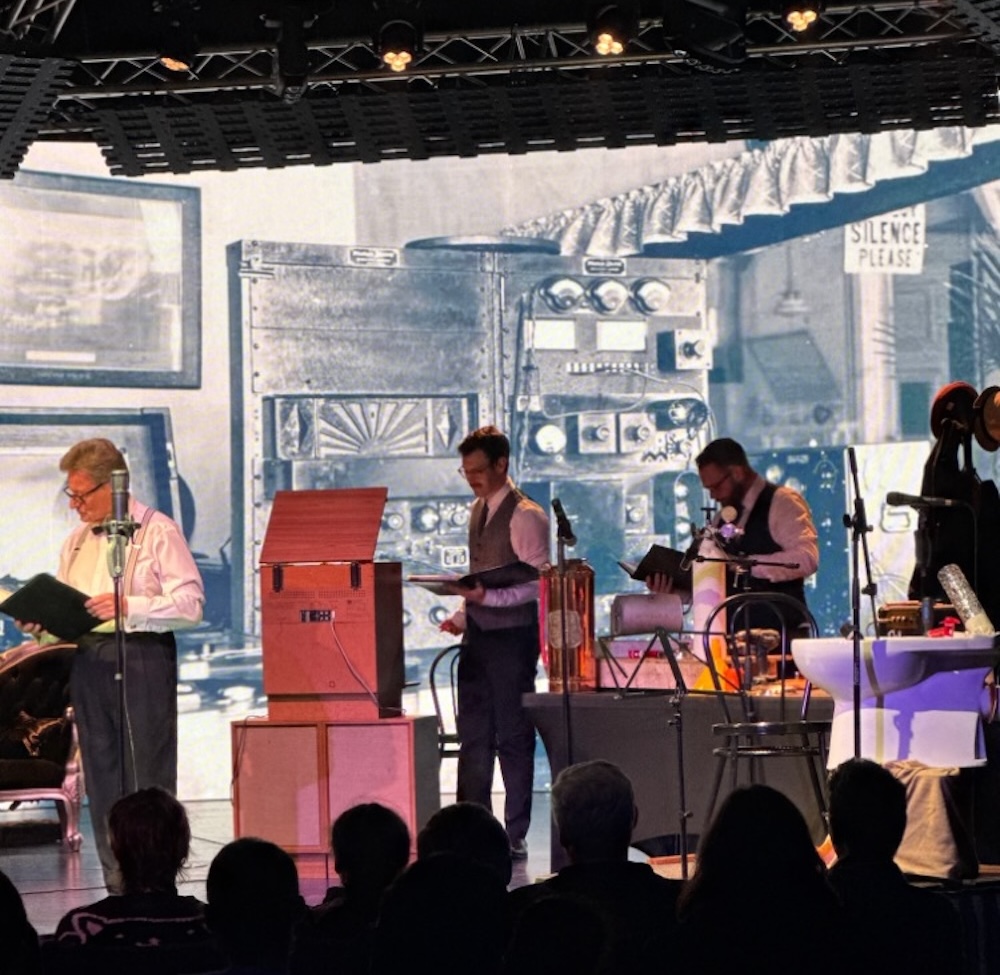
Though the actors’ blocking was mostly functional—facilitating the collaborative soundscape—the stage was abuzz with activity and disruption that would otherwise be invisible to radio listeners. Knowing laughs rippled through the crowd, particularly during Greg MacNeill’s cheeky fourth-wall breaks. Meanwhile, Will O’Mahoney and Ben Sutton kept impressively straight faces despite ricocheting between multiple characters.
Sarah MacNeill grounded the performance with a subtlety that counterbalanced the farce. Her dry, almost mechanical tones lent the piece a certain unnerving stability, anchoring it amid the madness. One standout sequence, complete with artillery fire and muffled military orders, crescendoed before cutting suddenly to silence (and intermission), leaving our skin crawling with the futility of man’s resistance against the unknown.
By the second act, the tone shifted from media sensationalism to a pensive scene: frenetic broadcast news and desperate unanswered pleas for help were replaced with survivors reflecting on the bleak aftermath, the vulnerability of the invaders to microorganisms, and humanity fortuitously let off the hook. A sly “make it great again” reference drew a knowing laugh—but also underscored how relevant the story remains. In this age of climate crisis, technological overreach, and rolling ecological grief, War of the Worlds speaks directly to our inability—or unwillingness—to grapple with anthropogenic doom.
MacNeill’s production was far more than a nostalgic homage for theatre nerds or retro lovers. With great respect for the source material, MacNeill reframed War of the Worlds not just as a historical curio but as a theatrical dissection, probing our current anxieties about media and spectacle. By embracing the work’s innate humour and making the mechanics of illusion through exposed Foley, lightning-fast character switches, and deliberate theatricality—we were treated to far more than an ode to Orson Welles’s propulsion to Hollywood stardom. It asked us to consider our own vulnerability to spectacle, our taste for disaster, and our faith in the very technologies that may yet outstrip us.
By the final announcer’s epilogue, the audience was left chuffed, not just at the ridiculousness of handheld fans doubling as heat rays and the like, but with the unnerving suspicion that the joke is still very much on us. Projected across the backdrop: an AI dystopian cityscape—lingering long after the crowd dispersed. One couldn’t help but feel that the real alien threat might not be out there but embedded in our own appetite for annihilation.
CAT LANDRO