
Review: Blacksheep – Jae West at State Theatre Centre of WA
Blacksheep – Jae West at State Theatre Centre of WA
Saturday, January 31, 2026
Descending into the Rehearsal Room for Jae West’s Blacksheep felt appropriately subterranean—a literal drop beneath the city and into something more interior. The descent into the bowels of the State Theatre Centre mirrored the work to come: searching yet guided, personal without being isolating. The room was well filled for the early session, with a notably female-heavy audience. This wasn’t a crowd waiting to be entertained so much as one ready to recognise itself.
Blacksheep opened by positioning itself outside the normative frame. Drawing on the agricultural origins of the term—black wool once deemed useless and unprofitable—West reframed the outsider not as a failure, but as an anomaly with potential: an identity imposed from the outside, then slowly reclaimed. The work asked what happens when we identify as the black sheep and begin to behave accordingly—when “othering” becomes either a wound or a superpower. Like the black cat, once feared and later fetishised, West leant into the mystique, testing how much of identity is story and which stories we choose to believe.
The performance unfolded as a braided autobiography, moving between childhood earnestness and adult self-awareness. West’s stage presence initially read as sensitive and eager. She described herself as a circular peg in a square hole—a child who tried hard to be good while sensing she didn’t quite fit. Childhood memories surfaced through pop culture and movement: old photographs, early dance routines performed for parents in front of the television, and a red feather boa worn with total sincerity pointed to a girl already rehearsing how to be seen.
When the Spice Girls’ Stop Right Now blasted through the room, the response was immediate. It landed as a shared cultural flashpoint—a moment of solidarity for those who grew up buoyed by the promise of “girl power”. I recognised it myself: I too was a young girl swept up in that fervour, until the boys at school were adamant that Frogstomp was cooler, and enthusiasm for things made by women quietly became something to outgrow. West presented these memories not as nostalgia, but as early lessons in how gender, taste, and approval become entangled. The personal quickly became communal.
This impulse placed Blacksheep in conversation with recent Blue Room solo works led by other non-male artists, where autobiography functions less as confession than as cultural case study. Validation and being seen formed the undercurrent here, whether through synchronised swimming, pop fandom, or later, more perilous forms of self-erasure.
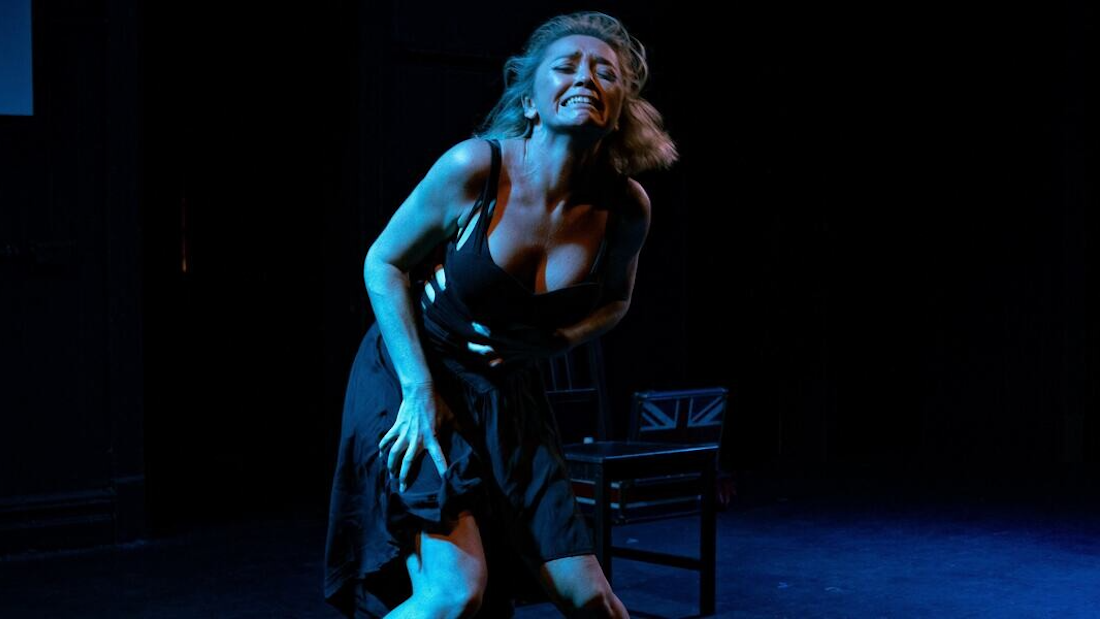
The show did not flinch from darker terrain. A mannequin appeared as a stand-in for the “perfect normal woman”, absorbing West’s projections of longing and frustration. Crash dieting before the school ball marked the beginning of a fraught relationship with food and control. A haunting rendition of Skinny Love accompanied anxious movement under a blue wash of light; echoes of negative self-talk—“Are you dieting, babes?”—ricocheted around the room. A black silk sheet evoked intrusive thinking as the imagery escalated towards panic and loss of control. In one of the work’s most confronting passages, the ghost of an eating disorder was rendered tangible, handled with care rather than shock.
Blacksheep resisted freezing identity at any single revelation. West’s coming out at school—rare and risky at the time—was treated not as a narrative climax but as a waypoint. The thrill of queer belonging followed: gay clubs, drag families, towering red boots, and lip-synced anthems (Let’s Have a Kiki, Gaga). The crowd responded warmly, energised by the drag-club exuberance, even as West acknowledged the pressures that accompany belonging—labels, sexual expectation, and the demand to perform queerness correctly.
Sexuality, like gender, was treated as fluid and evolving. West spoke about being attracted to people rather than genders and the suspicion that often greets that position. Humour punctured the tension—jokes about being labelled “greedy”, sexual inexperience, and the awkward negotiations of adulthood after the end of a long-term same-sex relationship. Contraception also entered the frame: avoiding hormonal options, West named herself, with dry wit, the black sheep of contraception.
The later sections widened the lens. Drawing on ideas popularised by Brené Brown, the work suggested that the parts of our story we refuse to face continue to exert power, while those we claim can be reshaped. A social experiment conducted in London—West standing blindfolded in public, inviting strangers to draw a heart on her body—was revisited through video documentation, framed as agency rather than exposure.
The closing movement returned to embodiment. West danced through different ages of herself before landing on a refusal to contort any further: “I won’t fit into your perfectly pedicured box.” As the standing ovation erupted, there was a sense that something had landed exactly where it needed to. This first Fringe season of Blacksheep felt less like a debut than a necessary offering—one that understood gender as learned, performed, resisted, and revised over time. Importantly, West closed by providing resources for eating disorder support, grounding the work’s catharsis in care.
Blacksheep made a compelling case for the value of the outsider, not as an exception but as a guide. In a cultural moment still invested in boxes and binaries, West’s refusal to fit neatly reads as both personal survival and political gesture.
CAT LANDRO