Lucky Oceans puts a WA spin on Western swing for York Festival 2025
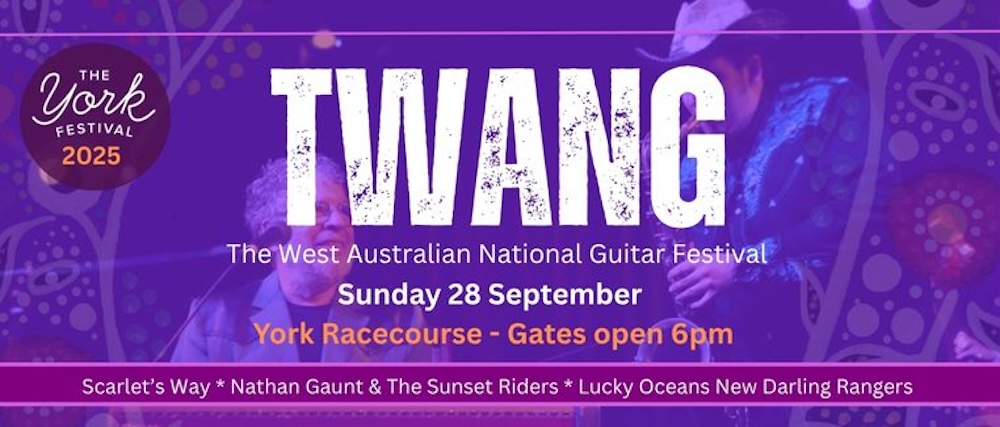
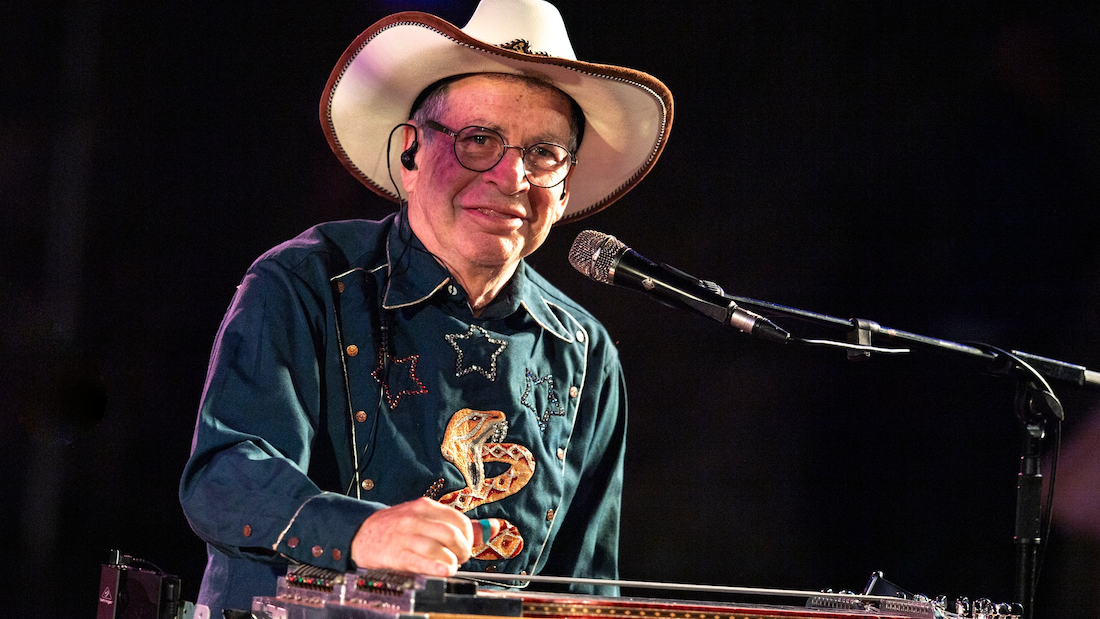
Lucky Oceans, renowned for his mastery of the pedal steel guitar, is putting a WA spin on Western swing with his new band, New Darling Rangers. Following a successful debut show at Freo.Social in May, the group is returning to play at York Festival’s signature event, TWANG, on Sunday, September 28—which is also the official launch of the Western Australian National Guitar Festival. LILLIAN WILSON spoke with Lucky Oceans about his relationship with the pedal steel guitar, his history with the Western swing genre and the formation of New Darling Rangers.
You’re part of the first TWANG event in York this September. What does it mean to you to help launch a festival that’s shining a light on string players in WA?
Perth is a guitar town, and WA is a guitar state. There are so many talented guitarists here, covering a wide range of genres whose music will delight broad audiences. I feel honoured to be a big part of this first festival and hope that it continues for a long time.
You’re best known for the pedal steel guitar—what was it that drew you to the instrument in the first place, and are you still discovering the sounds it’s capable of creating to this day?
To my knowledge, I first heard a lap steel guitar played by Freddie Roulette, an African American musician who played in Charlie Musselwhite’s Blues Band, although Singing Cowboy, Gene Autry, was the first concert I ever went to, and he might have had a steel guitarist. I played bottleneck slide in a blues style and was figuring out country licks on an electric lap steel when I cofounded Asleep at the Wheel. When it became obvious that we needed a pedal steel to expand our sound palette, we drove to the legendary Manny’s Music in New York City—where Jimi Hendrix was frequently seen trying out new gear—and I bought one there.
Because I was single, without a family and living in a band house, I spent most of the next three years learning pedal steel guitar—copying from records, learning from instructional courses and picking other players’ brains as we travelled around the country. Asleep at the Wheel was a ‘players’ band’ with improvised solos, and we toured and recorded extensively, so it was easier for me to earn a reputation as a leading voice on the instrument. I’m even included in a book by Hugh Gregory called 1000 Great Guitarists.
Because the pedal steel guitar is such a new instrument, much of its potential remains untapped. The 25 years after its birth, around 1955—were a very creative time of exploration for the instrument. In 1981, I settled in Fremantle. There wasn’t enough work in local country music to support me and my family, so I started taking the pedal steel into other genres—using it in nightclub cover bands and jazz groups in addition to being a member of diverse genre bands, playing and touring with Paul Kelly and Joe Camilleri and composing music for film and TV scores.
Presenting and programming the acclaimed national radio show The Daily Planet for 21 years opened my ears to lots of wonderful music. Since leaving that role in 2017, I have been actively engaging with excellent musicians based in the Perth area, regardless of their age and genre. So I play regularly with 19-year-old Louis Rebeiro and recently played with 82-year-old maestro Ray Walker. I’m a member of the African group Zukhuta, led by the great Mozambican/Australian guitarist Mahamudo Selimane. I co-lead Slide Summit with the Hindustani classical sarodist, the Indian/Australian Praashekh Borkar.
I am also expanding the voice of the instrument through extended techniques and pedals with great guitarist Ben Witt in The Beatles Reimagined and with Cam Avery from Tame Impala, as I am in unreleased, ambient recordings with drummer Ben Vanderwal and Zac Grafton. In these lineups I’m using glitchy sampling pedals and a pitch shifter controlled by an expression pedal that I operate with my right elbow. I also employ a secondary pickup on the nut side of the pedal steel that amplifies a mirror image of the standard pickup. Slide the bar up the neck, and the pitch on the extra pickup goes down, as its string section lengthens, and vice versa.
Then there’s my constant tinkering with what strings the mechanical pedals on my pedal steel do and my practice around technique and language on the instrument. So, instead of ossifying in my ‘senior’ years, I’m moving into significant exploration in trying to develop new sounds, voices and techniques for the instrument, through the technical developments, and by playing in different genres and actively searching out new sounds.
New Darling Rangers have a pretty distinct sound. What drew you to Western swing, and how do you put your own stamp on it here in WA?
I was drawn to Western swing along with the other co-founders of Asleep at the Wheel when we heard Merle Haggard’s 1970 album Tribute to the Damn Best Fiddle Player in the World. He and his band recorded it with members of Bob Wills’ band, and it remains a high-water mark in the genre’s history. Having grown up with swing music-loving parents and gravitating to country music in my late teens, it was amazing to discover the Western swing genre, which combined great elements of country and swing. So Asleep at the Wheel added Western swing as a major part of our repertoire.
We sought out old 78 recordings of Bob Wills and other Western swing bands and integrated them into our shows. I learnt dozens of Western swing steel instrumentals. The swing element and our vibrant, youthful take on it was what differentiated AATW from the ‘play it like the recording’ approach of other country groups, so we appealed to both country and rock audiences.
We went to Bob Wills’ last recording in Dallas in 1973 and met the great man himself and many of his band members, who we became friends with. They provided us with an invaluable link to the music’s origins while we played it for current audiences. In Australia, I have played Western swing in a few lineups, starting out when I joined the Nansing Quartet and the Jam Tarts in the mid-80s. I then joined Dude Ranch, and we put our own stamp on the genre, recording an album that swept the WA Music Awards in 1992. In the early 2000s I put together an all-star lineup that played in Singapore and at the National Folk Festival in Canberra, featuring Felicity Urquhart.
While in the Zydecats, I wrote songs that we performed in the Western swing style. The first iteration of the Darling Rangers played at the Fairbridge Festival and featured Jim Fisher and Ian Simpson, who were in the first band I played with when I arrived in Perth, and Sam Lemann and Adam Gare from the Nansing Quartet.
Palyku man David Milroy and I play together in a show called Music is the Colour of My Skin, which toured Tasmania in March 2025 as part of the state’s premier festival, Ten Days on the Island. We also played the Perth Festival in February 2025 in a recreation of the Coolbaru Club. David is best known as a Patrick White Award-winning playwright. His plays, often set in the 50s and 60s and sometimes in regional Australia, feature a lot of his songs in a 50s country swing style.
I realised that many of Dave’s fine songs would suit a Western swing band. So I thought, ‘Why play the standard Western swing repertoire when we could adapt these songs and give them a new life outside the plays while creating a distinctively Western Australian version of Western swing?’ It was then a logical step to include some of my own originals, like I Love You Most of All (When You’re Not Here), which I recorded with Asleep at the Wheel for our reunion album, Half a Hundred Years.
The band brings together Louis Rebeiro, Jon Knox-Matthews and David Milroy. What’s the chemistry like between you on stage, and how do your styles merge in the new group?
Jon Knox-Matthews is an exceptional Western swing and country guitarist. It’s hard to believe he’s from Perth, as he has mastered the lightning-quick, hard-driving sounds of 50s California country swing guitarists. Every solo he takes is exciting, and he knows the genre very well. I have been playing with Louis Rebeiro for less than two years now, but it has been an amazing experience. Although only 19, he has an old soul and a wide curiosity about music. His superhuman musical ability and enthusiasm light up any group he plays with. Jon and Louis play in one of Louis’ groups, so there is pre-existing chemistry between them already.
I wanted Louis mostly on piano for this show because, although he plays guitar, that role is already covered by Jon and Dave, and because one of his pianistic specialities is playing boogie-woogie. Asleep at the Wheel pianist Floyd Domino’s mastery of boogie-woogie was one of the main things that made that band unique and exciting. Although Louis didn’t know much about Western swing when we started the band, he immediately loved the genre and started enthusiastically learning its ins and outs, as did our regular bassist Dijon Summers.
One of my great pleasures is introducing musicians to each other. I play in separate bands with Louis, Jon and David. Seeing David play with Louis for the first time was a joy for me, as was Louis hearing David’s great songs. We’re not playing the standard songs of the Western swing repertoire, so there are some grooves that you wouldn’t expect to hear, but the essence of Western swing is bringing new elements into country music—jazz, swing, mariachi, polka, Tex-Mex and blues—so why not keep that tradition going in 2025 in our corner of the world?
Your debut with the band was opening for Pokey LaFarge at Freo.Social, and the response was huge. What did that night show you about your potential as a band?
We put the band together really quickly, so we didn’t quite know what to expect, but sometimes a band has a natural chemistry that makes every show a magic carpet ride, full of excitement and new adventures. We felt that from the first note at Freo.Social, both between the band members and in the audience’s response. It was a surprise but a happy one, and it showed us the wisdom of the musical path we have chosen, and we look forward to continuing our explorations along it.
You’ve worn many hats—performer, broadcaster, bandleader. What is it you enjoy about being in a band, and how does it feel being back in one at this stage of your career?
I presented the Daily Planet on ABC, and it was a beautiful experience of learning about music and sharing it with the world. But nothing comes close to the experience of playing in a band, of building a little family that plays and discovers together. Bands have been my main creative form for most of my life, starting with high school groups, then Asleep at the Wheel, Dude Ranch, and Zydecats, and now, the many bands I play with, including the New Darling Rangers.
Being able to return to Western swing once again is wonderful. I love being able to share my knowledge of the genre, which, through my association with Bob Wills’ original Texas Playboys, stretches back to the 1930s. I have hit a sweet spot in my career, as I know that I have had a very fortunate musical life, and I no longer feel I have to compete with other musicians. I have had a lot of success and great experiences. I recognise that technical strengths can be weaknesses and vice versa and that every musician has their own unique story to tell.
In New Darling Rangers, I’m learning from Louis Rebeiro about how to retain your love and enthusiasm for music. And even though he’s 19, I learn from him how to wholeheartedly appreciate the work of our musical colleagues. Jon Knox-Matthews’ playing is so exciting, and he pours everything into every solo that he keeps me fresh and on my toes. David Milroy’s songs are inspirational in how they paint a picture of a time and place, and he has many insights about live performance. He also quietly contributes a Pilbara and Aboriginal point of view to the band, which I find very enlightening. It’s great being in a band where everyone is learning from each other and loving their journey of discovery.
Looking ahead, what do you want audiences to take away from seeing New Darling Rangers at TWANG, and what’s next for you and the band? Any new music or live shows we can look forward to?
The New Darling Rangers are a special group, so we will save ourselves for big outdoor shows, and as such, the York Festival is our only booking at the moment. Recording and touring would be great. I do lots of other things: ambient music, African music, Indian music and who knows what’s next? All the shows are listed on the Lucky Oceans website. I want audiences to have a great time when they see us. I want them to come up close to the stage and yell and dance and hoot and holler so this music can feel at home. I want them to go home with their hearts full and feeling that life is good.
Lucky Oceans plays at York Festival’s signature event, TWANG, on Sunday, September 28, 2025. Tickets are on sale now from tickets.oztix.com.au