Descendents Run Down Under for Everything Sucks anniversary tour
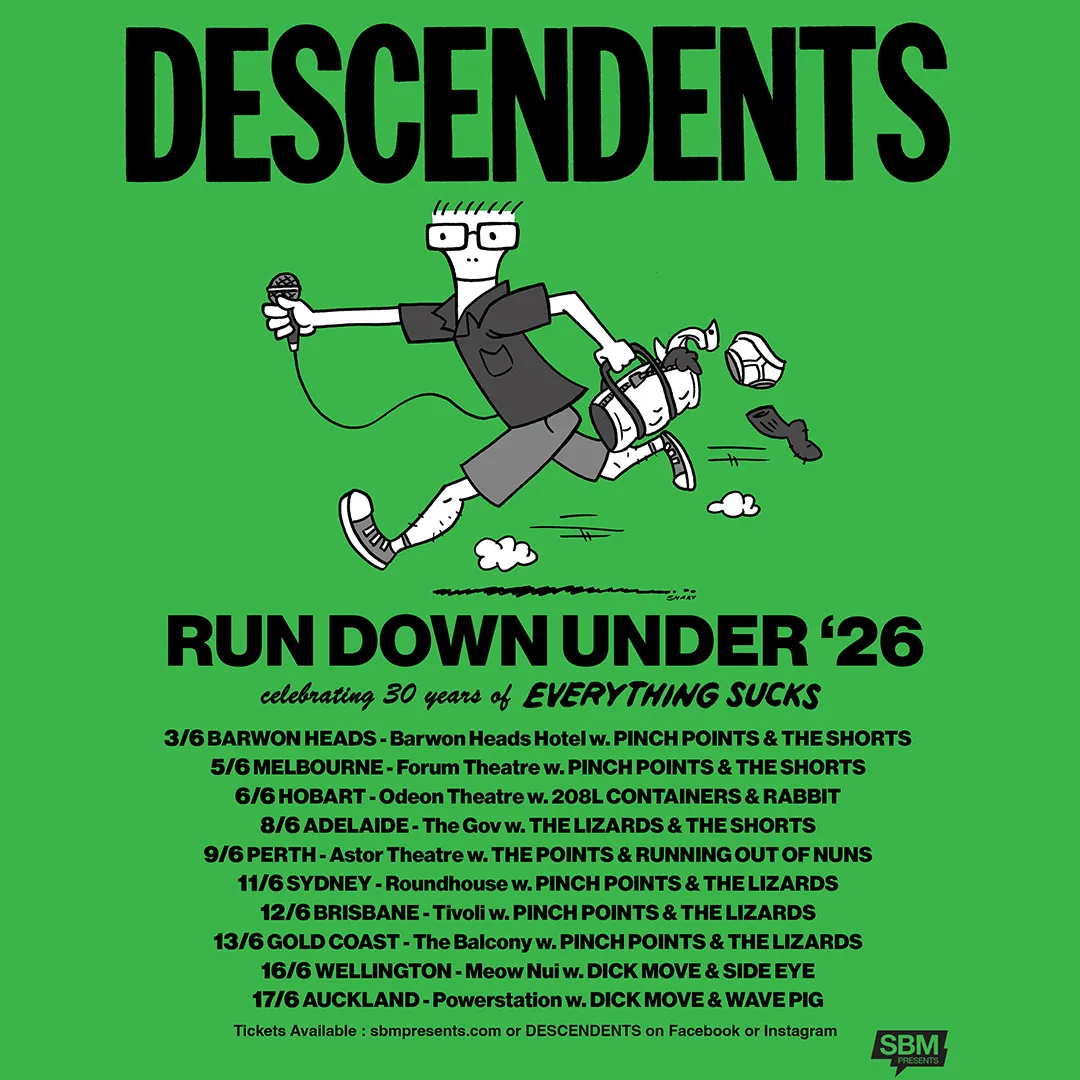
Californian punk legends Descendents return to Australia this month for their Run Down Under Tour, celebrating the 30th anniversary of their fifth studio album Everything Sucks. Bringing together standout tracks from the 1996 record alongside classics from across their career, the four-piece will hit Astor Theatre on Tuesday, June 9, with tickets on sale now. KAREN LOWE spoke to Descendents drummer Bill Stevenson about rehearsing 64-song marathons, his favourite non-punk drummers and how Frenzal Rhomb make his job more about making sure the mics are in the right place.
You guys will be touring Australia soon—starting off in Victoria. Are you looking forward to the tour? What are some of your favourite memories of Australia?
We’ve had nothing but good fun down there. Every single time we’ve toured down there—I think the first time we went was in 1989 with All. So, All went maybe four times, and Descendents have been maybe four times. I love it. I think I have kinship with it because I grew up in Hermosa Beach, California. I lived 800 metres from the beach, so I spent my life at the beach. With so much of Australia’s populated areas being coastal, there’s kind of a prevalent beach culture that I am comfortable with because I grew up a Dom Boom kid. I also like the largely favourable climate. I’m afraid of… really cold weather.
Something else is I like playing to 600 people a lot more than I do to 2,000 people. I think back to all the concerts I’ve been to, and I think, ok—is it a good memory? I saw KISS in an arena. Is that a good memory? No, what about when I saw The Germs when it was eighty people and it was four bucks at the door? THAT is what I like.
Oh wow! Yes, the smaller concerts can have so much more personality.
Yeah, I live for it. I’m looking forward to it. Sometimes it can be a little bit of a slog down there. You get to the hotel, get to sleep at 3:00 AM, be in the lobby at seven to get a flight for the next thing, get off the airplane and go straight to soundcheck. When you’re younger, you can just stay up all night, drive the van, get up and play, and spend all night hanging out with people partying after. Then the sleep deprivation thing really hurts when you wake up the next day, going, “Urrrrgh!”
I just saw this morning that All is performing shows around the States—is there a possibility that you guys will bring this to Australia as well?
Yeah. Why not? Both bands have just kind of always been best friends. Even people who aren’t in the band anymore. And so every once in a while, we do some All shows, and why not do an All thing in Australia? It would be fun!
It’s the 30th anniversary of Everything Sucks. What are your favourite songs to play off that album, and are there any songs in general that you wish you played more?
Well, I mean, we play the ones that we want to play. That album’s got fifteen songs on it, and I think we play six or seven of them on a regular basis, and then it’s another eight or nine that we haven’t been playing. It’s been fun to focus on those nine and bone up on them and get them all up to speed and dust them off a little bit. Every once in a while you’ll pull a song out, and it’s like, “Oh wait, Houston, we have a problem!”
To be real honest, we didn’t plan to say, “Hey, let’s go do a tour where we play Everything Sucks in full.” I found out about it when I saw it being advertised that way. I called our booking agent, and I went, “Wait! We’re supposed to play the whole Everything Sucks album?” She’s like, “Well, that’s what you agreed to.” She’s said it’s right there in the contract. I looked at it. It was pretty… they snuck it in on me. But we’re cool doing it. I’m saying it wasn’t our idea. It was the promoter’s idea.
That’s not really something we would do. I don’t know how you feel about it, but when bands start doing that thing or they start going around touring and they’re playing the one album that everybody likes, I always feel like that’s a band that’s out of ideas. It’s like when Fonzie jumped the shark—that is not something I would do much of. Maybe a show or two. But we’re doing it and we’re working on all the songs. It’s like, okay, what’s fun about this is the challenge of getting it going. We already practise 54 songs. Now it’s 64 songs—I counted this morning as we practised. That’s two full sets plus an encore. I’m like, hey, man! Not bad for a bunch of 62-year-olds, who have brain tumours and two who have had heart attacks.
Descendents officially started in 1977 (with you in 1978), and over that time, you have seen the music industry go through many changes. What are some of the biggest changes you’ve seen, and what challenges or improvements have those changes brought?
I don’t know if the music industry—like the mechanisms of music—has changed or if I just became aware of gross stuff, like the terminology. So, the bands that are going to play with you at your show are just bands that are playing with you? No. You have to call them the opening act and the support act, except, first of all, you call my band an act. I’m not acting! I’m playing music! That to me is just too businessy—not for punk rock. Punk rock shouldn’t be like that.
Here’s another one. The city that you’re going to play in? They call that a market. What are we? A corporation? Then the promoters are always hitting you up for content. What is content? Am I trying to get clicks? What am I? Twelve years old? Also, this is the worst one. What do you call it when you say you normally play in a thousand-capacity venue, but for these two shows here, you’re going to play it in a 300-capacity venue, which is what I love? They call it an underplay! We’ll just set up a couple of underplays. What’s an underplay? I’m not going to play less well than I always do. Mine are all overplay! I will always overplay even if there are only nine people there!
Then on the other side, with the internet, I think it’s really easy for bands to make connections—to network, to set up their own tours, and to find places to stay after the show when they can’t afford it. I mean, for three-quarters of our career, we couldn’t afford to have a hotel or to rent a tour bus. So just to network and to proliferate your music exposure to the music. I think all that stuff’s a million times better.
Also, another thing I think that’s changed is that punk rock kind of blossomed and then blew open into a million punk scenes. There’s not just one, and that’s cool. I think that brought about just all kinds of cool, crazy new music where you listen and then, if you listen real hard enough, you go, ‘Okay, that’s like a ninth cousin of the Ramones.’ I still hear that spirit in there, but you wouldn’t call it orthodox punk rock. I love how far the bands have gone with it.
Your catalogue spans decades, but the sonic DNA of Descendents is instantly recognisable. What’s one micro‑detail in your songwriting or recording process that fans would never notice but you obsess over?
Oh, I mean, we practise a lot. I always get jealous when I see bands that are kind of trashy and loose, but they sound kick-ass, because if we’re not tight, if we didn’t practise enough, we suck! We just take a lot of pride in trying to play the material well. Where that comes to bear in the studio is that we don’t really do a lot of fiddling around. There aren’t a lot of overdubs or ‘production stuff tricks’ or tomfoolery, or ‘We’re not going to add a horn section in the bridge or a tambourine or layered guitars.’
The way the bands layer the guitars now, to me, it becomes generic guitar. Meaning I can’t tell who’s playing it. If you quote nine channels of guitar, I can’t tell who’s playing it. I want to hear the guys playing, and I think that’s always been our thing. It’s just kind of like, ‘Okay, four guys with bats.’ Everybody gets their fair share. Everybody tries to kick butt and have fun with each other, and that’s it.
We’ve never had an agenda or a strategy like a direction. What’s the direction of our new album going to be? Put me, Karl, Stephen and Milo in a room together, and we’ll show each other all the songs we have, and you know what? That will be the new album, whatever that is. It could be songs on farts, or it could be whatever sounds like fog rock.
Your drumming is famously precise yet explosive. Who is one non‑punk drummer that has influenced your style?
Well, I think the most obvious non-punk drummer would be Bill Ward from Black Sabbath or Billy Cobham from the Billy Cobham Orchestra. Or Mitch Mitchell from the Jimi Hendrix Experience, or Elvin Jones, who was in that just spectacular Coltrane lineup for all those years.
Then with the punk drummers you got, well, my hero Robo from Black Flag. He was Black Flag’s drummer before I was. He is one of my best friends, and I’ve stolen everything he’s ever done. Then also Mark Laff from Generation X. I’ve ripped off everything that man has ever done, and I told him so. About two weeks ago, he friend-requested me on one of the social things, and I’m like going, “Stephen, look! Mark Laff knows who I am!” I messaged him back and I go, “What a pleasure this is to hear from you, sir. I have ripped off everything you’ve ever played!”
Clem Burke is a beast, and so is Tommy Ramone for the Ramones. Don Bolles from The Germs; Charlie Quintana from The Plugz—he later ended up being in Social Distortion for a long time. John McCarthy from the Alley Cats.
Having played with Black Flag, The Lemonheads and Descendents, amongst others, what’s one lesson from each band that you took on how you approach music today?
Oh, wow. That each gets a chapter. I’ll begin at the beginning. With Descendants and All, I have to put that all in one thing. That’s really where I focused on tight precision. Tony Lombardo, our original bass player, wanted it real tight.
Let’s see, Lemonheads; I produced a record for them, and I drummed on it, and Karl played bass, and I did one little tour for that record, as well as a bunch of one-off shows, but I don’t consider myself a Lemonhead. In the Lemonheads, it was nice. I didn’t have to do ballistic caffeine abuse to get through the show because those are all, by my terms, slow songs. I could play those songs in my sleep, and so it was a more relaxed thing. Evan’s got that kind of buttery baritone voice, and you don’t want to be just beating the shit out of your drums, so I learned a little bit there.
What I learnt a lot in was my other band, Only Crime, because that was a band where the average age of all the people that aren’t me put them at about fifteen years my junior. So they’re telling me at age 50, “Why don’t you do this?” and I’m like, “Why don’t you come back and put it out on drums!?” “Well, you can do it!” Then I have to try it. I’m like, “I can’t do it!” And they’re like, “You can! Try it again.” It really had me out of my comfort zone, where I was pushing myself beyond what I thought I was capable of doing. An Only Crime show is really, really hard for me, but it’s a great challenge.
I remember when we were recording and Matt Hoffman, one of our guitar players, was trying to get me to do this thing, and he was telling it to me, and I tried it like 50 times, and I went, “Dude, I can’t do it. I’m 50 years old—you’re 27! I can’t do it!” He just looked at me and went, “Shut the fuck up. You’re Bill. You can play anything.” I mean, I can’t fight that logic. Had total faith in me. I tried it a few more times, and I finally figured it out.
You’ve produced countless records at The Blasting Room, including our own Frenzal Rhomb’s The Cup of Pestilence. What’s a subtle production trick you’ve developed that most listeners would never notice but makes a huge difference?
Well, we’ve done their last three albums. That’s another band where they’re so good at what they do and they write such great songs. They’re all so technically capable and they’re very conscientious about doing a good job, so really, it’s about putting the microphones in the right place and getting the good tanks. They’re all complete beasts on their instruments, so it’s a real joy recording them, and I couldn’t fault them in any way. I hope they come back for a fourth album. I would love it.
What’s one mistake you see newer bands make in the studio, and how do you help them correct it without crushing their confidence? On that, what’s the most important non‑musical lesson you try to pass on to younger musicians?
A really big percentage of the things that I have learnt as a player, I learnt as a producer by watching bands do wrong. Ok, so I’m not going to be able to get a good sound out of this drummer because his volumes are too erratic. Sometimes the snare drum is like ‘fe fe fe fe fe’, and then sometimes it’s like ‘whack, whack!’ You can’t really do anything with that. It’s arbitrary too. It’s not like, ‘Ok, in the bridge it’s whack, whack, and then in the verse it’s ‘fe fe.’ It’s just random velocity, with drummers not knowing how to tune the drums well or not knowing how to hit them in a good way. Metre isn’t a problem anymore because with Pro Tools, nobody needs to know how to play anymore. If it’s off time, you scoot it around.
With drummers, I’ve learned a lot just by even watching them—how they set the drums up or the ergonomics of their set. Some drummers set their drum set up so terribly unergonomically, and let’s say they’re having trouble with this part. I’ll get out there, and I’ll get behind this drum set, and I’ll try to demonstrate the part in slow motion. I’m looking at them, and I’m like, ‘Dude, how can you play this drum set?’ The cymbals are five miles away, and the hi-hat is way over here. You can see your arms are crossed!’ It’s stuff like this that I learnt. I also learn by watching great drummers. There are a handful of drummers that I watched, and I’m like, ‘Whoa! I’m going to steal that,’ or ‘I see why he’s doing that that way. I’m going to start doing it that way too.
It’s the same thing with vocalists. I think the magic trick, though, is that you are talking about that magic studio trick honestly; for me… It has almost come full circle after being Mr ‘Oh, I’m the producer, and I’m going to tell the guy how to do it better and coax him into a better performance or tell him when he’s flat or tell him when he’s sharp or tell him when he’s ahead of the beat or tell him when he’s behind the beat.’
Now it’s a different approach. It’s more like, you got this band in here, and they are good players. They are good enough players—especially for the vocalist; he’s a good singer. Just let him sing it. It’s kind of like everybody deserves three tries, right? “Oh well, you were a little flat on that last half of that thing.” They know they’re flat. They can hear it, so let ’em try it again, Bill. I think it’s the secret. Let them do their job that they came to do. They are probably their own worst critic.
Then, if they’re making the same repeated mistake on successful takes, then I’ll define the mistake for them. I’ll say, “So on the line row, row, row, your boat, you’re always getting really sharp on the word boat. You’ve done it every time. Now we’ve done ten takes, and you’ve always been sharp on the word boat. So just try to watch that.” Then let ’em go. Don’t say a fucking word. That’s how I try to use a real good ‘boardside’ manner, as in a doctor with good bedside manner. I use good boardside manners and let him play.
What bands do you currently have on rotation in your CD player? And are there any bands that you just didn’t get until you saw them live?
Well, I saw Pears live before I had heard the music. I just happened to be in a club where I just went in to have a drink with my buddies. I looked over, and I’m like, ‘What the actual fuck is happening on the stage?’ So I got into them kind of backwards.
Ok, so rotation right now, I’ve been into Mannequin Pussy and also Snow Tha Product. Those are my two good examples. One of my all-time favourites, or two of my all-time favourites, are things that I worked on. One is the Supporting Caste album by Propagandhi, and it’s got that wonderful song on there called Without Love. It’s the saddest thing. It’s the saddest thing in the whole world. It’s beautiful. I love a sad song. I like a song that will make me get so upset that I start crying. I seek that out and I have done that since I was a little kid.
And then the other one would be the band Audio Karate. That album is called Lady Melody, and the song is my all-time favourite song I’ve ever recorded at the Blasting Room, and it’s called Jesus is Alive and Well and Living in Mexico. It’s my son’s favourite too. He got into him when he was five. And they’re still his favourite band. I think they inspired him to learn guitar, and now he has his own band. They are doing the All tour with me, and it will be so cool because him and I are going to be the rhythm section for John Snodgrass, and then Miles’s Band is going to play too.
Descendents bring their Run Down Under – Everything Sucks 30th Anniversary Tour to Astor Theatre on Tuesday, June 9, 2026. Tickets are on sale now from sbmpresents.com