
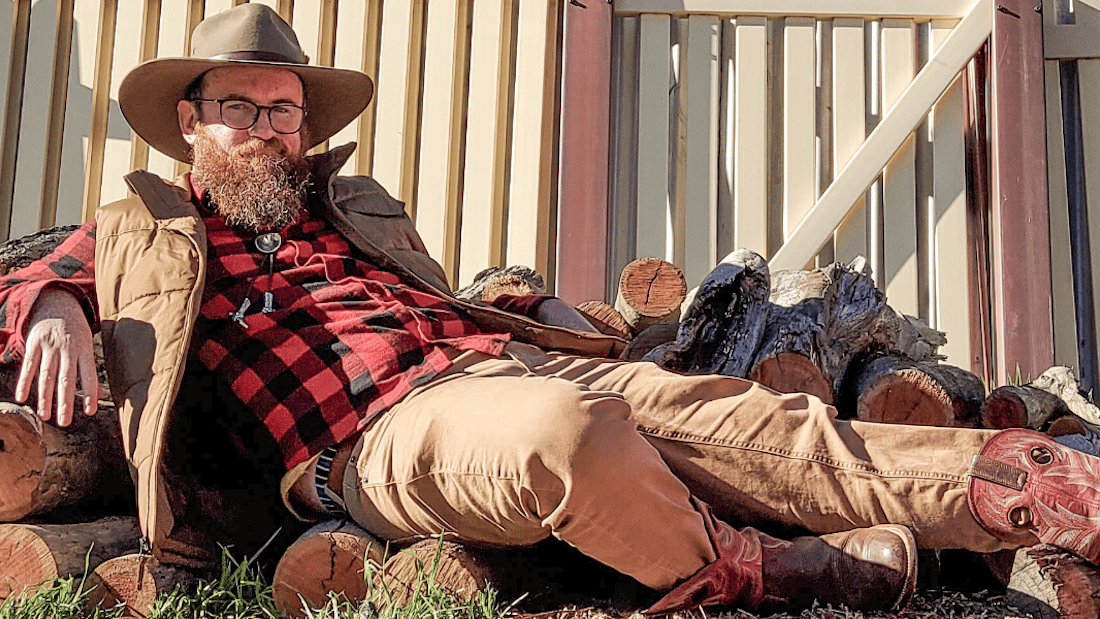
Woody Campfire brings his Camp Woodyfire to Fringe 2026
Cheeky story-telling, cheeky yarns, and fireside tunes with a quintessentially Australian flavour await Fringe-goers looking for something a little different this year. Woody Campfire’s Camp Woodyfire pays warm and witty homage to dusty highways, sticky pub nights, and the unpredictable magic of life on the road in Perth performer Tomás Ford’s new show. Woody Campfire’s Camp Woodyfire will be playing at Roof Deck at The Court from Friday, January 30, to Saturday, February 14, with tickets on sale now. BEC WELDON sat down with Woody Campfire himself, Fringe World veteran Tomás Ford, to talk all things music, Fringe and campfires.
Hey Woody, thanks for joining us! You’re returning to Fringe with a brand new show, Woody Campfire’s Camp Woodyfire. Tell us all about it!
Camp Woodyfire is built out of an album of songs that I’ve been working on for a few years. I’ve spent the last few years on the road in rural Australia, as a kind of vagabond troubadour, singing my way around country towns and having a range of romantic adventures with blokes out bush.
It stood out to me really quickly in my travels that I was experiencing a side of country Australia, and of gay stuff in general, that I hadn’t heard much about. It’s generally still really weird and tricky to be a gay fella out bush. Especially in WA, where the distances between people can be much further than lots of places over east.
So I set to writing a set of songs that offer a bit of a window into that world. It’s not about their individual stories—those aren’t mine to tell, and it can be easier to accidentally ‘out’ blokes in communities where everyone knows each other, so I’ve got to be careful with that. I’ve taken my experiences and… uh… extensive… “research…” and built a set of musical yarns that I reckon ring true to the world I’ve been let into.
Sounds great, and this Fringe season is a final stop in your tour of Woody Campfire’s Camp Woodyfire, right? Where have Woody’s fireside yarns taken you this year?
As we chat, I’m in Tamworth for the Country Music Festival. Folks seem to really know me here now! Which is novel and really nice—though it’s my third time here. I’ve been on a tour that started on Boxing Day with a week at Woodford Folk Festival, wound around to a couple of gigs in Canberra and then came up here to Tamworth. Lots of the travel was research—exploring settings for songs, but also scoping out potential towns to build into a touring circuit on this side of the country. I’m glad I did that—it’s given me a real sense of the places I reckon I can build an audience.
Before that, I’d spent the year busking around the country as much as I could. Before the pandemic, I’d toured a lot under my own name doing fringe festivals, so I knew the power of just getting up my hours in front of different kinds of crowds with a new act. Busking’s great for that—my creative process is usually built off failing in public until an act starts to feel bulletproof.
You recently were officially crowned Australia’s 2nd Best Busker at the National Busking Championships! Sounds like an awesome competition. How does one become a National Busking Champion?
Yeah, that was in November in Cooma in NSW. It was a fun two-day slog for me—I outright won the final heat of the competition on the Saturday, which put me in the national finals on the Sunday, where I placed second. My busking shows are intentionally ramshackle, hyperactive and chaotic—which often isn’t the kind of thing that judges at competitions like that are looking for.
After folks got over the initial shock of how much energy I bring to my shows, the community there gave me so much love that it gave me a huge boost of confidence in what I’m doing. It’s taken a lot of work to rebuild my confidence after the pandemic, so it meant a lot.
And I was stoked to place second overall in the competition—“Australia’s 2nd Best Busker” is pretty much the best possible positioning my ramshackle lil’ act could have.
Yeah, what a huge achievement! Over the time that you’ve been busking, have you noticed a change in the craft and the way that people engage with and respond to it?
I busk a lot more regularly than I used to, but most obviously it’s a bit harder to make a buck than it used to be because folks don’t carry cash as much. I do OK out of it, but it’s more something I do to connect with new audiences than it is something I do to make a million bucks. That said, the better I get, the better the money appears to be.
The biggest change is that it’s more common to be competing with buskers with big sound systems, loop pedals and stuff like that. Some of those folks are great, but I prefer to do that kind of stuff on a stage. The attraction of street stuff for me is to get a rawer kind of connection.
That’s an interesting insight, especially the rawness of the experience. Being such a staple Perth busker and performer, what drew you to live music performance and busking in the first place?
I’m really driven by connecting as directly and powerfully as I can with audiences. There’s always been a lot more craft behind what I do than people can take in at first glance. I often hear from folks around the third time they see me play that they realise my songs are actually really good, which gives me a chuckle. Onstage, nothing is as valuable as that connection. I’m always at war with myself over that, because I pretty obsessively craft my songs and shows.
But I’ve learned that that’s my strength as a performer. And in Fringe shows I’m able to get a bit deeper into the storytelling side of what I do, which I really enjoy too.
Your music is playful and cheeky but with a really distinct affection for Australian themes, characters and imagery. What is it about these stories that draws you to tell them?
To be honest, initially it was sort of ironic. I made a show in 2022 called Campfire Ukulele Torture, which took a big leap into Australiana. That show was really personal and was about me contending with my life as a then-married bisexual fella and the weirdness of being at the start of middle age. I built a persona for that who was a boy scout leader having a nervous breakdown, musically drawing on Slim Dusty, John Williamson and that yuck bloke we don’t talk about from Basso. So it was all kind of ironic.
As I’ve continued, I’ve discovered an actual love of Australian bush balladry, and the irony has vanished, really. Don’t get me wrong, I still have a lot of fun with it. But I love it as a form, and I’ve become a student of it.
The fun side effect is that by playing with that stuff, I’m naturally playing with ideas of national identity. It’s fun to queer those up a bit, y’know?
That’s a great perspective, and building on that, you’ve previously spoken about Woody being a persona that you find a sense of home and identity in. What led to his emergence, and how did you begin to find your voice through him?
I had a rough few years, to be honest. The pandemic annihilated what had been a very successful independent touring circuit through Australia, New Zealand and the UK. Then a week or so after Campfire Ukulele Torture closed, I ended up going through a divorce, after which I came to a realisation that I wanted to go on with life as a gay fella. All of which was a big challenge to my sense of self.
I ended up spending a lot of time in the country thanks to a fella I was seeing. Weirdly, that led to me finding that the blokier version of myself that I’d let myself be for the show was closer to who I felt I was inside.
I think it’s common for big changes to change who people are, and luckily I’d subconsciously done a lot of planning work about who I wanted to be. I look back on it as reimagining myself somehow.
It’s the candour and vulnerability of storytelling like that that gives your shows this warmth and audience intimacy, especially when staged around a campfire! What is it about that setting and atmosphere that draws you to recreate it for punters?
People let their guard down a little around a campfire, including me. Even though it’s a fake campfire, it gives us all something to look at if we get uncomfortable. And it encourages a chatty environment. When the fire’s there, it gives context to what I’m doing that is sometimes lacking without it. After all, we all know what it is to have a yarn around a fire.
You have an acoustic record set for release in December 2025, with a fully arranged LP planned for 2026! Is this your first album? What was the creative process behind bringing it to life, and did you have a creative vision from the start?
Well, it’s my first proper album as Woody. I did a couple as Tomás Ford, but I made an annoying amount of shows under my own name that I didn’t record because I just didn’t have resources or time. I was touring too hard.
The acoustic LP came out of a session I did in Sydney after coming second in the national busking comp, which I laboured over for a month back home to get the best mix I could out of. It was meant to be an EP, but I was able to nail a whole album’s worth, so technically, I guess that’s my first album now.
But the Camp Woodyfire album is a lot more epic and arranged. I’ve been able to use my skills from years of electronic music production to build a really widescreen kind of sound for these songs, and it really is its own universe in terms of subject matter. There’s a lot of organic instrumentation and some more electronic moments, all around my voice and pretty… distinctive… way of playing the ukulele. It’s the best writing of my career to date, and I’ve yet to hear another record like it, so I’m really excited to see what people think of it.
Thank you again for chatting! Before we wrap up, you must have developed some seriously impressive campfire expertise after all those shows. What, in your opinion, makes for a perfect campfire?
Dry wood, for a start.
But—good mates, good music and good stories. You want to get everyone cosy enough that the good stories start to come out. A good campfire is really a good deep-and-meaningful thing, after all. You should leave better mates than you came in as, I reckon.
Woody Campfire’s Camp Woodyfire will be playing at Roof Deck at The Court from Friday, January 30, to Saturday, February 14, 2026. Tickets are on sale now from fringeworld.com.au