Tone List’s decade of sonic exploration
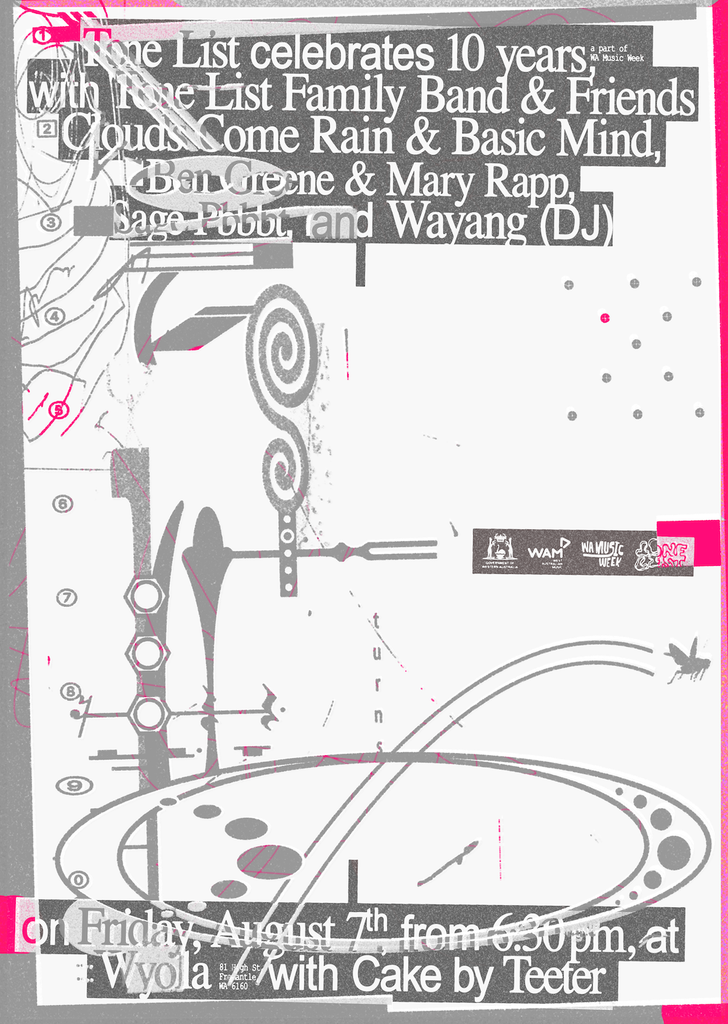
Celebrating ten years of exploratory music in Boorloo, Tone List has grown from a small artist-run record label into a producing platform encompassing festivals, concerts, residencies, workshops, international exchanges and even an opera. Ahead of Tone List’s tenth-anniversary celebration at Wyola Club this Friday, August 7—featuring performances, one-off collaborations and the release of its new anniversary book, TL10Y—CAT LANDRO spoke with co-founder Josten Myburgh about what inspired the collective, the community that has formed around it, and what it takes to sustain an artist-run organisation for a decade.
When you and Dan O’Connor began Tone List in 2016, what did you feel was missing from Perth’s experimental and improvised music landscape—and what did you hope Tone List could make possible?
Dan, Jameson Feakes, Lenny Jacobs and myself started Tone List in 2016 on Dan’s initiative. I think we all had had encounters with the idea of improvised music as something beyond just a technique you could use in music: it could be a whole way of being a musician, or even living one’s life. We were inspired by the Sydney scene around SplitRec and the NOW now; by Catalytic Sound in Chicago; and by DIY spaces like Conduit Arts in Naarm and StudioAcht in Berlin. It was kind of like seeing punks who wrote sheet music or played the trumpet instead of—or, as well as—guitars and drums and pedals. The level of rigour and seriousness was really high: people were world-class at their instruments, even if it was just to pursue this really esoteric interest, or they might be technically loose, but they would be so decisive or present or something. And all of this had nothing to do with music institutions.
It sounds pretentious no matter what way I put it. And it’s not like that wasn’t here in ways. But I think we just wanted to live something like those lives, but in our home!
In an interview around Tone List’s launch, you hoped the local scene would retain “the same friendly and inclusive atmosphere,” only on a larger scale, while Dan imagined Tone List reaching around 30 releases. When you look back across more than 40 releases, eight festivals and hundreds of performances, which moments made you realise Tone List had become something more substantial than the label you initially envisioned?
Maybe it was the Audible Edge Festival this year? It was definitely the best thing we’ve ever done. I’ve always wanted to be able to be the kind of organisation where people just go on a whim, trusting that it will be good. People really bought into the festival this year and I think they were rewarded. The atmosphere in the room was unbelievable; it just enchanted all of the music in the exact way we believed it could. Earning that trust is seriously moving. Every day I feel in disbelief about what we did! I wish I could tell you what is in store for the next one—if we get funding, it’s going to be bonkers.
Tone List has developed from a record label into a broader producing platform encompassing concerts, festivals, workshops, regional residencies, international exchanges and even an opera. How has your understanding of what the organisation is—or needs to be—changed over the decade?
It seems like it has changed a lot, but we are actually doing almost the same stuff as when we began. Audible Edge, our performance residencies and our touring projects started in 2017, our improviser’s intensive Sounding Together in 2018… we had lots of good ideas back then and have kept at them. I feel great about that.
It has always just been a collective of friends doing what we feel like doing with each other’s support, and sometimes that’s an opera. It’s grown because we’re ambitious, because people have gradually come to trust us and give us opportunities, and also because we’ve just learned to write better grants, so we have more resources to work with.
Probably the biggest recent change is the inclusion of new board members in 2024. Taking governance more seriously takes a lot of time, but if we’re lucky, it’s going to have some great rewards. Having an organisation of Tone List’s “scale” is, in theory, good for a scene—it just makes different things possible. I feel very curious about the challenge of maintaining our integrity as we navigate more bureaucracy and other pressures associated with being a not-for-profit.
“Exploratory music” can be more open and useful than “experimental music,” but it can also be difficult to define. What does that term mean for Tone List?
Experimental music has its own cultural history and traditions. Personally, I identify strongly with the experimental tradition. But getting away from that word was sort of about trying to shed some associations that word has come to be associated with… things being dark, edgy, etc. We wanted a space that could include experimental pop, avant-jazz, left-field electronic music, as well as more “classic” experimental practices, and not feel codified. I guess we also wanted to make room for music that didn’t self-define as experimental but still struggled to find a home in Perth. We wanted to be inclusive, basically, because small scenes need that. So we chose exploratory, which was going around at the time, as an umbrella term.
How has Boorloo’s exploratory-music community changed over the past ten years—musically, socially or generationally? What has grown stronger, and what remains difficult?
I think the depth of the scene is higher because most people my age leave Perth by now if they want a serious music career. I think a bunch of us committed to staying and trying to grow something here. So you have a bunch of musicians in their 30s and older who have kept at it for at least a decade and are doing astounding work. Anyone who saw Jameson Feakes and Maria Moles’ duo at Audible Edge will know what I mean. Watch it on YouTube. 2016’s babies are 2026’s GOATs. Plus there’s a younger generation of people influenced by us that’s just starting to really flourish. If you look very close at the documentation of Naoko Uemoto, Saskia Willinge and Uma Volkmer’s trio set at Audible Edge this year, you can see me being moved to tears.
As for what is difficult: I feel optimistic about Tone List, but the world is definitely harder to live in. Personally, because of my fortunate circumstances, I have nothing to complain about. But our government’s complicity in the genocide in Gaza really was a wake-up call as to just how out of our hands our shared situation feels and how disinterested the broader arts industry is in responding seriously to that. I really feel like everyone here is carrying a great sadness behind their eyes at the moment. If nothing else, I want Tone List to be a balm for that, but I also hope our actions resolutely prove that other things are possible.
You have remained firmly based in Boorloo despite the geographic isolation and limited infrastructure facing artists here. How has that location shaped Tone List’s identity?
Place is also people in place. Those who stuck around got under each other’s skin just as much as Country did. If you only have a few people to collaborate with, you’ll work hard to make things work with them. I think that’s how we get bands like Pale Ribbons Tossed Into the Dark, who are one of the best bands in the world, or the intergenerational collaboration between Eduardo Cossio and Ross Bolleter—Dark Shine is an astounding record. Or, yes, Sage J Harlow’s opera O,D,E, which I think at its heart has the idiosyncrasies of the Boorloo scene threaded all through it. We persist with each other and are rewarded with great music. I don’t mean that like it’s a chore. But if you play free jazz and live in a city with a huge free jazz scene, you don’t have to ask the musique concrète composer if they want to jam. You just play free jazz. Here, you have to have that jam, and then you end up forming one of the best bands in the world! Oops.
Tone List’s work seems to be as much about creating the conditions in which a scene can exist as it is about presenting individual artists. What does a healthy local musical ecology need?
My hot take answer is really sick, adventurous music. I don’t just mean this in the avant-garde scene! We have to win people over, and we’re competing with so many forces which want to keep people away from the realness and power of live music. I believe we have to work really hard to make actual magic! I mean really, we have a world that’s slipping away from us that we need to win back.
The less hot take answer is hospitality. I think taking care of the musicians you’re near and the audience that comes to hear you is really important. It is easy to be cool about it, and I deeply respect the value of it being possible to put on a show with no effort. But just being kind, respectful, caring about the people around you, and really trying to show that with your actions… I think that’s hugely important. That comes from touring—you forget the venues that didn’t really care you were there, and you never forget the venues that took you upstairs afterwards to try their homebrew kiwi fruit wine.
Tone List places considerable emphasis on affordability, accessibility, paying artists and creating spaces for close listening, kindness and playfulness. Were those principles present from the beginning, or have they developed through experience?
Ticketing and accessibility were developed through experience. One question is, how do you grow the revenue of something so it can do things that people love? Especially when things are so expensive? We have spent a lot of time finessing a ticketing model where no one is turned away but where the standard ticket price helps us actually pay people to play. There is also a statement here about the value of music: we want people to think about how much music is worth and how much a concert would really cost to properly support the musicians playing. In a more ideal world, the arts would be significantly more publicly subsidised, and everything could just be really cheap and accessible. Alas.
Accessibility too: I guess once you realise how unjustly the world treats disabled people, you want to do something about it, but without disrespecting the culture of disabled people by coming in like a saviour. We tried to set simple precedents—like: the gigs have to be in wheelchair-accessible venues, not using strobes, etc—and then work with disabled artists in our community to try and be more ambitious with what we can do and to make sure their art is part of the scene, not just their ideas. Patrick Gunasekera has been instrumental in this process for us. We should all be taught this stuff, but we’re not, so…
The playfulness and kindness and such were always there, though. We wanted to make Tone List very inclusive from the get-go, because we figured that a small scene that tried to be cool and exclusive would just die. We were also young adults in that first wave of #MeToo, and I think we thought the least we could do is try to shed some of the macho energy of previous generations. Our proximity to places like Berlin and Sydney, whose scenes prove you can be an exceptionally rigorous, serious musician without being a tough guy or losing your sense of humour, helped.
Artist-run organisations are often sustained by an enormous amount of largely invisible labour. What has it actually taken to keep Tone List going for ten years, and were there periods when its future felt uncertain?
I don’t think I’ve felt less certain about it. We have always had long-term goals for it. We wanted to last at least long enough for a younger generation to get inspired and do their own things, which groups like WWIM have done. We’ve proved we can survive a founding member leaving—I have so much respect for Dan, who left in 2024, for doing such great work and then bowing out when the time felt right for him.
I am kind of ‘perilously ambitious;’ I don’t really know how to help myself! I really believe in this stuff. Audible Edge and Sounding Together are the best things I do. They give people hope. I want to keep doing them.
How does Friday’s anniversary program reflect Tone List’s history, and what do you hope someone encountering the organisation for the first time will understand or feel by the end of the night?
We wanted to do something a bit like ‘old-school Tone List.’ So, lots of improvised music and sets from artists on the first few Tone List releases and a moment for us original members to play as a quintet, which we haven’t done in at least six years. I wanted it to feel a bit like 2016 again. We were going to do it in a dusty old hall but couldn’t find one that quite fit the vision! But Wyola is a great, flexible new venue and will serve it well.
The gig is not an accurate representation of the whole scene. I hate the idea of trying to do that. It’s just another show of people trying stuff and experimenting, this time with the goofy energy of a kid’s tenth birthday party and a bit of pomp and ceremony. Friends who are still friends, still making music together with new friends! I hope people feel that spirit and have a good time.
I think you will see a lot of love that the community pours into Tone List though: Luci Young (Young1) has made three four-piece Tone List suits adorned with cyanotape prints of ten years of our history. As a gift to us—I can’t believe it. Kate Makowiecka has made us a massive soup; Teeter Bakery has made us a birthday cake and Josh Wells has put ten years of his photography on the walls… I’m sure people will bring silliness and sentimentality into the space. I hope that’s not too cringe! Let us have our moment!
Tone List has described the anniversary as both a celebration and an appeal for support. What does the organisation need from its community now—and what do you hope its next ten years might make possible?
It’s not drastic. As I mentioned, we’re entering a gap in funding. We need a little bit of support to get through the next nine months before—if we are lucky—our core funding will kick back in. But we’re not doing a donation drive. We just want folks to show up, take some merch home, maybe buy one of the suits!
The next ten years: if we become core-funded, we can actually plan ahead for once. Which means some of our wildest dreams might happen. Bringing favourite artists to Boorloo and whatnot! We have to think in that way because procuring partnerships, making long-term plans and having global ambitions help with funding pitches.
But personally I think the most important thing is to think less about my own wild dreams and instead pour as much money and support into the pockets of local artists so they can use it to make great music. I’ve always thought we need to do things our way in Boorloo and that if we really commit to our place and each other, unbelievable and unique stuff will happen. We can’t wish we were something else, or pretend we are. Trying to be the ‘Perth Dark MOFO’ or something is a doomed endeavour. We have to ‘be like our place’ as Tyson Yunkaporta says. Or try. In the absence of cheap rent and plentiful DIY spaces like early-2000s Berlin: I will try and resource people by paying them loads of money, to help them make their dreams happen and help us all inch towards a better world.
Tone List’s tenth-anniversary celebration takes place at Wyola Club on Friday, August 7, 2026. Tickets are on sale now from moshtix.com.au