
Sylvaine brings the ethereal sounds of Norway to Australian shores
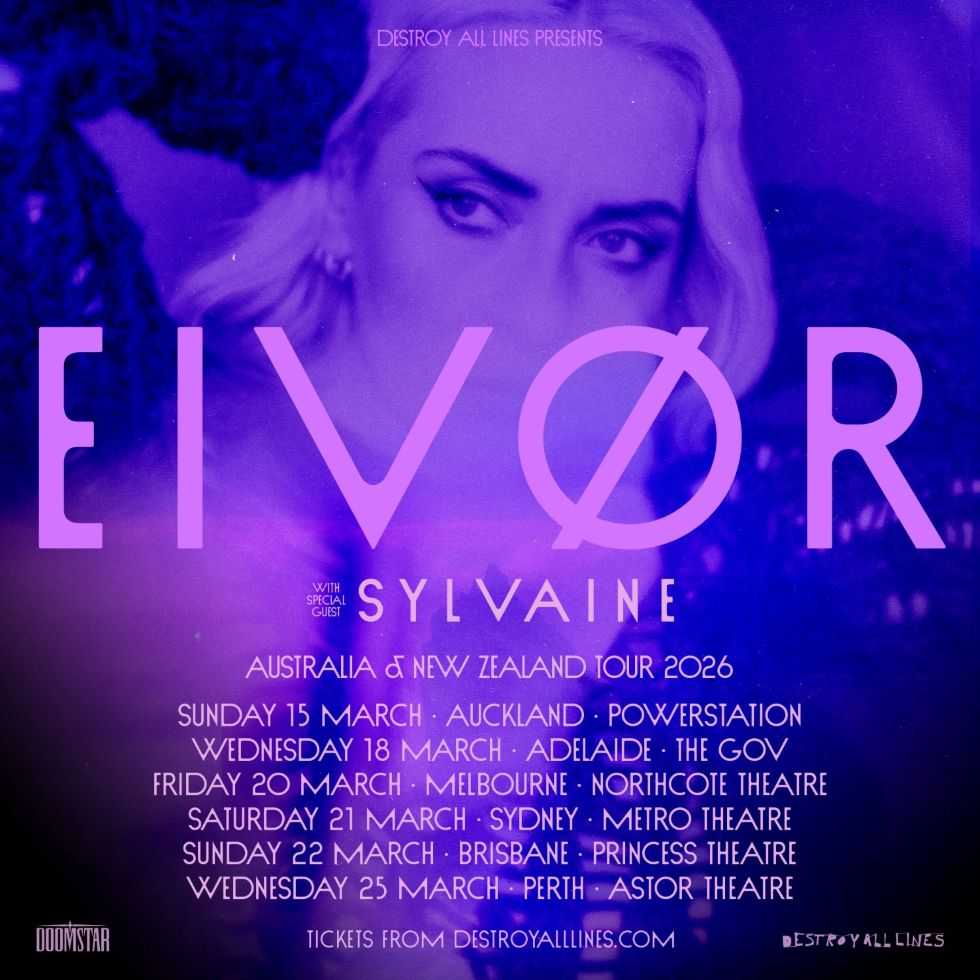
Norwegian multi-instrumentalist Sylvaine, the solo project of Kathrine Shepard, is set to hit the road with Eivør for an Australian headline tour this March. Since 2013, the instrumentalist has released four albums to date, with hit tracks Nowhere, Still Somewhere, Eg Er Framand and Mono No Aware. Sylvaine will support Eivør at Astor Theatre on Wednesday, March 25, with tickets on sale now. JEFF SMITH chatted with Sylvaine to find out more about touring down under for the first time, recording her newest EP in a church, and her go-to outback road trip album.
So, from what I’m aware, this is your first time in Australia. Is there anything you’re particularly curious about or hoping to experience while you’re here?
Oh my goodness, yeah, I mean, there are so many things, actually, like, I grew up watching Steve Irwin. I have to admit, The Crocodile Hunter was, like, my favourite show when I was about four, five, and six years old, literally to the point I would bring my VHS tapes with the recorded versions of his show to school to make other people watch them.
So I’m very excited to see some of the Australian landscape and the flora and fauna, because it’s going to be very, very exotic for me, coming from Scandinavia, which is pretty much the opposite from what I can expect down under. So, yeah, very much looking forward to experiencing it. Because we have a limited amount of time, sadly, we won’t be able to explore every place we go to that much, but I did see we have a day off in Adelaide after our first show in Australia, and I had a friend of mine who told me I should go to Kangaroo Island.
I think we have some time in Melbourne, Brisbane, and Perth, so we’re going to try to see a few different things. I’m just very excited to be in Australia and to see what it looks like in the cities and outside the cities and just meet the people. I’ve had such great experiences with Australians before, so they’ve been very kind. Very excited to see the audiences there as well.
So, you toured with Eivør in 2024, and now you’re continuing that partnership in Australia and New Zealand. Is there something about Eivør’s music, and your own music, that you feel like complements each other?
I think that we’re two artists who have music that can’t be easily put into one single box, so it kind of works. I feel like we have some of the same impulses in our music, and then she definitely leans more towards a quirky, alternative kind of pop vibe. Of course, I have a little bit more of the metal elements in my music. So, yeah, I think it’s interesting; it’s two projects that basically have a similar love for vocals. Definitely the folk and pop music aspects that exist in her music and in mine kind of come together. It makes for a nice dynamic between us, and it’s still different enough for people not to be bored that there are two blonde chicks that are doing the same exact thing, which we’re not!
I think that’s why I was asked to do this tour back in 2024, when I was first asked to join her here in Europe. Also, because I’m lucky enough to be able to do the Sylvaine music, just me, on stage, it makes it quite easy for me to just jump in and be like, ‘Yeah, sure, let’s go.’ I think that’s why I was asked to do the North American tour last year as well and now the Australian-New Zealand tour this year. I didn’t even realise there was one tour with Eivør per year for the last three years, and I’m not complaining about that. I loved Eivør’s music way before I went on tour with her, so it’s a privilege, and I’m excited to do it again.
Oh, that’s fantastic. So, you were born in San Diego to an American father and Norwegian mother. You grew up in Oslo and have lived in Paris since 2015. How has such a diverse life and upbringing fed into your music?
That is a good question. When you look at it on paper, it’s like, wow, I get around! I was in Paris for a while, from 2014 to 2020, and now I’m back in Oslo full-time. I was living halfway between Paris and halfway between Oslo, which was really cool, because Norway and France aren’t super far apart from each other. I learnt that there’s a wild difference between how people function and the kind of society in France and here. It’s always great when you have the opportunity to live somewhere else. That’s always a great idea because it really expands your horizons and gives you more understanding of other cultures and other ways to see things. I know that one thing that I could directly trace back to the Paris years was the loneliness aspect, because I didn’t speak fluent French; I spoke a little bit of French. I didn’t really know anyone there, except for the partner that I moved there with at the time.
It was kind of isolating, in a way. I mean, obviously, as years passed by, that got better. But I remember writing my second album, Wistful. It was written half here in Norway and half there in France, and I can really hear the loneliness in that record. So, every record, I feel like, has a little bit of what was predominant in my life at the time. I do definitely think that growing up in Norway has affected my music in the sense of having this kind of strong connection with nature and the spiritual side of things.
I’m not sure it would have been exactly the same if I had grown up, like, smack bang in the middle of New York or something. It might have been a different creative output. So I do think it has affected the projects, especially the nature aspect, because I’ve grown up with it so much, so it’s become a part of my writing and music process. Like, I will be walking in the forest to try to find clarity if I’m stuck with something. It has affected the music, definitely.
And you play essentially everything on your records, like the vocals, guitars, bass, and synths. So when you’re touring with the full band, how does that change how the songs feel to you?
I remember when I first started working with my session musicians. My drummer, Dorian, has been the same since 2017, so we’ve been together the longest, and then my great bass player, Max, joined in 2019, and then my guitar player, Flo, joined in 2020. So, in the beginning, back in 2016, when I was practising for the first show, and then into 2017, we started playing a couple of more shows live.
I remember having this feeling that it was hard to let go of your own part, you know? Because I want the people that are playing with me to express themselves as well. It’s kind of a weird situation to be in when you get asked to be a part of a project where you basically don’t have a creative say in the output that much. They’re not writing the music; they’re not a part of the studio side of the project that much. It’s kind of like, ‘This is what I’ve recorded; this is what I want you to play. Play that.’ So I try to kind of stay open to their interpretation of my music and my parts.
But with these three guys, they’ve always been very respectful. They’ve always been kind of under the impression that this is my vision. These are my emotions that they’re trying to communicate. They’re trying to communicate my universe to the audience and do it in the most worthy and delicate way.
I feel that they have added a bit of their own sense into things, which is really cool, because it makes it different live than it does on record. In the beginning, when I first started, like, ten years ago, it was, like, a transitional period where I had to wrap my mind around, like, ‘Okay, I have to give these parts away now, and it’s not played exactly the same way.’ And that’s fine. Being a control freak, like, 100%, it took a little bit of getting used to. But I’m definitely really grateful for the guys in my band. Their touch is exactly what’s needed for playing this music live.
You operate across a real tonal spectrum from ethereal, dreamlike soundscapes right over to harsh black metal vocals. Are the same emotional impulses expressed differently, or are you coming from a different space when you switch back and forth between the two?
Very good question. I reckon that it might be stemming from the same impulse, and it’s just different aspects of that and how to express all of the different aspects of it. I mean, within an album, obviously, maybe there could be several different impulses expressed in a way that makes a cohesive story throughout the record. Or a reflection of who I am at the time and the issues that I’m struggling with at the time that I’m creating the record.
Generally speaking, when I bring out the harsher elements in my music when I’m talking about the voice, for example, like, when do I decide to use the screaming voice? That comes into play usually when I feel like the clean voice no longer has the ability to express the kind of urgency. The pressing feeling of these emotions that I’m trying to communicate to the audience.
So it’s not necessarily about anger or an alter ego like Dr Jekyll and Mr Hyde. It’s more about getting to a point where you’re like, ‘Oh my god, you have to listen to me; like, you don’t understand, this is super serious, you need to hear my words.’ That’s when the screaming voice comes in, and that’s maybe also when the blast beats and heavier things in the music come. When it’s kind of underlying, like maybe earlier in the song, I’m coming to terms with this, or, like, I’m realising this emotion, and I’m like, ‘Oh my goodness’, and it kind of overtakes me. In general, emotions are also alive, and they kind of go like waves. Sometimes they will feel unruly and really hard to deal with, and sometimes you can ride them more easily.
Is it difficult to switch back and forth between the two?
I wouldn’t say no; I would say, actually, that’s a very natural thing because it’s something I didn’t really consciously choose. It just came out this way. If we’re talking about performing live, when you go switch back and forth, for example, between very energetic parts where the body is much more in use or with the screaming vocals, then down to, like, very clean or very naked parts. It can definitely be a demanding switch, like, no doubt. Vocally speaking, going back and forth between the screaming voice and the clean voice, depending on how you’re doing each day and where in the set you are and if it’s in the beginning or the end of the set, can definitely be demanding, too.
Cool! So your most recent EP, Eg Er Framand, was a turn towards Norwegian folk. It was recorded in a church where you performed as a high schooler.
Absolutely, yeah.
So what drew you back to those roots, and was it a deliberate contrast to your heavier work?
I can say for sure that was 100% a conscious choice, because I’d been wanting to do something in folk music for many years, and I think you can even hear this in my other music. I’ve always been kind of intimidated by the tradition of Norwegian folk music because it is a tradition, and it has weight to it that I really respect. It’s a bit like classical music where there’s been this tradition for hundreds of years, and the way you interpret it is really important. It’s basically the same with folk music, because it’s folk art that’s passed down from generation to generation.
I didn’t want to kind of sully it, so I’ve kept myself from doing it for many years. It’s funny, because since I was in high school and doing my music since I was 14, so many people told me, ‘Oh, you should do folk music; like, I think your voice would really lend itself to that.’ So I’d heard these comments a lot, and growing up in Norway, it’s something you get familiar with, because it’s one of our cultural heritage things. So, 2023 was the year where I was like, Fuck it. I’m going to try. At some point, you have to respect the creative kind of stream of consciousness that speaks through you and just go.
I came across the title track of this EP, Eg Er Framand, in 2021 or 2022 randomly on a Norwegian TV program on a Saturday evening. There was this guy performing this song, and I was like, ‘What is this song?’ It’s incredible. It’s just burrowed deep into my soul and, like, traumatised me right there. And I was just like, I need to perform this song. The funny part was I didn’t even hear the lyrics properly when he was performing it, and when I sat down and actually read the lyrics, I was like, ‘Wow, this is, like, more Sylvaine than I could ever write myself.’
More Sylvaine than Sylvaine?
Yeah, exactly! When this one song kind of sums up all of my projects in one way. It’s eerie how this song felt like something that was written by me, even if it obviously wasn’t. Or maybe it was a past life. Who knows? So I started singing it and getting familiar with it, and then at some point, I started sharing it with people, and the funny part is the reaction that I saw people have, because obviously nobody understands what the hell I’m talking about when I sing this song, because it’s in Norwegian, and it’s in a really kind of old and weird dialect. I knew that nobody would understand it, but for whatever reason, the sentiment in these melodies and, like, the way that it’s built is just so haunting. So every time I performed it live, the reaction would be the same. People would just, like, break, and I was just really fascinated. I would break too, because it’s just, like, again, these melodies are just something else. At some point, I felt like I needed to eternalise this.
So, that was actually the beginning of the EP, and that was my foot into Norwegian folk music. So I took the first track on that EP, called Dagsens Auga Sloknar Ut, and the last one, Eg Er Framand; they’re kind of less known in the Norwegian folk music community. Then the third song on that EP, Eg Veit I Himmerlrik Ei Borg, is probably the most known religious folk music piece we have in Norway. So I feel like I really put my own spin on that. I rewrote the lyrics because obviously all these ones already existed, and because they are religious, and Christianity isn’t a faith I belong to, so I felt disrespectful singing those words. Then the other three songs that I composed myself, inspired by folk music.
I recorded the EP in the church, where I had done some concerts at high school, because I love the church, because it’s not too big, and because it has a wooden structure in the ceiling, which means that it’s stone and wood, so it kind of has an interesting, warmer reverb but still a very long reverb. I just bought some microphones and dragged all my shit to this church, and they were so kind; they were like, ‘Of course you can record here.’ It was such a great adventure. I would… I am probably going to do it again.
Nice. Well, I look forward to it. One last question. So let’s say you’re road-tripping across the Australian outback, you know, in a Holden Ute. What album are you reaching for?
Hmm. Very interesting question. When it comes to landscapes in general, I often end up with these minimalistic piano compositions. I really am fascinated by minimalism. So, like, I’ve been very attracted to people like Philip Glass; he’s, of course, a bit more on the curious side, perhaps. Or, in modern times, like Max Richter, who is one of, I think, one of my favourite artists ever, actually.
Oh, you’ve got good taste.
Thank you. I have a feeling I’m going to listen to Goldman’s record, The Melody of Elegance. I do tend to listen to that record, which is a piano, only a piano, no voice, just piano. I remember being on a bus in Japan, going from Tokyo to the middle of nowhere, and I remember listening to that record. It’s a nice accompaniment without too much distraction, because obviously, I want to take in the scenery and not distract my mind too much. Maybe some kind of ambient drone-y stuff could be cool. Maybe some Emma Ruth Rundle, too, because sometimes she has this kind of desert feel in her music; like, maybe one of her records could be cool for these landscapes, I reckon. Maybe.
Sylvaine will support Eivør at Astor Theatre on Wednesday, March 25, 2026. Tickets are on sale now from destroyalllines.com