
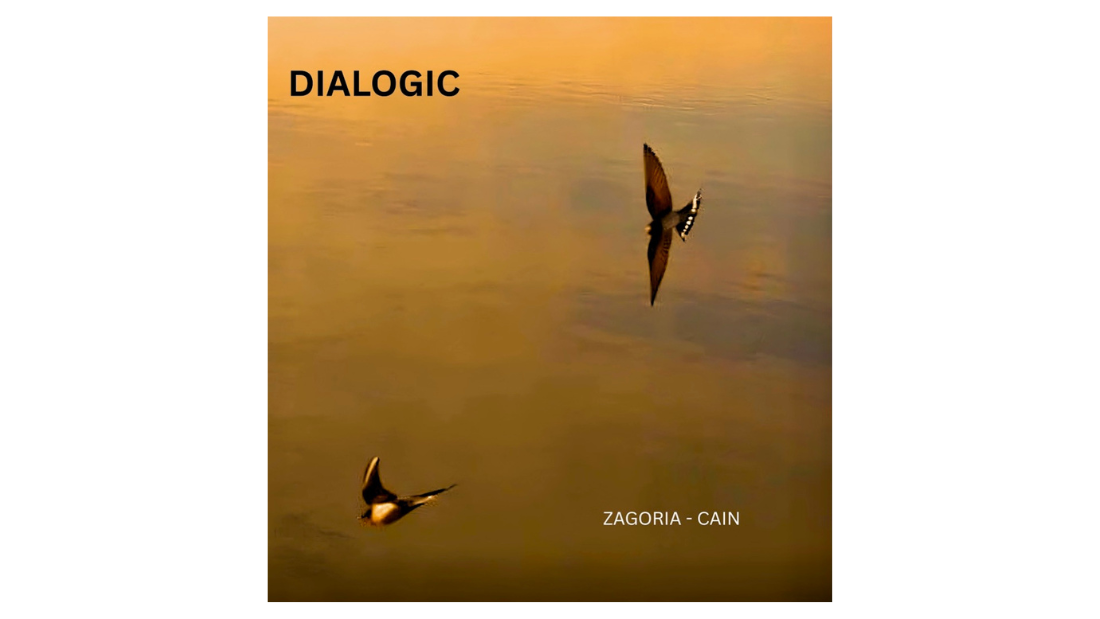
Review: Zagoria – Cain’s Dialogic
Zagoria – Cain
Dialogic
Independent
According to Miriam-Webster, ‘dialogic’ means ‘characterised by dialogue’. It is a great title for an album that explores the interplay between guitar and an array of wind instruments. Ethnically diverse, Dialogic filters a range of influences and musical cultures through the focused sensibilities of two extraordinary Perth-based musicians: guitarist Ilan Zagoria and wind player Mark Cain.
Although these two have been making music together for a dozen years, both have been honing their musical skills for much longer.
Mark Cain is now in his fourth decade as a full-time professional musician. That’s quite an achievement in Perth for someone who has essentially remained independent and focused on the less commercial genres of world, multi-cultural and new music.
Well into his twenties before he blew his first note, Cain had already acquired formidable musical knowledge working as a presenter on radio 6NR. He quickly applied this understanding to the serious business of making music. To ease the transition, he took lessons from renowned multi-instrumentalist and instrument maker Linsey Pollak, who in 1983 founded Perth’s Ethnic Music Centre (later Kulcha).
Over the years since, Cain has featured in an array of prominent Perth ensembles playing saxophone, clarinet, bass clarinet and a plethora of ethnic flutes and horns. Among others, he has played in The Rita Menendez Group, Crab Tango, Bulgarity, Nova Ensemble, The Flying Carpathians, Daramad and Eastwinds. A witty wordsmith, Cain coined some of these band names.
In the early 1990s, through his work with the legendary AC/PVC, he began to construct instruments out of PVC piping and other eccentric materials. He now frequently runs workshops in instrument making at music festivals and in-school presentations. Over a span of 27 years, he delivered other in-school presentations with different groups through Musica Viva and solo with Nexus Arts (Victoria).
Cain has also worked behind the scenes, having been a founding board member of the Ethnic Music Centre and more recently the driving force behind Hemispheres, a series of ethnically diverse concerts presented at Camelot Arts Club (Mosman Park) and PSAS (Fremantle).
Ilan Zagoria was raised in Zimbabwe in a secular Jewish household during the ‘Apartheid-light’ era, as the years before independence were known there. Like most young white boys the world over, he first engaged with English folk and African-American blues, learning to play songs by Dylan, Paul Simon and The Beatles. Although not religious, through his Jewish culture he grew to also love traditional Jewish music. His main claims to fame, though, during his Zimbabwe years were his fifteen-minute guitar/harmonica adaptations of Tubular Bells and Jesus Christ Superstar.
Zagoria left Zimbabwe in 1975, five years before independence, spent time in Israel on a kibbutz, and then travelled through Europe and America. In 1980 he settled in France, where he decided to explore his complex musical heritage. He focused on white Zimbabwean music and West African kora music (the kora is a West African harp) as well as his Jewish musical legacy. He also started to play the mbira, a traditional African ‘thumb piano’ (small metal keys on a wooden block).
In 1988 he moved to Australia where, trading his guitar for the percussive wooden keys of the marimba, he joined the Sundiata Marimba Band. Sundiata were a global music sensation in Perth in the era immediately before world music became a global phenomenon—for a number of years they dominated the World Music category in the Kiss My Wami awards. Over time the ensemble morphed into the African Music Congress, and Zagoria moved from marimba back to electric guitar. The latter manifestation of this band specialised in chimurenga music, the Zimbabwean protest music of the 1970s.
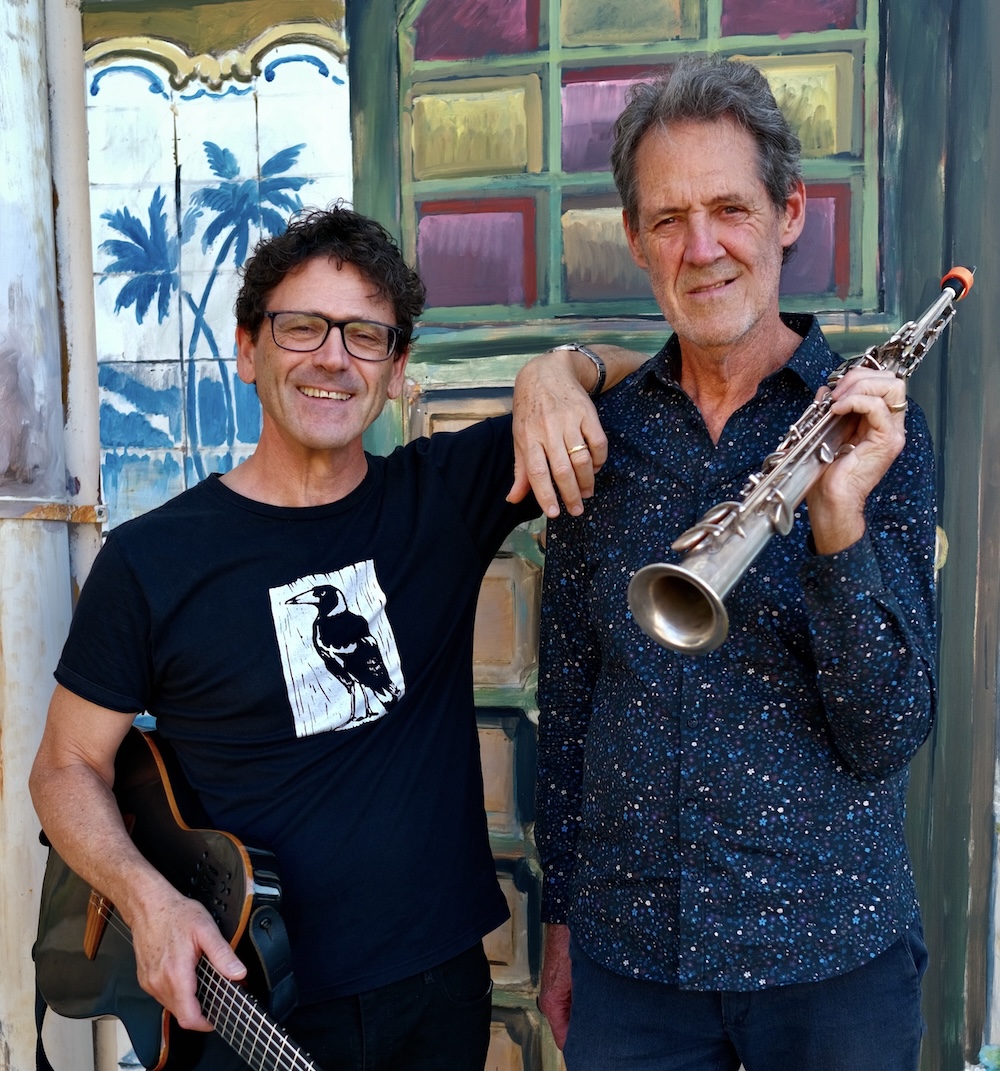
In the mid-1990s Zagoria went solo, though he continued to work in chimurenga and kora styles. His first solo album, Coal Train to Cape Town, was released in 1994 to critical acclaim. Over time his solo work merged into the Zagoria Trio.
In 2014, Mark Cain invited the trio to perform in a Hemispheres concert. Recognising Cain’s love of eastern modes, Zagoria reciprocated and invited him to play a few tunes in the show. He subsequently played on the same pieces for Zagoria’s next album. A little later the trio became a quartet when Cain joined the band as a permanent member.
The Dialogic album was recorded over a nine-month period in Cain’s home studio. The original idea was to do a strictly duo recording. To this end, as well as guitar and mbira, Zagoria also played electronic percussion. Eventually though, the temptation to include acoustic percussion became too great, and they decided to invite four percussionists to join them: Shane Kearney, Esfandiar Shahmir, Paul Tanner and Francisco Munoz. Assigning one percussionist per track, each player was given free reign to develop their parts.
Shahmir also plays the Persian ney, a unique style of flute—its blowing end fits between the player’s teeth. Its ethereal sound features on two of Cain’s compositions, adding to the complexity of the wind parts.
Zagoria plays a distinctly African guitar style as popularised by Zimbabwean/South African guitarist Johnny Clegg and in the West through Paul Simon’s Graceland album. A melodic rather than chord-based style, it is subtle in its complexity and eminently danceable—infectious, rhythmic, bright and busy. On some tunes he blends his guitar tightly with his mbira, the notes of the two forming an intricate and lush rhythmic bed. On others he uses an octaver on his guitar (tuning it an octave down) to capture the bass register.
Cain’s horn lines are similarly sinuous. With Eastern inflections infused with jazz and a hint of funk, he swaps between his saxophones, clarinet, bass clarinet, whistle and two ethnic wind instruments, the tarota and duduk.
Throughout the album the strings and wind work against each other, going in and out of sync—the dialogue of dialogic. At times they run in tight harmony or melodic unison; at others, in a back-and-forth duel, the line on one is repeated or contrasted on the other. Each take turns to solo, often following one another. It is a delicate, interweaving conversation of contrasting textures and contiguous melodies, rich and glorious in their vibrancy and unique in their blending of so many cultural influences—African, Jewish, and Middle Eastern. Through Cain’s love of jazz, and especially of mixing it with Eastern influences, there is a hint of America as well.
The melodic lines are unusual in that they waver between the light and dark. Neither wholly joyful nor completely in the shade, they sit somewhere in between, hinting at both. It makes them reflective and poignant while remaining upbeat, just like the complexity of life.
Zagoria is the major writer of the pair. Of the thirteen tracks, he either composed or adapted eight. Cain composed two in his own right and one, Grace, with French tubist Michel Godard. The remaining two tracks are covers of African tunes by key people who influenced Zagoria’s evolving style: Anna, a kora tune by Kauding Cissohko, and Blues for a Hip King by Abdullah Ibrahim.
Although primarily instrumental (tunes), there are two songs, Harare and Zambezi, both written and sung by Zagoria. In different ways, their lyrics explore the complexity and confusion of a person of European heritage growing up in Africa: the dual allegiance and the pull of a distant ancestry mixed with a deep connection to the spirit of place. Through this, the album is permeated by not only African musical influences but also the thematic complexity of being a semi-outsider within a culture. In a way, this perhaps parallels the white Australian experience of a displaced European culture within a unique southern landscape.
But such themes swim beneath the surface, apparent on close listening and reflection but carried through the rich flow of exciting music. The vocals are also blended down in the mix so that it is the texture of the voice rather than the lyric which stands out.
Multi-cultural music often seems like something you should listen to because it’s good for you. This glib generalisation overlooks the fact that it is also immensely entertaining. Lively, interesting and complex, it can be funky, playful, poignant, introspective, extraverted, slow, fast, soft and loud; in short, as diverse and sophisticated as any and all music. Put it in the hands of two virtuoso musicians of varied cultural and musical backgrounds—European in their blood but fluent in ethnic styles—and sparks fly. Dialogic is the result of one such rich collaboration. A gorgeous and intricate album, individual yet brimming with musical history and variety, it will sit with pride of place in any sophisticated listener’s collection.
The album is available on Bandcamp under the artists’ individual names and can also be purchased directly from them. On Monday, May 11 at 7:30pm, a special listening party of the album is being hosted on Bandcamp. To register, head to their page on bandcamp.com
IAN LILBURNE