

Review: WASO’s Devotion and Glory at Winthrop Hall
Devotion and Glory by WASO at Winthrop Hall
Wednesday, April 16, 2025
You don’t have to be religious to be moved by sacred music, but it probably helps if you are SBNR, as many now write on their Incoming Passenger Cards (spiritual but not religious). No such declaration was required, though, on entering Winthrop Hall last week for the WA Symphony’s Easter concert, Devotion and Glory.
A program of three deeply spiritual works, all of them first-time performances by WASO, in keeping with the theme, under guest conductor Joseph Nolan, the orchestra was joined by WA’s premier mixed-voice choir, the St. George’s Cathedral Consort.
The concert began with the world premiere of Australian composer Olivia Davies’ Femina Mortem, a short, powerful work for choir and organ commissioned for WASO by Prue Ashurst.
Davies (b. 1988) specialises in acoustic and electro-acoustic music in experimental, classical-minimalist, and ambient realms. Composer in residence for WASO from 2022 to 2024, during her tenure a number of major works were commissioned and premiered. This was the second week in a row that she featured in a WASO concert.
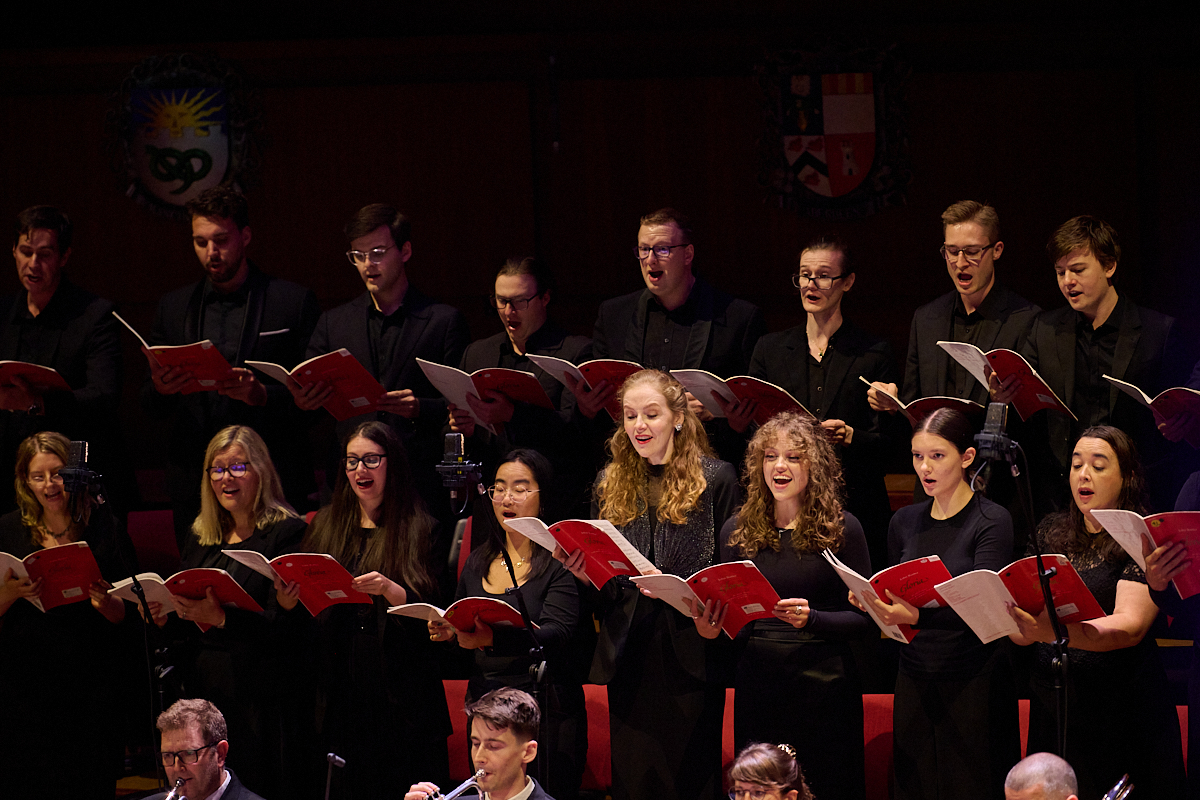
Before Femina Mortem commenced, Nolan invited Davies onto the stage to talk the audience through the work. She advised that the piece is based on a Hildegard von Bingen’s poem/prayer in celebration of feminine power. As this reframes women’s role in Christianity from guilt to blessing and redemption, in the modern world it has acquired a strong feminist significance.
The piece itself is broken into two distinct parts: an ethereal, shifting, somewhat dissonant opening and a chant that incorporates phrases taken from von Bingen’s melodies. Davies invited us to listen out for the differences.
The piece opened with a sweeping phrase for the soprano end of the choir. Reminiscent of György Ligeti, especially the alien angels Stanley Kubrick used for the monolith sequences in 2001, gradually the other female voices joined in, and finally, through an ascending bass and baritone line, the men.
The shift to the chant was heralded by a deep, sustained drone on the organ. This developed into a haunting swoon as phrases from von Bingen’s poem were gradually woven into the texture. Slowly the organ notes began to shift, deepening and extending, and then all too soon the piece was over.
The second work was testament to the notion that even the composer of sacred music does not have to be a particularly religious person—or so English composer John Rutter (b. 1945) claims of himself. This is somewhat surprising given the number of sacred works Rutter has composed.

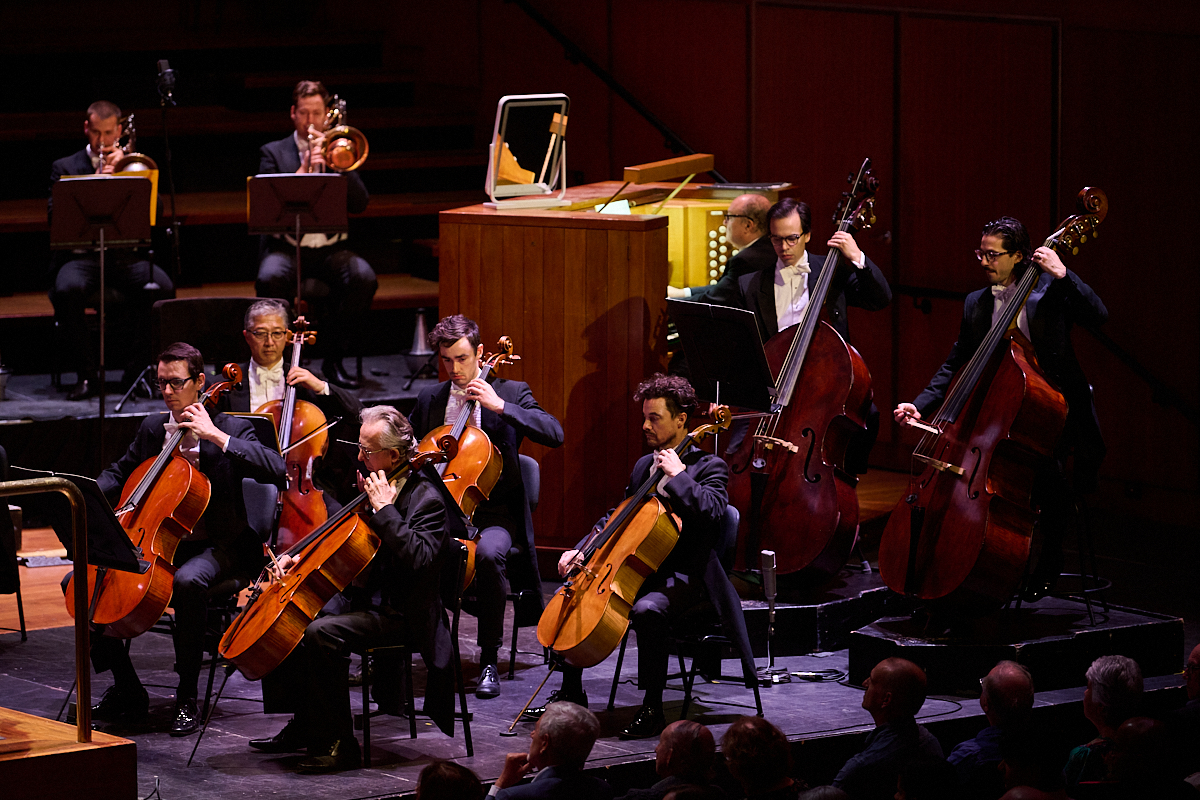
His Gloria, for choir and small orchestra (organ, brass and percussion), dates from 1974. Each of its three movements began with a different type of orchestral flourish and then developed into a more reflective choral sequence.
For the opening movement, a stirring brass fanfare, more John Williams than JS Bach, was gradually suffused by an almost whimsical organ figure before the choir came in on a full-throated roar. Progressively, it evolved into a warm, soft buzz intercut with grace notes from the sopranos. First one singer, then two, then a bank of them.
For the second movement, a flourish on the glockenspiel segued into a quicker, more rhythmic song, the male and female voices bouncing lines against each other, while a shimmer of cymbals, roll of the timpani, and quick burst of sticks on the snare introduced the drawn-out Ave Maria of the finale. A spine-tingling flourish of trumpets and trombones brought the piece to a dramatic climax. Glory be to God!
Thus endeth the first half.
Guest conductor Dr. Joseph Nolan is a British-Australian organist and choral conductor. Prior to his appointment as Master of Music at Perth’s St. George’s Cathedral, he was engaged by Her Majesty’s Chapel Royal, St. James’s Palace, and performed many times at Buckingham Palace. Twice nominated as Artist of the Year in Limelight Magazine, he is the only organist to have been awarded Limelight’s Recording of the Month. He has performed with all of the major Australian orchestras and internationally with The Malaysian Philharmonic and the New Zealand Symphony. Having been awarded a medal of the Chevalier des Arts des Lettres by the French government, he was just the man to direct the Easter concert.
Formed by Nolan in 2009, St. George’s Cathedral Consort has been hailed as the leading choral ensemble of this type in Australia. It has been described in The Australian as ‘elite, world-class, and producing a sound akin to the evanescence of snow.’ The choir regularly performs with WASO as well as with many acclaimed ensembles in the UK.
The final work in the program was the WA premiere of Australian composer Mary Finsterer’s (b. 1962) award-winning Stabat Mater (2024). This forty-minute work focuses on the Virgin Mary’s grief on witnessing the crucifixion. As Nolan noted in the introduction to the program brochure: ‘This epic and remarkable work reflects Finsterer’s absolute commitment to her Catholic faith.’
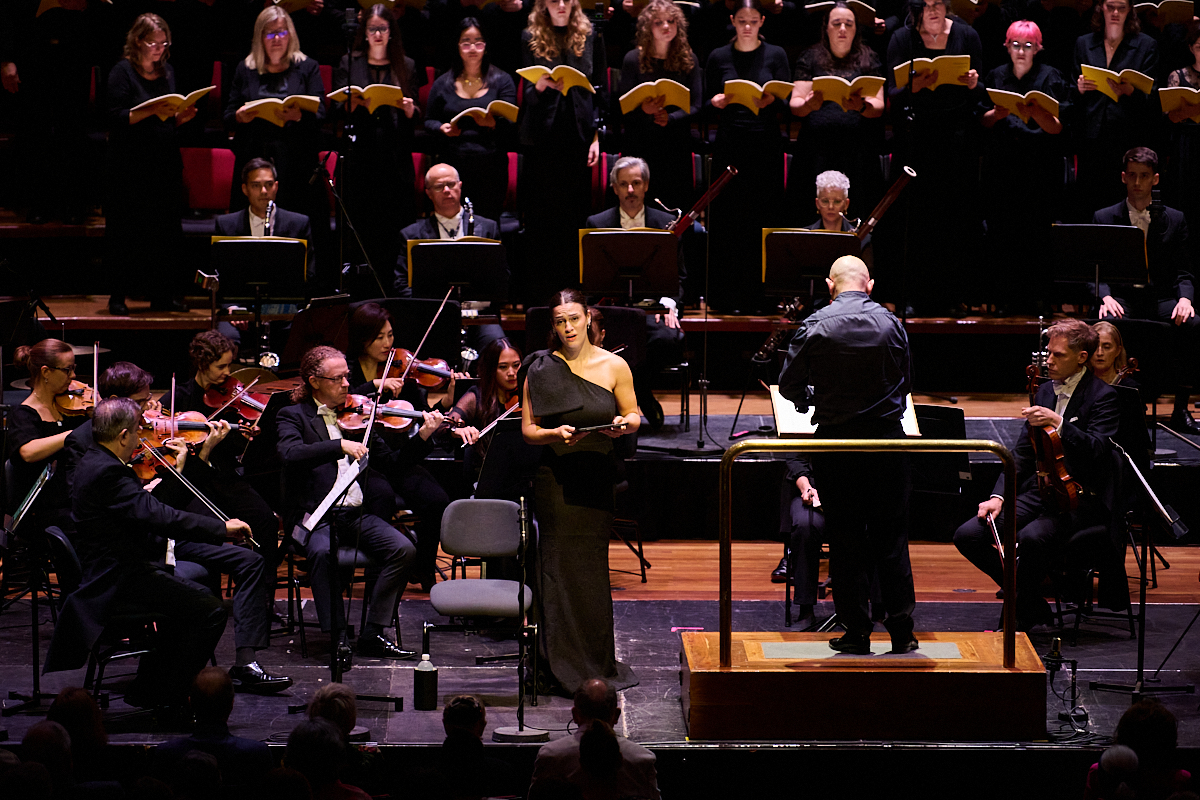
Once again the work was presented through an unusual orchestration. The choir was joined by a soloist soprano, Mia Robinson, as the Virgin Mary, while the organ was joined by a reduced string section, oboes, brass and timpani.
Originally composed to be performed in conjunction with Mozart’s Requiem by the Sydney Symphony Orchestra, unfortunately COVID saw that concert cancelled. Instead, it had its world premiere last year with the Melbourne Symphony.
The most overtly religious in the program, this dynamic and extremely powerful work depicted a range of emotions through an array of orchestral colours. From soft and gentle solo strings to loud and overpowering horns and organ, it would build to a climax and then cut back to a spare duet of solo voice and violin. At times it was spine-tinglingly sensational; at others, almost painfully poignant.
Robinson was riveting, not only in the range of voice but also through her simple presence. In an elegant black gown, with her Latin features and long dark hair, she embodied the stoic grief of the mourning Mary, an evocative and deeply moving performance.
The final element in the work was a pre-recorded voiceover of Mel Gibson reciting various traditional prayers and the final verses of the Stabat Mater. Speaking in Latin through a very deep, gravelly voice, this was the one aspect of the work that, to agnostic ears at least, did not really work. Maybe for the Catholics in the audience this grounded the music in a specific religious ceremony, but to those outside the faith it added a strained note, more heavy metal and sci-fi than sacred.
The piece ended with a simple unaccompanied choir: Amen.
Despite the voiceover, this extraordinary work richly deserved the standing ovation it received.
Yet again, WASO extended its audience and drew in a different demographic. Typically people dress in finery for a night at the symphony, more suits and gowns than jeans and polo shirts, but not so for this show. The audience were more like a church congregation, relaxed and casual in their appearance, the common touch. It was as though they’d been drawn to the sacred side of the occasion as much as the grandeur of the music.
It’s admirable the way WASO programs its concerts to appeal to different sectors within the community. By doing so, it effectively earns its keep as one of the state’s major cultural institutions.
Its Easter concert in Winthrop Hall was an extraordinary, rich, and deeply moving performance of three sublime contemporary works. The sacred side of the human spirit is alive and well and being nurtured by fine creative souls.
IAN LILBURNE
Photos by Rebecca Mansell