
Review: The Space Lady at Buffalo Club
The Space Lady at Buffalo Club
w/ Andy Burns
Saturday, January 17, 2026
There was something quietly affirming about the crowd gathered at the Buffalo Club—a warm spill of outsiders, eccentrics and the gently disobedient, the kind of people who had opted out of a bigger, shinier pilgrimage elsewhere in Fremantle.
As thousands of patrons coughed up $180 to see Nick Cave performing on a colossal purpose-built stage at Fremantle Park, The Buffalo Club quietly resided at the opposite end of that equation. It’s one of Fremantle’s functioning counter-spaces—a venue that still backs punk shows, strange bills, and unprestigious sincerity. Which made it the right place for The Space Lady. Less spectacle, more communion.
Opening proceedings was Andy Burns, promoter as much as performer, stepping onstage in a slim suit despite the humidity—salaryman chic with a self-aware grin. He launched straight in, puncturing an upbeat ’80s backing track with guttural hocking sounds, the bodily intrusion cutting through plastic cheer. Whether it was an emulation of Japanese businessmen hawking spit onto the sidewalk or simply a deliberate rupture, it set the tone: bodies don’t disappear just because the backing track is clean.
Songs veered from taut propulsion (Roadrunner) to tender absurdity, including a heartfelt number about a neighbour’s cat, Colby. Burns’ earnestness flirted with exposure rather than irony—crooning, shifting registers, pulling out Roy Orbison harmonies against the track. There was something affecting about watching him bleed it out like a man who’d sung these songs into too many karaoke mirrors.
Then The Space Lady arrived—and the room tuned in.
For readers unfamiliar with her legacy, The Space Lady (Susan Dietrich) has been quietly doing this work for decades. She began busking in the late ’70s, spending decades on the streets of Boston and San Francisco supporting her three children, hid her family around Mount Shasta to avoid the Vietnam draft—and when her accordion was destroyed, she didn’t replace it. She recalibrated. Casio reframed everything.
That history matters, because her aesthetic choices are political ones. No breath, no strain, no visible effort—just signal. Where the accordion’s roots sound in folk lineage and labour, the Casio imagines a future scaled to the individual: domestic sci-fi rather than spectacle, intimacy rather than awe. She doesn’t perform songs so much as transmit them.
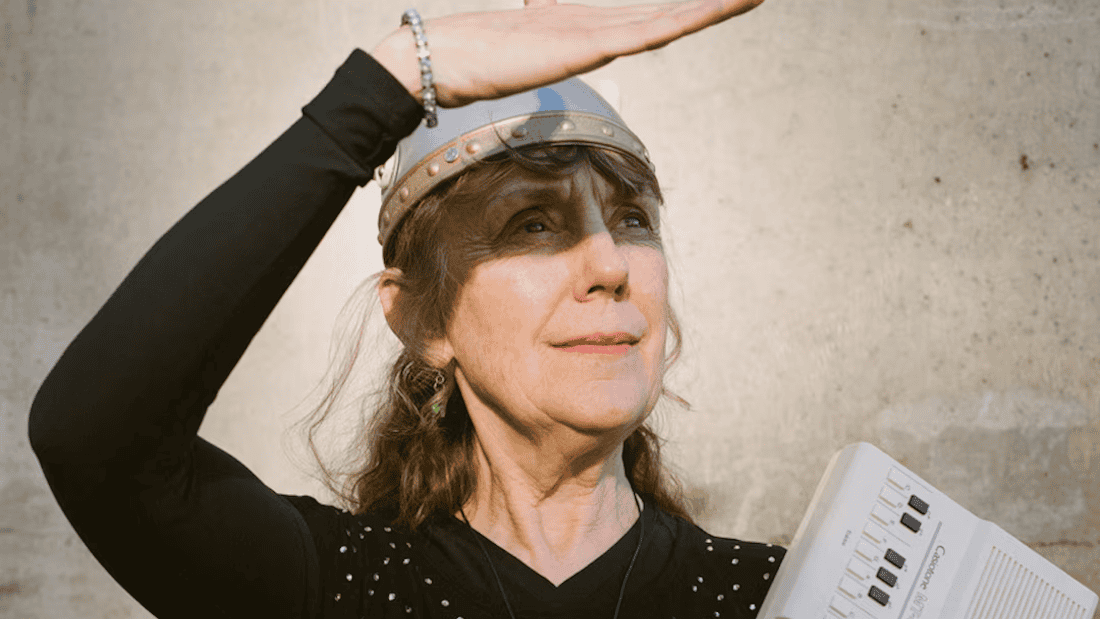
Helmeted, winged and metallic, she appeared less like a performer ascending and more like a signal tuning in. The iconic silver headpiece—somewhere between an Asterix comic and the messenger god Apollo—glinted beneath the lights. A red bulb blinked intermittently. “That means I’m thinking,” she smiled, immediately dissolving any mythic distance.
She opened with Strawberry Fields, fragile and floating. Her delivery throughout was strikingly unembellished—matter-of-fact, almost stubbornly plain. A shout rang out—happy birthday. She’d turned 78 at her Adelaide show the night before. The room erupted. “You make me feel 28 again,” she smiled.
Her outfit was threaded with fairy lights, a portable night sky. Yet there was no cultish aura. She kept returning to the room—talking, laughing, checking in. “I’m not actually from space,” she said at one point, to a knowing laugh. “As you’ve probably surmised, I’m an old hippie.” The persona didn’t collapse; it clarified. This wasn’t escapism. It was an invitation.
On the Electric Prunes’ I Had Too Much To Dream Last Night, her falsetto hovered over the Casio MT40’s spacey organ tones, so light they felt in danger of drifting away.
“I think I died and went to heaven in Australia!” she declared. “You read me, and I read you. We’ve got a cyclical energy going on here.” It didn’t sound rehearsed. It sounded earned.
She spoke openly about her tools: twenty instrument sounds, but only six drum beats—waltz, swing, slow rock, rock, samba, and pop. Constraint not as limitation, but as ethic.
Ghost Riders In The Sky was introduced via a childhood love of ghost stories and folk music in Colorado—the “good old Divided States of America”—tipping the room into immersion, with audible glee at a Rawhide-reminiscent groove. From cowboy songs to an Indigenous song referencing the Modoc people near Mount Shasta and her original tune, Captain Jack, she framed folk not as myth-making but truth-telling. Another original, Synthesise Me, blissfully synthesised the Space Lady credo: mesmerise, harmonise, humanise.
“Are you ready for my heavy metal number?” she teased, hitting a sped-up drumroll button and launching into Born To Be Wild, with a shout-out to “Captain Jack and all the rest of us who refuse to be tamed.” There was innocence here—a genuine belief that rock and roll might still make something happen. The exit drumroll felt like being gently sucked back into the spaceship.
Later came I Wonder, a quietly devastating anti-war song, and Major Tom, played on her “secret” mini Casio VL-Tone—marketed originally as a calculator, she noted—the Peter Schilling song continuing where Bowie left off. The sci-fi framing wasn’t fantasy so much as solidarity: a way of making contact safer and intimacy possible.
Even her commitment to covers, decades in, reads as a choice rather than a limitation. Singing other people’s songs asserts connection over authorship and transmission over ownership. These aren’t interpretations designed to elevate her above the material; they flatten the hierarchy, meeting the audience at eye level.
By the time she closed with Patti Smith’s Because The Night, luminous and unforced, the room felt collectively held. “The feeling is mutual,” she said, simply.
In a moment when live music is increasingly priced beyond reach and intimacy is sold back to us as a premium experience, The Space Lady offered something else entirely. Not politics shouted from above, but practised at ground level. Where spectacle asks for reverence, she asks for eye contact—and in doing so, reminds us that connection itself is a radical act.
CAT LANDRO