
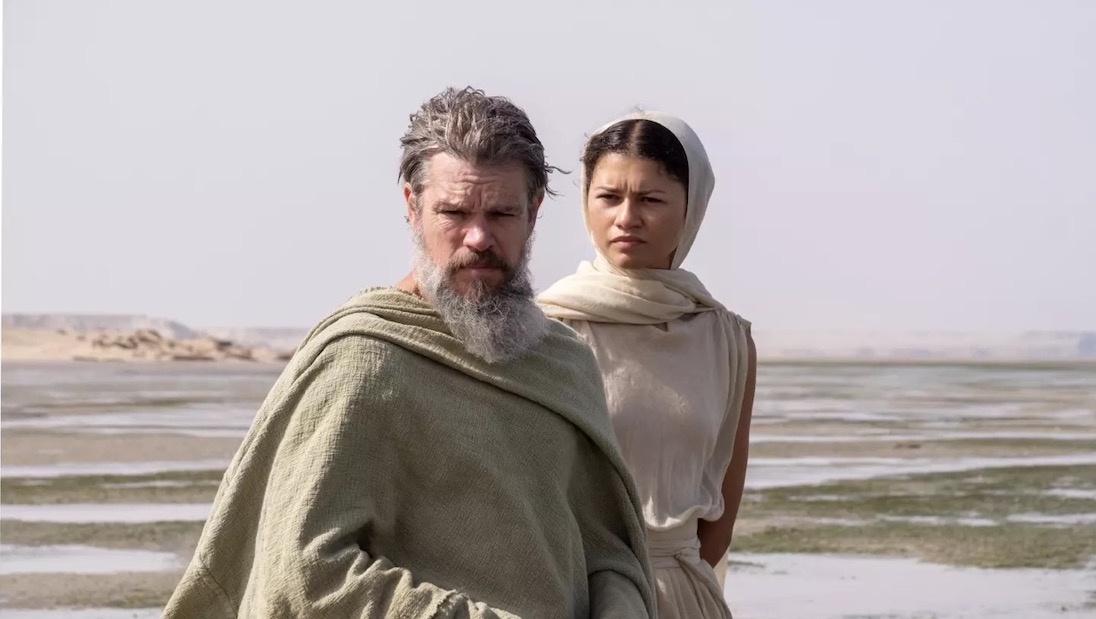
Review: The Odyssey – Bard to the bone
Directed by Christopher Nolan
Starring Matt Damon, Tom Holland, Anne Hathaway, Robert Pattinson, Zendaya
8/10
It’s ten years since the end of the Trojan War, and the wise general Odysseus (Matt Damon) has not returned home. His abandoned wife Penelope (Anne Hathaway) is beset by suitors, while his son Telemachus’ (Tom Holland) very life is endangered by the very same men, as they lust after the crown of Ithaca. Meanwhile, a stranded Odysseus begins to remember his adventures and his tragic losses as he starts to fight against the fog that’s clouded his memory.
It’s brave, almost to the point of hubris, to adapt one of the oldest stories known to Western civilisation and to place your name next to Homer for a screenwriter’s credit. Still, Nolan tackles this in his usual fashion, with a deft (almost clinical) eye for shot composition and a narrative given added complexity by its jumbled structure. The Odyssey is a work of tales and memories, starting with a bardic account of the Trojan War given in the halls of Ithaca, as Penelope and Telemachus are besieged by suitors. We learn of Odysseus through stories and memories, accounts that are disjointed and unreliable, mingled with regret and guilt. That it is a work of myth is built into this story’s bones.
This is immaculately brought to the screen by some stunning production elements. Although not historically accurate, the design has a verisimilitude in the context of the film, especially with the more mythological elements. There’s a genuine attempt to integrate these parts into the whole that leans towards horror, with a reliance on some practical in-camera effects to really help sell the illusion. It’s a stunning attempt that feels like a continuing part of an English directorial tradition. A successor to John Boorman’s take on Le Morte d’Arthur in Excalibur, or Terry Gilliam’s take on Baron Munchausen’s tales in The Adventures of Baron Munchausen, The Odyssey is beautiful and stylish, and maybe a little flawed.
Where The Odyssey is adrift is in its themes. Is it about survivors’ guilt, PTSD, regret, the erosion of civilisation through war, the depths to which desperation drives us, determinism, or the power of myth? The answer is “yes”. The Odyssey tries to nail all the themes to the mast and a boatload more as well. The original story is a rambling narrative examining humanity’s power in determining its own destiny in defiance of the gods, celebrating a sly hero attempting to trick fate, even as he fails. Although this plethora of themes is not adequately explored by the film, in the moment it feels like enough that they are touched upon.
The main cast choice is also something of a low point. It’s a stable of actors that the director is familiar with, but none of them bring the gravitas needed to be outstanding in the parts. Robert Pattinson is probably the best of the major cast, playing a scheming suitor with malevolent glee. The rest are merely satisfactory, but that’s faint praise in comparison to the work around them.
Finally, we should mention the soundtrack. Nolan is often reliant on his scores to carry the emotional weight of his film, so much so that the choice of sound mix has often been criticised. Here’s no exception, and Ludwig Göransson’s composition is up to the task. Littered with ancient instruments and rousing choral work, it is the perfect companion to the stark and surreal imagery on screen. Powerful and sometimes overwhelming, it fits Nolan’s signature style.
A masterpiece, but a flawed one—this is certainly the stuff of legends.
DAVID O’CONNELL