
Review: The Captive – Man of La Manacles
Directed by Alejandro Amenábar
Starring Julio Peña, Miguel Rellán, Alessandro Borghi, Fernando Tejero
7/10
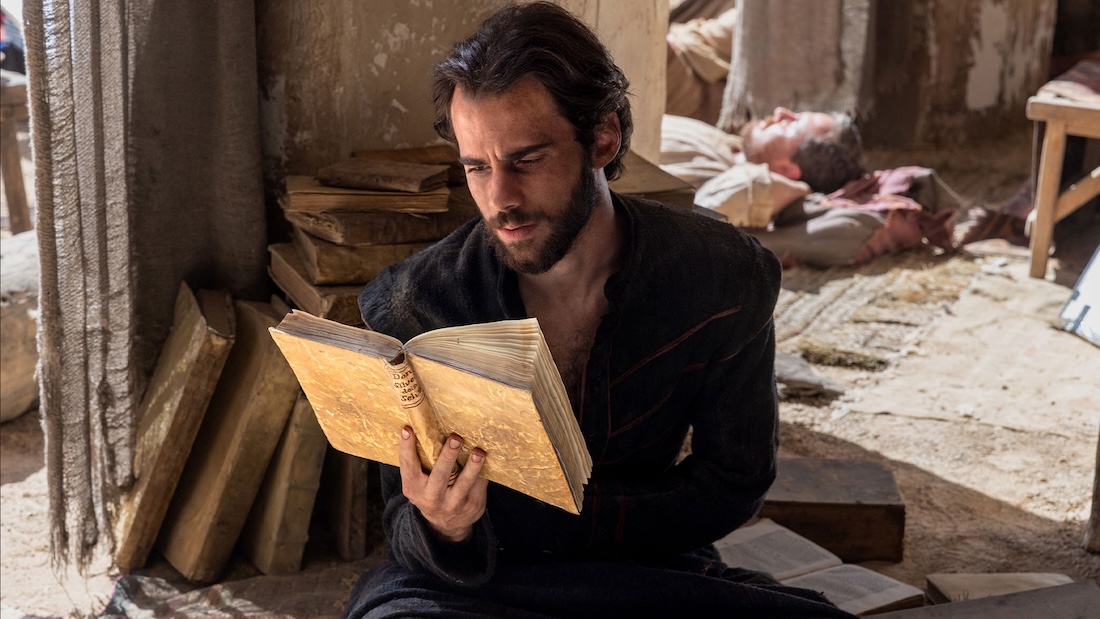
Miguel de Cervantes (Julio Peña), sporting a lifeless left arm following the battle of Lepanto, finds himself imprisoned under quite brutal and oppressive conditions in Algiers among his fellow Christians in 1575. While many gather hoping to have their ransom paid, Cervantes impresses writer and priest Antonio de Sosa (Miguel Rellán) by skilfully editing and improving his manuscripts. With some encouragement, he soon begins to make use of his gifts as a storyteller, entertaining and sustaining both himself and his fellow prisoners with tales that offer a fleeting escape from the city and their captivity.
With his wildly popular tales overheard by the mysterious Regent of Algiers, Hasán Bajá (Alessandro Borghi) holds the orator’s fate in cruel precariousness but finds himself desiring further entertaining tales and more from Cervantes, granting him privileges, and when his stories please the Regent, freedom to roam the city. During these reprieves, Cervantes discovers a vulnerable and alluring underground of outlawed sexuality hiding inches from religious oppression and certain death.
Reuniting with cinematographer Javier Aguirresarobe (who worked together on The Others and Agora), he and Amenábar conjure images on an intimate scale, which invites us behind closed doors and into hidden realms of forbidden pleasures. The Captive grants us a fascinating perspective of the undercurrent of homosexuality under the Islamic scrutiny of the Ottoman Empire, and regardless of how dubious you might be regarding the film’s portrayal of Cervantes’ sexuality, the idea itself is worthy of exploring, especially within the dangerous parameters of this oppressive time and place. The existence and indeed survival of these communities and the individuals who form them is one of the more surprising facets explored in this film.
Amenábar seems determined to tell a personal story and leans into some of the more speculative areas of Cervantes’ early life, whilst striving to get everything else right where he can to ground the film, with varying degrees of success. However, at times the film can feel a shade too polished for any subsequent displays of brutal, raw realism. Some of the foreshadowing imagery of Cervantes’ Don Quixote novel feels a little too heavy-handed, but the oratory storytelling scenes, which blend reality with fiction, work really well and lend the film an enjoyable level of mistrust, where we can’t be sure if our captive hero is living in a real moment or running with a wild and bold fiction of his own design.
Treacherous holy man Blanco De Paz (Fernando Tejero) really generates some great tension among the great cast of captives who hang desperately on the end of Cervantes’ stories. This great supporting cast really lends a charm to a film which at times seems at risk of being a shade conventional. It grazes past promising themes surrounding coerced abjuration, explored more effectively in films such as Martin Scorsese’s Silence, but never seems to hold onto them long enough to go somewhere more compelling. With that being said, The Captive still manages to shine a light on a time, place, and moment of historical significance that seems to have been neglected in our stories, and it’s great to see it handled by a director who always delivers something worth the price of admission. The Captive is pretty easy to recommend, especially for fans of “El manco de Lepanto” or anyone with a passing interest in history.
JOHN HOLDCROFT
The Captive plays as part of the 2026 HSBC Spanish and Latin American Film Festival at Luna Leederville and Luna on SX. Tickets are on sale now from lunapalace.com.au