
Review: The Altar Boys – Children carrying adult burdens
Directed by Piotr Domalewski
Starring Tobiasz Wajda, Bruno Błach-Baar, Mikołaj Juszczyk, Filip Juszczyk
8/10
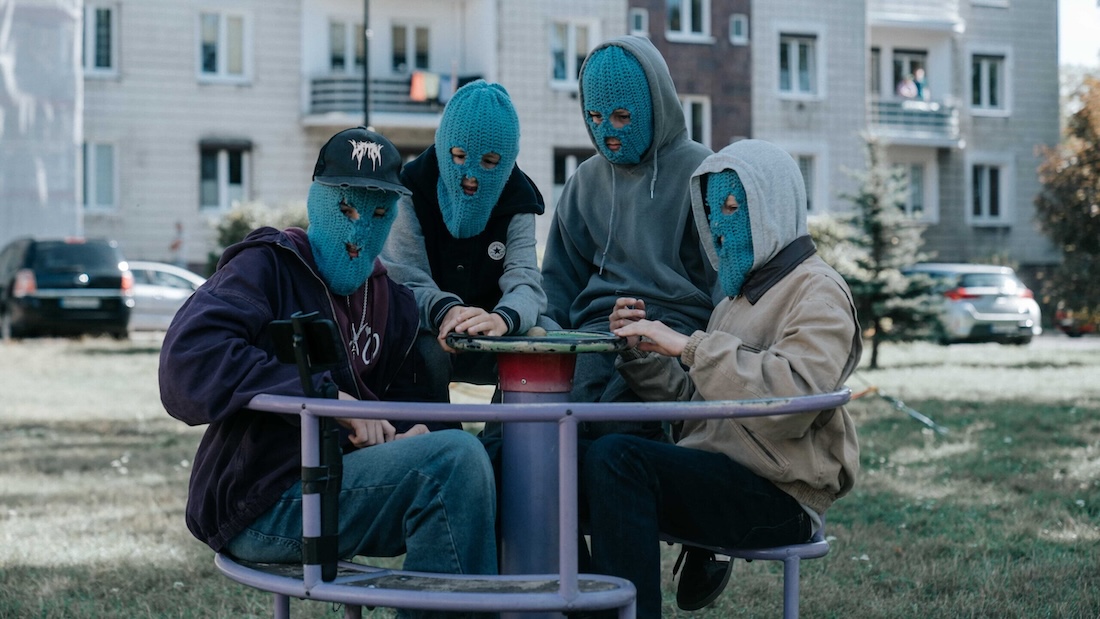
Their blue woollen hats should be funny. Pulled over the boys’ faces as improvised disguises, they belong to childhood games and grand plans made with friends. But the children wearing them are confronting domestic violence, poverty and emotional neglect. Their playfulness makes what follows harder to bear.
The Altar Boys follows four teenage altar boys frustrated by the distance between the values preached in their parish and the suffering around them. They install a listening device in the confessional and turn its revelations into a mission: help those in need and punish wrongdoing.
There is something of Robin Hood in their redistribution of church wealth to struggling parishioners. Yet the comparison also carries an uncomfortable question: why must children deliver the compassion that the institution should already be practicing? The film’s mischievous premise and youthful energy might give it a comedic edge, but there’s much more going on beneath the surface.
The boys’ naïve disguises keep reminding us how young they are, even as their mission draws them into situations demanding adult judgement and protection. There is affection in their friendship and ingenuity, but little comfort in watching them assume responsibilities that others have abandoned. “God rewards the good,” the boys announce as they distribute money, but their conviction proves to be as dangerous as it is touching. They take the obligation to help seriously, while the adults around them offer explanations, limitations and excuses. Yet deciding who deserves help—and who deserves punishment—places a power in their hands that compassion alone cannot teach them to use.
Listening in on others’ live is also an intrusion, and it sees them slip towards judgement and punishment—their good intentions do not make their methods harmless. Children trying to correct injustices begin exercising a power they are poorly equipped to handle, and the adults’ failures have left them without reliable guidance. That reversal of responsibility is most painful in the story of a boy who feels unloved by his mother and takes on the task of making her happy—the wider mission to rescue the community acquiring an intimate counterpart. At home, too, a child is trying to repair something an adult should never have made his responsibility, and his longing gives the film a sadness that its playful moments cannot disperse.
The most challenging part of the film to accept is the severity of the ‘lesson’ imposed on the boys. Their compassion offers little protection from cruelty, and the consequences fall heavily on them. The film’s harshness is powerful, but it’s difficult to reconcile how much suffering the children must endure for it to make its point, with little hope to be found in the outcome.
For Australian audiences, no familiarity with Polish Catholic life is necessary to recognise the underlying message of The Altar Boys. Families and institutions teach children to be good, caring and responsible, but what happens when children take those instructions seriously in a world where adults do not? The Altar Boys deserves attention for making that question difficult to dismiss. Its youthful mischief may invite laughter, but what lingers is the burden beneath it: children attempting to put the adult world right, and facing the consequences.
KASIA ELLIS
The Altar Boys screens at Luna Leederville on Sunday, November 1, 2026, at 6:30 pm, as part of the 12th Polish Film Festival. Buy your tickets here.