
Review: sitting, screaming at The Blue Room Theatre
sitting, screaming at The Blue Room Theatre
Saturday, January 31, 2026
A full house for the final night of sitting, screaming carried a charge beyond Fringe enthusiasm. This was theatre that trusted its audience to sit with discomfort, ambiguity and care—and, crucially, trusted its own craft enough not to flinch.
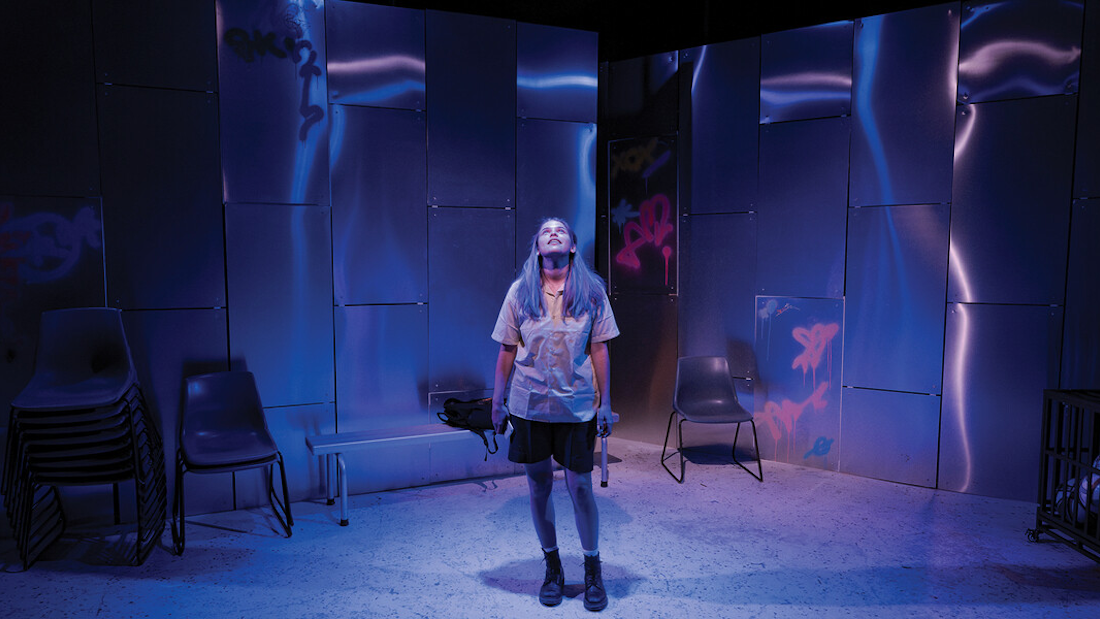
The stage established its world immediately: stacks of plastic chairs, a metal bench seat, and a cage of sports balls. Public high school, coded in efficient shorthand. In this space slouched Sam (Helena Cielak), with blue-streaked hair, a schoolbag slung with defiant familiarity, and disdain barely contained. From the outset, the production’s writing and staging signalled strength through detail rather than declaration.
Sam’s opening exchange with a school guidance counsellor unfolded as a ritual of institutional banality. The conversation drifted, circular and faintly concerned, while small grotesqueries crept in: beetroot caught in moustache hair, casual expressions of disgust, and the word “grotty” landing with quiet cruelty. The laugh it prompted was uneasy, recognition eclipsing humour.
It soon became clear that the show’s structural gamble was also its greatest strength. Written by Madelaine Nunn, the script allows every secondary character to live inside Sam. Best friend, parents, teachers, classmates—all emerged through Sam’s internal narration, physical shifts and sharply calibrated vocal pivots. The effect was novelistic: first-person, densely observed, and saturated with adolescent specificity.
Friendship dynamics flickered into view with particular acuity. An umbrella became an accidental marker of growing up, later echoed when Sam trudged home through torrential rain without one, clinging stubbornly to the idea of not becoming the adults around her. Such motifs were never underlined; they returned only when emotionally necessary.
Short scenes were stitched together with pulsing EDM interludes—youthful, contemporary, threaded with unease. Mic squeals and overlapping chatter evoked a school assembly. Into this environment stepped Mr D, a seemingly feminist teacher whose attentiveness felt like relief after a parade of oblivious adults. He noticed. He listened. He said the right things.
Running alongside this was Sam’s family life, rendered with devastating tenderness. Her father’s prostate cancer was handled without sentimentality: “Too much wanking,” her mum quipped—a perfectly timed comedic release valve amid the heaviness. Her dad shrank, in Sam’s words, to “a small raisin on the couch,” smelling of cream cheese and the inside of a suitcase. These domestic details grounded the work, refusing melodrama in favour of specificity.
Cielak’s control was astonishing. She moved seamlessly between interior monologue and external dialogue, between huge vocal projection and near-stillness. A schoolyard fight exploded into sound and movement, then collapsed abruptly into silence. The spectacle ended; the consequences lingered. A panic attack sequence—light tremors, piercing high-pitched sound—was deeply affecting, recognisable in its physical truth.
Under Lucy Clements’ direction, the grooming emerged gradually and without sensationalism. Late-night emails. Boundary crossings framed as care. Flattery delivered as insight. “I can see that you’re strong.” Authority did the rest. The coercion peaked quietly and devastatingly when Sam was manoeuvred into apologising for a violation she did not initiate. The audible gasp from the audience said everything.
The production was unflinching but careful. It allowed space for Sam’s confusion, her loneliness, and her need to be held. A self-inflicted wound became a literal offering of vulnerability. Later, rumours about another girl snapped into focus; the failure of solidarity among teenagers mirrored the failures of the adults meant to protect them.
The work refused easy resolution. Institutional responses circled uselessly. A fantasy of justice briefly appeared only to dissolve.
And so sitting, screaming closed with deafening quiet: Sam beside her best friend, a gentle hand resting on another. Solidarity without spectacle. Sitting, without screaming.
This was an exceptional piece of theatre, if not this reviewer’s highlight of the entire season: not just for its extraordinary solo performance, but for its writing, direction and stagecraft, all in precise, devastating alignment. Nothing here was accidental. It celebrated neither suffering nor survival narratives. The work merely asked to be witnessed—and trusted its audience to do so.
CAT LANDRO