
Review: Satu Vänskä’s Mozart w/ WASO at Winthrop Hall
Satu Vänskä’s Mozart w/ WASO at Winthrop Hall
Friday, April 11, 2025
Satu Vänskä is an extraordinary musician. Finnish, though born in Japan, where her family lived until she was ten, she began playing violin at age three. As a teenager she studied in Finland and Germany before joining Yehudi Menuhin’s Live Music Now Foundation. She is now Principal Violin with the Australian Chamber Orchestra (ACO) and the director/frontwoman/violinist/vocalist with the ACO-Underground, an electro-acoustic ensemble AKA ‘Satu in the Beyond.’
Last weekend Vänskä was guest director/conductor for the WA Symphony. In pared-down chamber orchestra mode (strings with occasional brass, wind and harpsichord), the show was mainly Mozart (Symphony #21 in A and Violin Concerto #3 in G), capped by two shorter pieces, Olivia Davies’ Crystalline and Lili Boulanger’s Of A Spring Morning, and tailed by Luigi Boccherini’s Symphony in D minor, The House of the Devil. Set pretty well in reverse chronology, 2018-1918-1772-1775-1771, the concert was effectively a journey back in musical time.
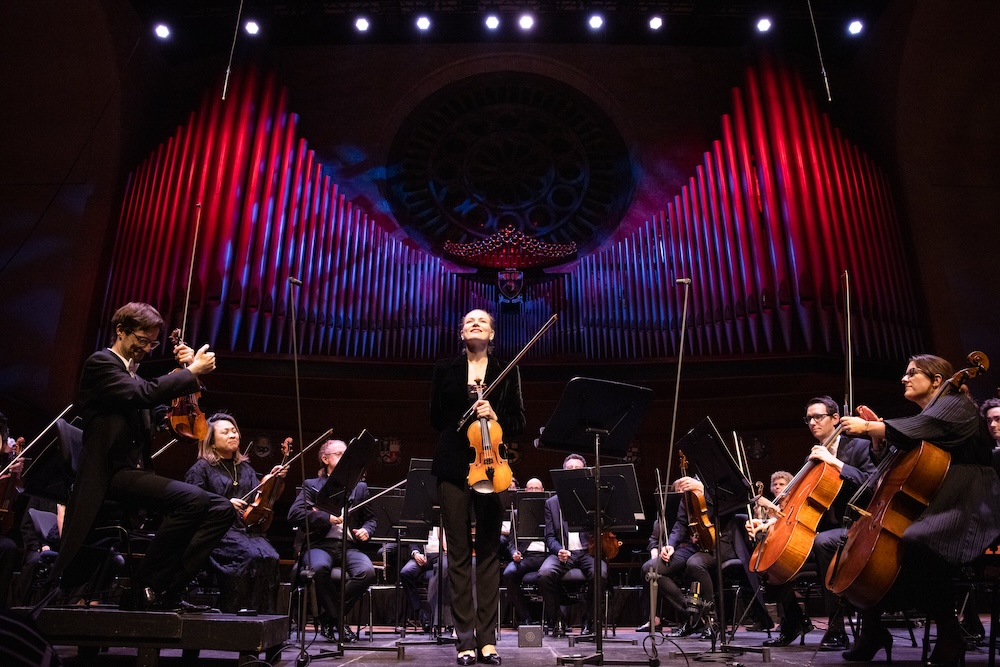
Vänskä bristles with spritely energy—you could feel it from the back of the hall as she glided onto stage. Standing in the centre circle, without a podium, her bow as baton, she briskly launched the strings-only orchestra into Davies’ startling contemporary composition.
Inspired by the process of crystal formation, Crystalline began with an isolated phrase on the celli, a short single bowed swoop that echoed into silence and then repeated. Gradually the violas joined in, extending the swoop into a fuller phrase. Next were the double basses, and finally the violins. Ethereal, angelic, the short piece quickly congealed into esoteric minimalism, a warm Steve Reich-like pulse. Then, in the same order, one by one the instruments dropped out, forming a symmetrical arc with the violins alone at the end repeating the opening phrase a register up. A concise statement: reflective, haunting, striking in its evocation of the now.
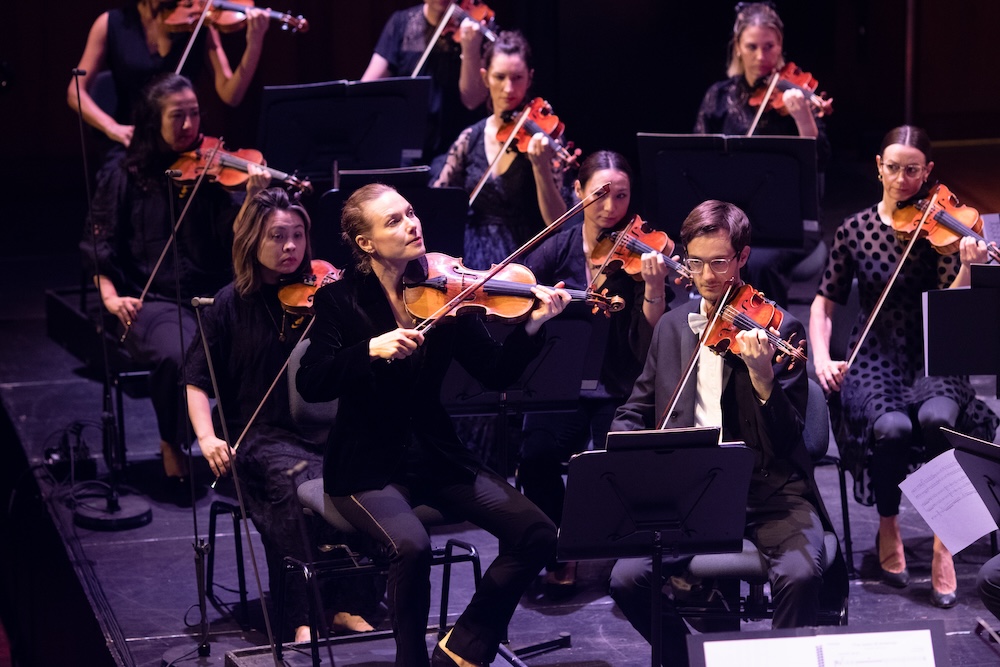
The Boulanger that followed threw us back into the heady days of high modernism. Equally innovative and of its time, the strings were enhanced by a single bassoon and two each of flutes, oboes and French horns. As the additional players took to the back row, Vänskä took up her Stradivarius and sat in the front row of violins.
Lili Boulanger was the younger sister of the legendary composition teacher Nadia, who included among her more than 250 students Aaron Copeland, Philip Glass and Quincy Jones. Lili died tragically young in 1918, within a year of composing Of A Spring Morning. A prolific artist who could have further shaped the course of twentieth-century music, she was lost to tuberculosis at age twenty-four.
Spring Morning begins and ends on an abrupt flourish. In between, the flutes soar over ‘crunchy’ violin chords, a full array of pizzicato strings, and a warm bed of woodwind, flutes and horns. Darkly romantic and melodious, reminiscent of Claude Debussy, it was the type of music Alfred Hitchcock might have used in one of his psychological mysteries, a Rebecca perhaps.
At the end of the piece, while the rest of the ensemble re-tuned, the two oboists exited the stage.
The Mozart symphony that followed was rich and elegant, brimming with melodic ideas, and strangely evocative of the movement of water. Wave-like surges pulsed darkly throughout, as though Mozart might be looking forward two hundred years and imagining what it would be like to go body surfing. Still, like much of his work, the perfection washes over you. Everything fits so perfectly together, every note on every instrument in just the right place.

It’s hard to get your head around the fact that not only was Mozart sixteen when he composed this symphony, but he’d already written twenty of them. By the time he was twenty, partly on his father’s admonition to keep up his violin practice, young Wolfgang had also composed six violin concertos, of which the third is rated among the finest in the genre and still regularly performed.
In our world, we think of sixteen-year-old boys as strumming their first guitar in between surfing and chasing girls, and we idolise artists like Stevie Wonder, Steven Winwood, and Michael Jackson, who at that age had written and performed a handful of catchy tunes. But their achievement pales in comparison to this. Granted, in 1772 the symphony had not become the pre-eminent musical form it has been since Beethoven got his hands on it and was more akin to a significant short story than a major novel, but it was still way more sophisticated than even the very best pop song.
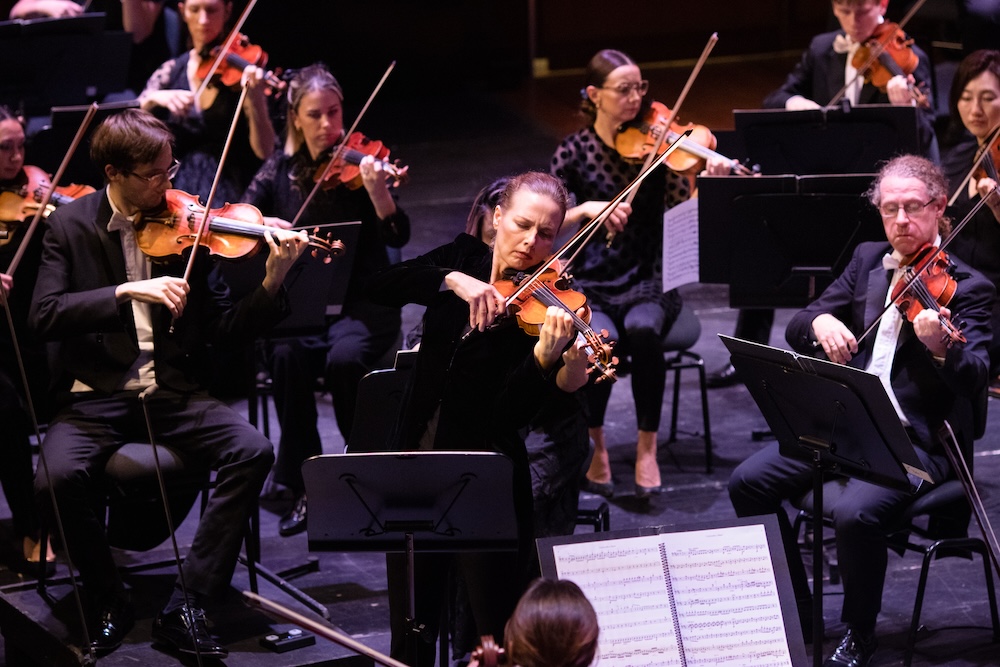
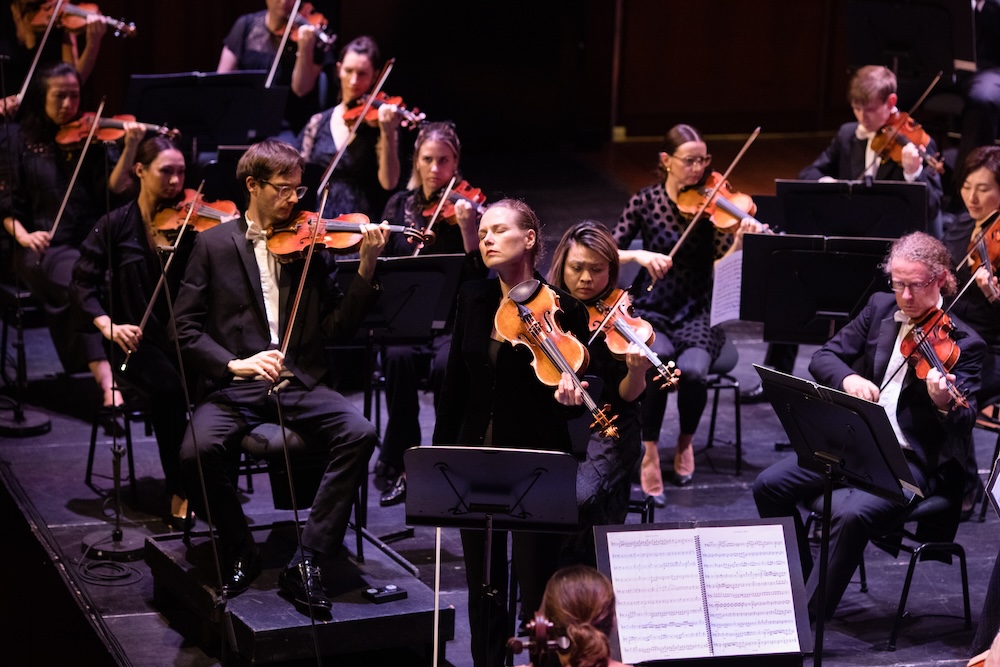
Throughout this symphony’s performance, especially in the final movement, Vänskä bounced in her seat as she simultaneously conducted and played. She would rapidly finger an intricate line, wave her bow to lead the band, then deliver another run of frenetic notes. Accustomed to the ACO, where only the cellists sit, it seemed her instinct was to jump to her feet. She simply couldn’t sit still. Her energy was infectious.
But, even though it was jolly and youthfully joyous, perhaps his first truly great symphony, the 21st doesn’t have the same playfulness you find—or rather hear—in Mozart’s mature work. In his later years he became a great joker. Once attuned to him, his outrageous juxtaposition of instruments, timbres, and melodies can be laugh-out-loud funny. WASO demonstrated this superbly last year when, under the baton of Fabien Gabel, they performed the Elvira Madigan piano concerto and Symphony #39 in Eb major.
After the interval, the program moved onto Mozart’s violin concerto.
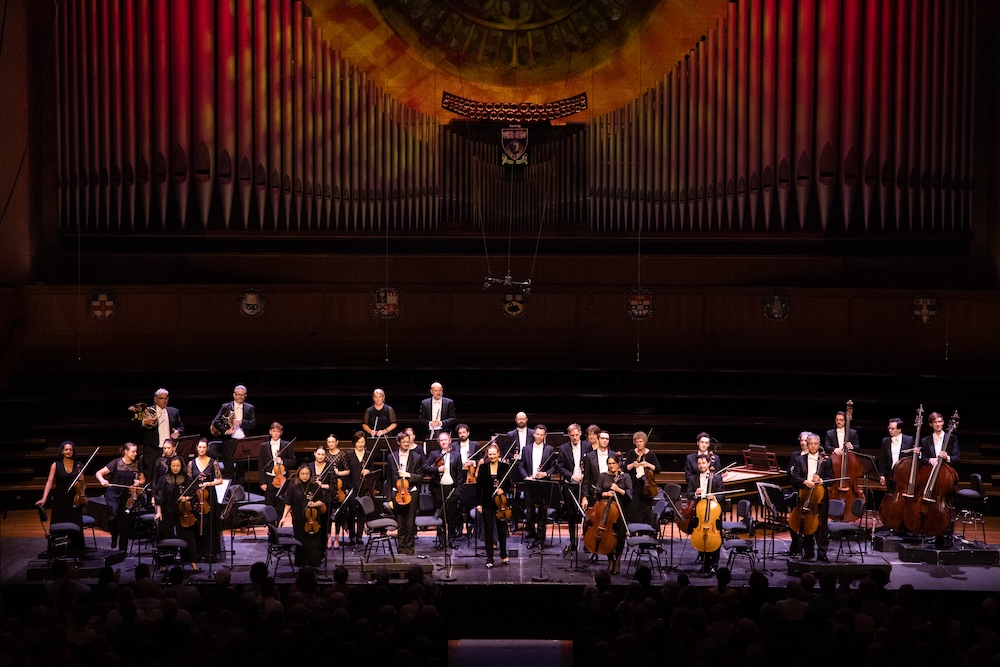
It’s been said that Mozart could play anything on the violin. After seeing Vänskä deliver the sensational solos in the first two movements of this by turns powerful and extraordinarily delicate work, one suspects she can too. Best, as soloist, she was finally able to stand up and play—or rather stand up, sway and play. In the final movement she seemed to conduct by dancing.
The first solo, with its virtuoso flourishes and impossibly fast runs, seemed to prefigure the frenetic playing of Paganini and the spine-tingling solo in Beethoven’s only violin concerto. The second movement’s more delicate solo was, alas, interrupted by an audience member kicking over their glass—the second show in a row where this has happened. (Drinking and wooden floors don’t mix.) Still, it didn’t throw Vänskä and was but a minor glitch in an extraordinary performance.
At the end of the work, Vänskä swiftly left the stage, could be glimpsed through the opened stage door taking a quick sip of water, and then, to stomping feet and the odd whistle, returned for her richly deserved curtain call.
The concert ended with Luigi Boccherini’s once widely played symphony. An Italian composer who spent much of his career in Spain, critic Stanley Sadie has claimed, as quoted in David Garret’s program note, that Boccherini was ‘the chief representative of Latin instrumental music during the Viennese Classical period.’ Garret goes on to say that this included ‘some of the emotional stress associated with the ‘Storm and Stress’ movement … [and the] sensuous, pliable Latinate quality of his melody and harmony.’
Pushing thirty when he composed The House of the Devil, the work both looks ahead to the intensity of the nineteenth century while echoing strongly the mood and textures of the preceding Baroque era. The melded second and third movements were strongly reminiscent of Vivaldi’s Four Seasons, especially the furious flourish of strings that opens Winter and the occasional spiccato bowing. In some ways it seems that the four seasons were run together in one sweep.
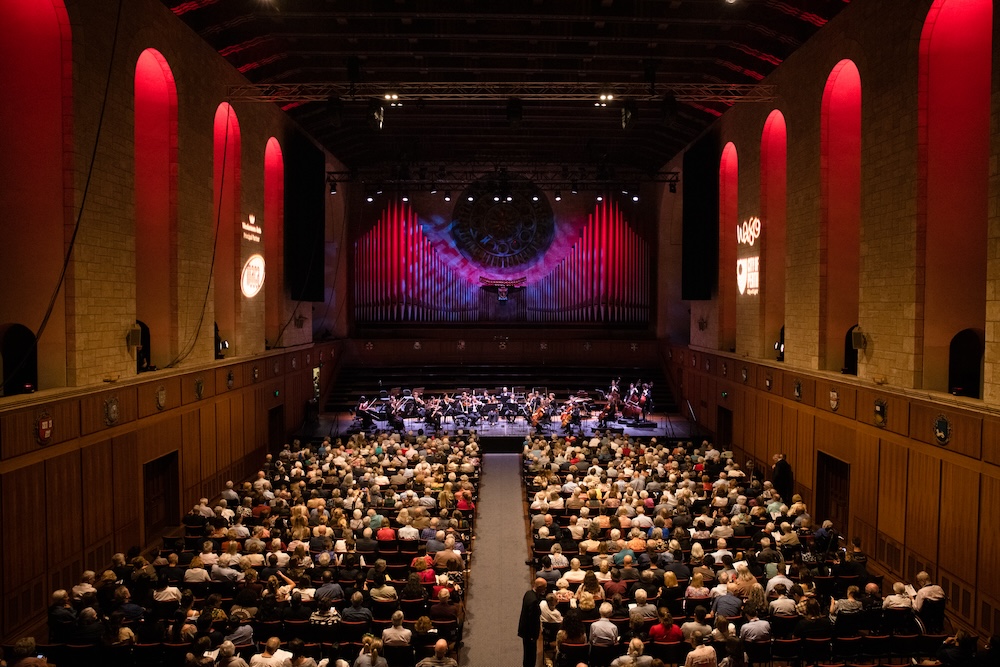
Joined by the harpsichord, the music was heavier and grander, in the nineteenth-century tradition, yet more subtle in its playfulness. The devil’s house portrayed seemed richer and more human than you would expect, more like earth than hell.
The symphony ended to thunderous applause and three curtain calls.
Of the five works, only the Violin Concerto has previously been performed by WASO. The other four were WA premieres. Vänskä is to be complimented for introducing Perth to these extraordinary pieces and delivering all five with such verve and charm.
The orchestra, as always, was exemplary, showing yet another side of its collective virtuosity. It’s amazing to think that the rehearsals only started on Tuesday and they had but two full days to master such intricate and haunting works.
The house Friday was nearing full—a mainly older audience peppered with hipsters, young women, the odd politician (aren’t they all?) and one little cherub in silver ballet pumps and a plastic tiara who sat on her mummy’s lap. One wonders what music was formulating in her young head after hearing such a fine concert composed primarily by young people.
Uplifted, it was glorious to walk out of Winthrop Hall to find rain and a thunderstorm. It was almost as though the magnificent music had provoked a change of season.
IAN LILBURNE
Photos by Daniel James Grant