
Review: Haribo Kimchi at State Theatre Studio Underground
Haribo Kimchi at State Theatre Studio Underground
Thursday, February 19, 2026
Jaha Koo’s Haribo Kimchi is a delightfully full-flavoured theatrical experience; a deeply meaningful performance that belies its playful confectionery exterior. Performed at the State Theatre’s Studio Underground as part of Perth Festival 2026, the Korean director and actor’s show wove together complex themes of cultural identity and the concept of home with such an articulate deftness that even the most emotionally moving scenes maintained a sense of the performance’s overarching sugary lightness.
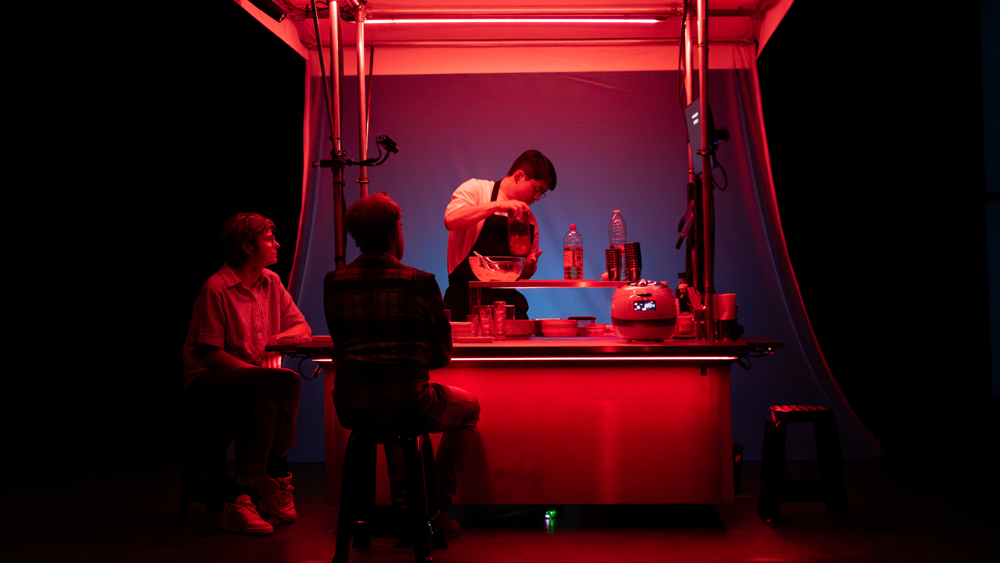
The show commences with the red neon glow of a pojangmacha, a traditional Korean street-food stall, positioned centre stage. Serving as the production’s base of operations, the stall anchors the onstage actions to Koo’s identity, even as the surrounding TV screens and non-linear narrative whisk the audience away across the globe. This strong and very visceral connection also adds to the performance by grounding Koo’s wildly imaginative excursions. The constant visceral symbol of the stall means that even the most absurd moments are consumed while tethered to reality.

And the stall, and its food production, are as real as theatre can be. At the top of the show, Koo enacts the role of owner-vendor of the pojangmacha, unpacking the stall and readying the tools of his trade before launching into the preparation of authentic dishes with rhythmic precision. As he is cooking and plating, Koo speaks to the audience with a mild-mannered, unassuming grace. This manner is disarming, and his pacing seems to suggest that he is completely unaware that he is actually in the middle of a high-concept stage production.
To further the act, Koo breaks the fourth wall by inviting two audience members to sit at the counter to dine on the food he has prepared. He settles the pair in with a smile and small talk; there is even a bit of raw awkwardness when he mishears one of the new diners, but he is able to level this fledgling relationship with the offer of his signature drink: a potent blend of beer and sake. Watching him pour the crisp lager into the rice wine as he cooks the entree on the griddle with the practised flair of a street-side artisan, Koo establishes his care for the audience and imbues a communal intimacy with not just his diners but the theatre as a whole.
However, such culinary theatre is more than just a demonstration of skill and rather a vehicle for the exploration of the play’s themes. Speaking in Korean, with English subtitles placed above the pojangmacha, the stage fades to dark as TV screens come to life with the view of a city below from a plane’s window. Detailing his experience of leaving home, Koo focuses on instances where food and culture intersect and explores the emotional impact that these had on him. Suddenly, the lighthearted banter of the kitchen gives way to the stark, often painful experiences of Koo recounting the sad and often tumultuous times one faces when one leaves their roots behind.

It is as the performance progresses that Koo begins to truly reveal his uniqueness as both director and performer. Allowing his imagination to run wild, Koo is joined on his journey by a cast of unlikely companions: a snail, a Haribo gummy bear and a toy robotic eel, all of which can sing. These characters bring the inner mind of Koo to life; their appearance on the show’s TV screens grants them a literal depth and width. The songs they perform are like playful, psychedelic day-dream vignettes, and far from serving as mere distractions, they are able to deliver a deep emotional impact to the performance due to their outwardly childlike and friendly appearance.
While the sight and sound of an auto-tuned gummy bear candy singing a guitar-riff-heavy, K-pop-influenced number about finding peace in the chaotic world of a migrant may sound surprising, there is a genuine sweetness to such a performance as executed by Koo. Anchored by the real-life pojangmacha, these avatars articulate the show’s heavier themes of racism and loneliness in a way that an adult human could never, while additionally preventing the show’s topics from becoming too overbearing or didactic.
It is these whimsical, surrealist moments that ultimately draw the entire odyssey together. By finding a unique voice, Koo is able to transform his lived experiences into a shared, melodic celebration of cultural persistence that is ultimately irresistible to bite down on. Haribo Kimchi is a work that understands the palate of human emotion and recognises that the bitterest truths are often best served with a side of whimsy.
MICHAEL HOLLICK
Photos by Bea Borgers


