
Review: Buddy – Your friend until the end
Directed by Casper Kelly
Starring Delaney Quinn, Cristin Milioti, Topher Grace, Keegan-Michael Key
8/10
What if the ’90s live-action kids’ show Barney and Friends was a nightmarish horror? Well, it kind of already is, but if it was intentionally scripted as such, you’d get Buddy. Director Casper Kelly brings us the latest in twisted horrors, drawing on childhood imagery (such as Imaginary, Child’s Play, or Puppet Master), but this film certainly injects new blood into the genre.
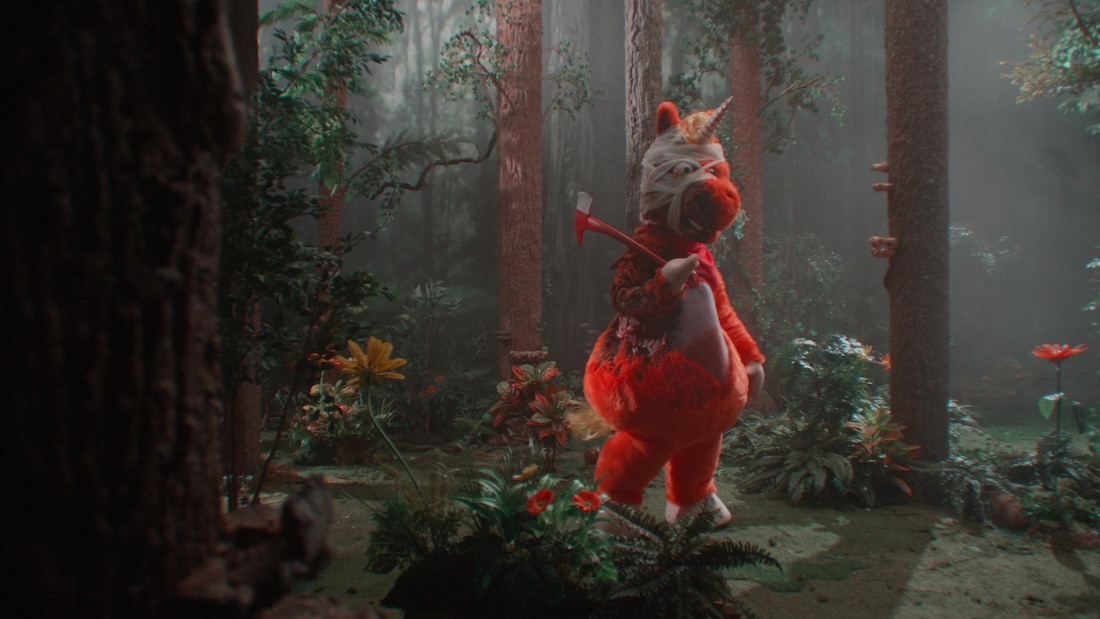
Four kids live in a house with a yard and call upon their magical stuffed unicorn toy Buddy (voiced by Keegan-Michael Key) to become real and help them solve their problems and teach them about life, all by the end of the first episode. However, as the episodes go on and kids disappear, Freddy (Delaney Quinn) begins to realise that Buddy might not be the affable friendly unicorn he pretends to be, but rather something darker. As the kids seek to escape, the danger they’re subjected to grows. Meanwhile, in the real world, Grace (Cristin Milioti) feels like something is missing from her family and can’t explain the feeling of despair and loss that’s overtaking her until late at night she sees a kids’ show with an orange unicorn, a TV show that doesn’t exist in her world.
Buddy stays with its schtick far longer than you’d expect it to, and it’s absolutely the right decision. It starts off in the format of a ’90s kids’ TV episode and stays with this for a few short episodes while it establishes its setting and threads through a sense of disquiet and menace. When it does break from this format, it still keeps the colourful staged reality. The result is disorienting, as it ramps up the level of gore and violence, but never truly abandons that stuffed toy aesthetic for the more traditional horror ground. The effect creates a greater sense of unease, which is exactly what you expect from the creator of the viral sensation Too Many Cooks.
The other thing that makes Buddy so terrifying is the way it explores real-world issues that are too raw to address directly. It’s certainly poking holes in the culture of toxic positivity and how that can be used for control but also touches on gaslighting, domestic violence and abusive control. Buddy portrays himself as a pater familias, establishing a facade of order so he can generate esteem for himself and the love of his family. When that is challenged, then his attitude is subject to violent change. Yet Buddy goes beyond that, making us question the indoctrination of values into children by TV across almost the entirety of its history.
Its young cast does exceptionally well in covering all aspects of this, shifting from the hyper-enthusiastic and over-earnest delivery appropriate for kids’ TV to terrified and overwhelmed by the carnage happening around them. Delaney Quinn in particular stands out, as she’s put through the emotional wringer in a nod towards the final girl trope. As for the adult cast, Cristin Milioti brings emotional heft as a mother experiencing a sense of loss who’s dragged into this nightmare reality, and comedian Keegan-Michael Key handles Buddy’s swings from friendly authoritarian figure to abusive monster with frightening ease.
Even for some of us who have witnessed the horror of ’90s Australian kids’ TV (seriously, why is EC from Lift Off faceless?), Buddy is terrifying at times. However, it commits to its world and premise, conveying them with an authenticity that makes it compelling to watch, with some great twists and turns along the way.
DAVID O’CONNELL