
Review: Backrooms – Unearthly geometry
Directed by Kane Parsons
Starring Chiwetel Ejiofor, Renate Reinsve, Lukita Maxwell, Finn Bennett
6.5/10
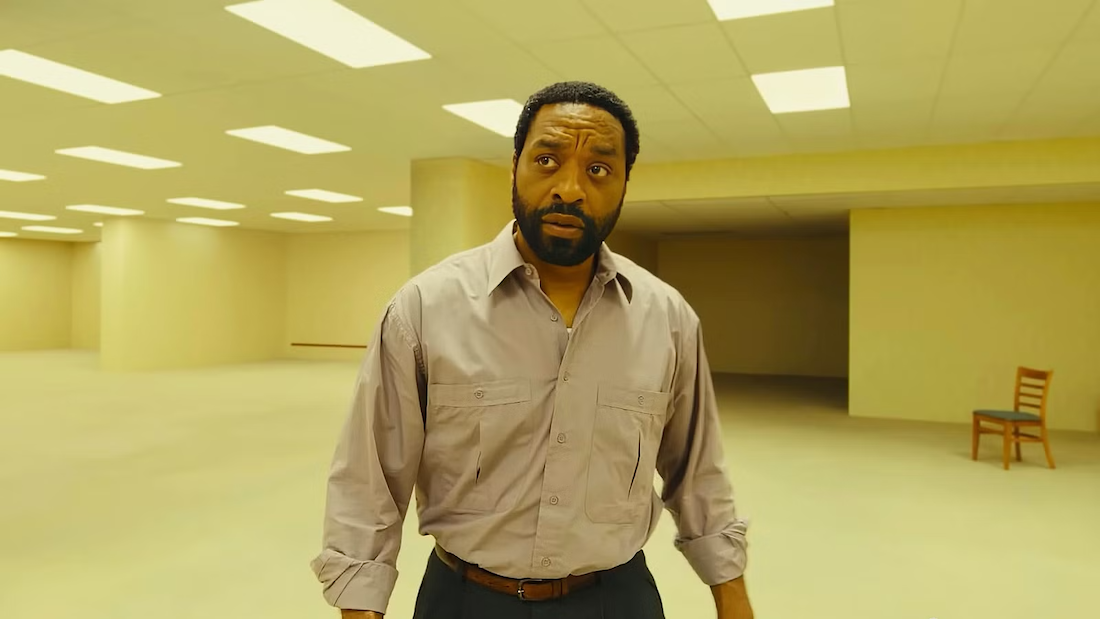
A vast unknowable labyrinthine structure has been lurking in the fears of humankind for millennia. It is the Greek labyrinth, the Arthurian fey woods, a Lovecraftian elder god’s abandoned city temple. This latest iteration adds mildewed carpet, yellow walls, and the buzz of fluorescent lights. Arising from digital folklore, the Backrooms was spawned by a single 4chan post to become a vast trove of internet myth-building.
Director Kane Parsons was responsible for one such stream through his series of YouTube found-footage videos, giving texture to the liminal space. Now he brings that eye to the big screen.
Clark (Chiwetel Ejiofor) is aggrieved by his life. Although he seeks therapy, his divorce, alcoholism, and failing business drag him down, but one evening he detaches from this world and manages to step into another. Intrigued by the twisted megastructure, he becomes obsessed, and when he disappears, his therapist (Renate Reinsve) comes looking for him in the labyrinthine halls of the Backrooms.
It’s hard to judge Backrooms. Personally, I prefer a strong narrative to usher me through a movie, but that’s not the drive of this film. Instead, it skews much of its narrative for tone, atmosphere, and a little soft world-building. However, it is very efficient in this regard, giving audiences an intriguing mystery to immerse themselves in. It might be hard to call Backrooms a great film, but it’s certainly a haunting one. One that sticks in the memory and may well grow in time.
Part of the issue is adaptation to different media and changing expectations. How do a series of YouTube shorts, showing unearthly architecture, translate into a two-hour film? The connective tissue isn’t quite hardy enough to carry the plot; the subtext isn’t substantive enough to make it entirely satisfying.
Yet there is something here. An unsettling series of images and occurrences that stick in the mind, given just enough reality to be disquietening. More so by their unknowable nature, which perhaps points at a solvable mystery and a universal secret.
This is helped by Parson’s eye. The banal but foreboding maze is given a horrid reality with each new room, simultaneously symbolising urban decay via abandoned shopping centres and the architecture of something alien and driven to madness.
Then there are the dual leads of Chiwetel Ejiofor and Renate Reinsve. Both carry so much under the surface. For Ejiofor’s Clark, it is disappointment and rage; for Reinsave’s Mary, grief and loneliness. There’s just enough of a tale there for both to unveil this with a degree of subtlety, elevating the work.
A solid debut and an eerie step into the dreams of a broken divine architect.
DAVID O’CONNELL