
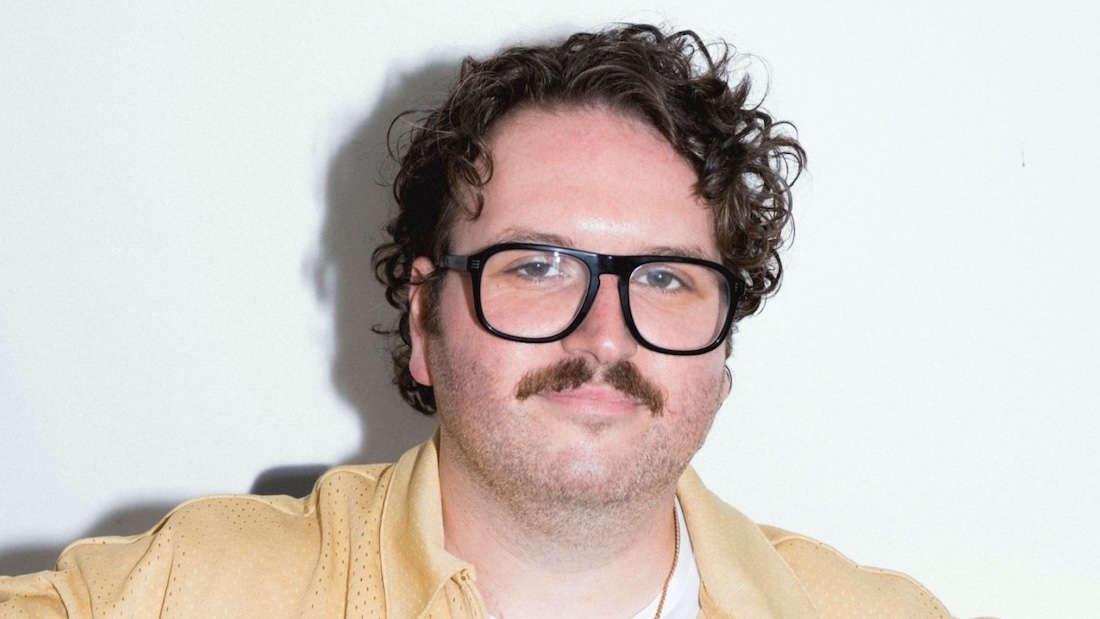
Review: Alexei Toliopoulos – VHS at The Rechabite
Alexei Toliopoulos – VHS at The Rechabite
Thursday, May 14, 2026
Alexei Toliopoulos opened VHS less like a stand-up and more like a man knowingly inserting himself into the VCR. In the seated Rechabite Hall, a vintage “And now for our feature presentation” cue gave way to Toliopovision, framed inside a faux old TV screen, with a Tarantino-adjacent grindhouse riff announcing that film fandom was most certainly on the menu. The nostalgia was daggy by design: not cleanly curated retro, but something fuzzier, stranger and more adhesive.
The stage was simple: a podium stacked with VHS cases, a projection screen behind, and LED strips glowing in genre-coded colours—blue and yellow evoking a Blockbuster-adjacent video store memory, red when the show moved into horror. Segments appeared as digitised tape, embedded with the lag and grain of the medium, suggesting his opening gag about digitising vintage VHS tapes to “evoke nostalgia” may not have been entirely a gimmick.
Toliopoulos himself stayed mostly at the mic with a clicker, not offering much in the way of physical dynamism, but that almost suited the format. VHS was less bodily stand-up than one man giving a guided tour through the over-labelled storage unit of his own brain: a show built around obsolete technology by a man for whom cinema is not a hobby, nor even just a career path, but a full life-organising principle.
He introduced himself, with the right amount of mock self-importance, as one of Australia’s most respected film critics and emergent actors before admitting he had returned to his fallback career: comedy. The gag worked because neither half was quite false. Toliopoulos has built a career from being professionally, alarmingly into movies through reviewing, podcasting and screen-obsessive projects such as Total Reboot and The Last Video Store. This was not film buffery in the casual Letterboxd sense.
As far back as he could remember, he wanted to be an actor. Teenage Alexei kept Robert De Niro and Al Pacino in his Mambo Velcro wallet like holy cards for boys who have seen too many gangster films. His school drama exam involved delivering Alec Baldwin’s Glengarry Glen Ross speech as a sweaty teenager, locking eyes with a 12-year-old student on “You think this is abuse? You think this is abuse, you cocksucker?” He called it his primal wound, which felt fair. Some people have formative romantic heartbreak. Some people have public humiliation via David Mamet.
His true holy site, though, was Video Ezy in Leichhardt: a very woggy suburb, he noted, with the store located in an old church. Almost too neat, really. The video store as chapel, the genre aisles as scripture, the weekly rental as communion. In the adventure section, young Alexei first encountered E.T., later noting that when E.T. began dying, he saw not alien tragedy but prosciutto. For the first 13 years of his life, he explained, he saw the world through the lens of the delicatessen. After that, cinema took over.
This is where VHS worked best: not when movies were treated as references to be recognised, but as evidence of a mind that had no choice but to process life through them. Toliopoulos described watching films as never simply watching the thing in front of him but mentally cross-referencing everything he had ever seen. A bit about Max Richter’s On the Nature of Daylight appearing in Hamnet was longwinded and absurdly specific, landing precisely because of its obsessive detail. This was what it was like inside Alexei’s movie brain: exhausting, over-indexed and terribly impressive.
The romance section took a pleasingly stupid turn. After a soon-to-be ex-girlfriend once told him she did not think movies could be art, 19-year-old Toliopoulos had delved into Wikipedia to examine the culprit: A Walk to Remember. Now, holding the VHS case open as though reading from sacred text, he dragged out the entry well past the point of reasonable comic return. The joke became less about the film than the warped sincerity of early internet plot summaries and the idea that a man could be moved by a movie he had not yet seen.
Horror shifted the stage into red and brought out dreams, nightmares, Greek superstition and the evil eye. A dream about ordering hotcake syrup as McDonald’s dipping sauce was treated with the gravity of divine revelation, while another eerie recounting built towards something supernatural before landing closer to ghost-administered haircut advice. These were not the sharpest sections, but they showed his knack for inflating tiny absurdities until they took on cinematic scale.
The late highlight was a GoodFellas-styled Dendy Direct scam, in which Toliopoulos and a friend stole arthouse cinema streaming vouchers and spent New Year’s Eve entering codes until they amassed an absurd amount of credit. Told like “one last job”, it was gloriously pathetic. The stakes could not have been lower, which only made the gangster framing funnier. When Dendy inevitably flagged the suspicious activity, the empire collapsed with all the menace of a customer service email.
Not every tangent escaped the film-nerd circuit board. There were moments when VHS played most directly to those already fluent in Alexei’s particular sickness: collectors, obsessives, special-interest faithful, and people who hear “4,000 hard-copy films” and respond with either applause or awe. But when he found the personal wound inside the reference, the material opened up.
By the end, Toliopoulos insisted the show was not really about movies but the life lived between them. He closed by returning to Glengarry Glen Ross, delivering the full “ABC” monologue with deliberately terrible actorly conviction before the Max Richter cue swelled back in for the final laugh. It was a neat trick: reframing teenage mortification as grand cinema. For Toliopoulos, movies are not an escape from life so much as the ridiculous, over-catalogued system by which life becomes legible at all.
CAT LANDRO