

Perth’s Radheya Jang draws a winning hand with Trading Cards at Flickerfest 2026
Flickerfest 2026 will be showcasing the award-winning animation by Oscar-qualified and AACTA-nominated Perth filmmaker Radheya Jang. An intimate journey through time, Trading Cards is about a man who travels back to meet his younger self—not in pursuit of adventure, but to trade cards. At first glance, the meeting seems harmless, a nostalgic act of connection. But as the cards pass hands, so too do fragments of innocence, worry-free wonder, and the unblemished spirit of youth. Trading Cards plays as part of Flickerfest 2026 at Luna Outdoor Leederville on Thursday, February 19, with tickets on sale now. BRAYDEN EDWARDS sat down with Radheya Jang to talk about time travel, trading cards, and the educational power of film.
Congratulations on being selected as part of Flickerfest’s 2026 program! What’s the story behind your short film Trading Cards? How did the idea come about, and how has it evolved over time?
Thank you! I was grateful to attend the festival with my parents, and it was amazing to experience the world premiere at Flickerfest together. The film comes from my lived experience with obsessive-compulsive disorder. Many of the ideas in the film I’d been wanting to incorporate into my work for years, and in 2023 these ideas coalesced into Trading Cards, at a time when I was really feeling the effects of OCD.
I had gotten diagnosed with OCD that year and learned a lot about it and realised that I previously had a very narrow understanding of what the disorder was. I hadn’t seen much media about the mental compulsions of OCD, including anxious thought cycles and rumination, and so I wanted to make a film that I would have liked to see.
While the film does mention treatments and the importance of having a support network, I created the film to showcase the horror of uncertainty and to spread awareness to have the disorder feel seen in that way. This is, of course, a creative expression of my own experiences, but OCD is so much broader than the material I present in the film.
I wanted to make a mental health film in a style I hadn’t seen before, in a dark fantasy style that feels enchanting, ominous, and nostalgic. We open with what I believe is a pretty unique version of the OCD cycle diagram, with an ancient symbol of the Ouroboros and the Sun nestled inside, which become recurring motifs in the film.
Did your own interest in trading cards inspire the concept? And was it challenging bringing a concept as big as time travel into a short film?
Yes, my childhood love of trading cards was a driving aspect of the film; when I was little I was obsessed with collecting them. I still have this little black and brown bag full of them. I think there must be over a thousand in there, and the bag actually makes an appearance multiple times in the film!
In adulthood I found myself fascinated by tarot cards, and so the two interests nicely found their way into the film. I found bringing time travel into the film quite liberating, as it presented so many possibilities. I’d never made a film like this, which is so self-referential and features extensions of myself as characters, so it was fun figuring out the look and feel of my other selves in the film and the ways in which they interacted and their differing perspectives that they would have on the world.
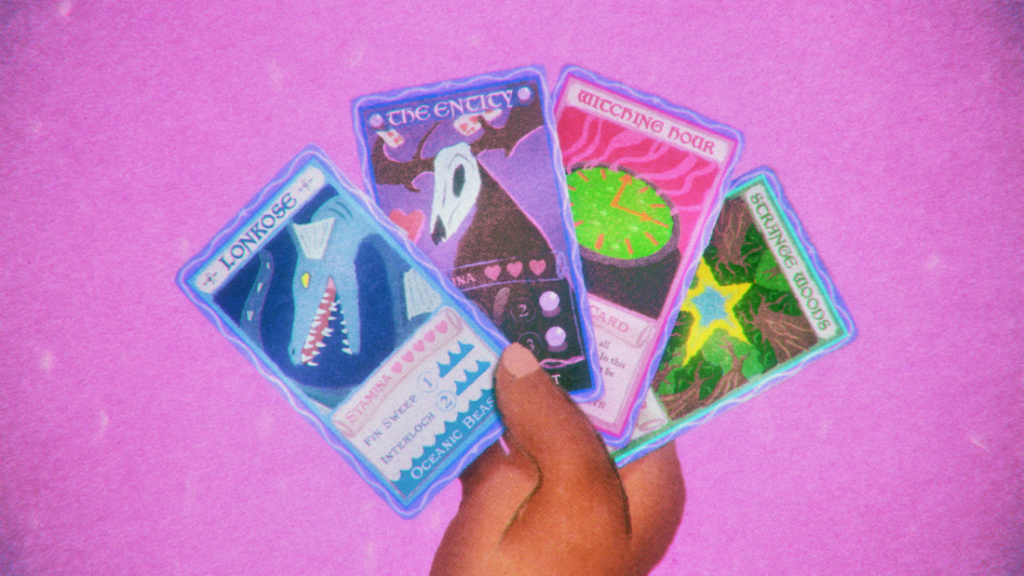
The animation style is very striking—what artists or filmmakers influenced the look and feel of the film? And who else helped bring the story to life on screen?
I was very much influenced by Pamela Colman Smith’s illustrations from the 1909 tarot deck conceptualised by A. E. Waite, and there are many scenes which are directly based on some of these original cards. The traditional woodcut engraving style was also an influence in the ink-outline illustrations and details.
At the time when I started properly writing Trading Cards, I was travelling in South Korea for three weeks as part of the Aporia International Village Film Festival. I felt very inspired and was constantly writing down ideas for the film. Being surrounded by the beautiful traditional Korean architecture was also really inspiring, and I incorporated these visual influences in the film and the identity of the characters, drawing upon my Korean heritage.
Strangely enough, at the same time I was also trying to come up with an idea for the Flickerfest Specsavers competition and was intent on an idea that involved some sort of bot verification test. I didn’t end up using that idea for the submission, but that led to thinking about these slightly annoying puzzles that I often come across in adult life.
I thought about what my childhood self would think if he saw a puzzle that had a 3×3 grid, and I think he’d see that and want to play tic-tac-toe. I thought that was intriguing, and from there I delved deeper into the differing perspectives my adult and childhood selves might have.
I was also inspired by the trailer for Playground by Rodrigo Goulão de Sousa. I love media that intertwines elements of childhood with eerie imagery. This led me to think about what my own interpretation of that might look like, based on my own interests, experiences of childhood, and fairy tales and folktales that had fascinated me for years.
I was very lucky to have worked with an incredible crew that helped so much to bring the film to life.
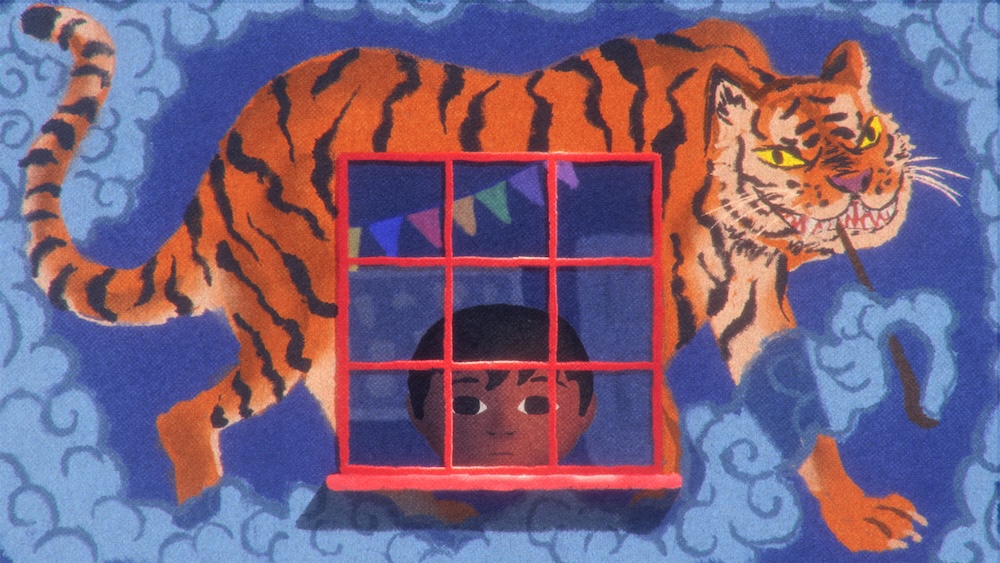
If you could travel back in time to meet your younger self, would you already have an interest in film? What first drew you to the craft as a child?
At the age that I depict myself in the film, I certainly had an interest in the arts and the creative space; my main passions were in drawing and writing stories. At that age I had dreams of becoming an author, and I would start writing many stories that I would never finish. I also loved gamebooks, which were choose-your-own-adventure books but more involved, and I would write my own versions of those in notebooks that could span hundreds of pages.
My love of art meant that I regularly drew. I loved creating creatures and monsters—one of these creatures actually is featured in the film, on one of the fictional trading cards—I smile thinking about what my younger self might think, that his designs are a part of a short film that has screened at a festival like Flickerfest. The style of the characters is inspired by the mediums I drew in throughout childhood.
When I was a little older, at around 11 and 12, I began to grow more interested in creating films and animation and was initially drawn to VFX. I started making short videos on my dad’s laptop using the webcam and would edit together films starring myself in iMovie. From there my love of creating films grew, and my passion for writing stories and creating visuals naturally came together in animated films.
Knowing what you know now, would you give your younger self advice—or would it be better to keep your mouth shut?
I would certainly be tempted to mention a couple bits of advice, but that’s the risk with time travel—you don’t know how that would change the past as you know it.
Despite my mental health struggles, I’ve been incredibly fortunate in many aspects of my life, particularly in having the best parents and family that I could ask for. I’m in a career that I love, and I have amazing friends. In many ways I’m living the dreams of my younger self! So with that to look forward to, maybe it’s better for me not to say anything at all.
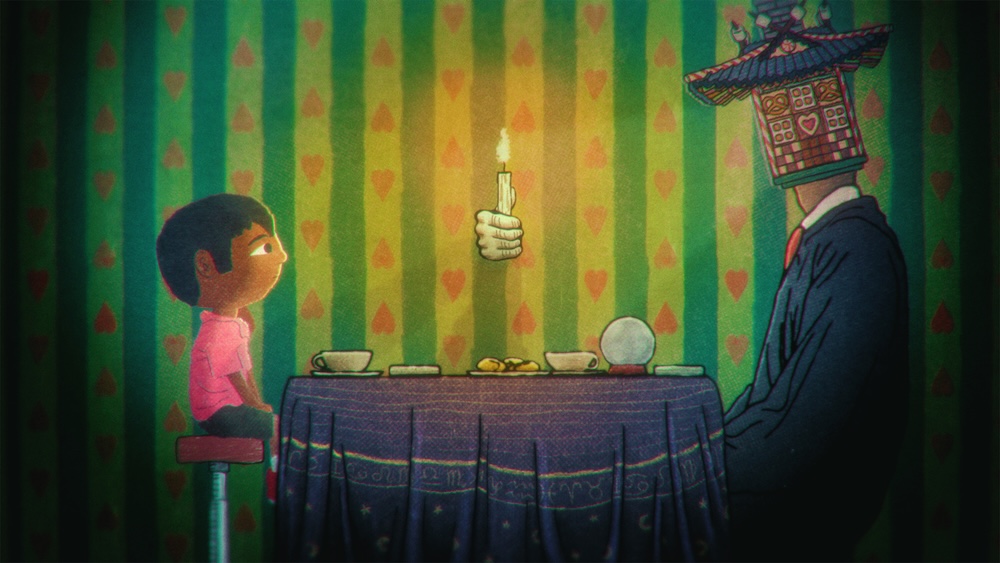
You’ve worked on some exciting ventures, including large-scale multimedia installations and public projects—what have been some of the highlights for you?
Several years ago I got to assist in Sohan Ariel Hayes’ studio in North Perth, working part-time for a couple of years. Working with him was really great. Many of the projects were projection-based, and being able to see the animated work in a physical space felt pretty special.
One of the highlights was helping out on an art exhibition and immersive light installation that was part of the Dandjoo Darbalung Arts Education Project at St Catherine’s College. This involved animating visuals based on artwork created by Western Australian school children influenced by Indigenous Australian art. The visuals were then projected onto large sails in the ceiling at Crown Perth.
Beyond entertainment, you’re passionate about the educational power of film. Do you have any big plans or dreams in this space going forward?
I hope Trading Cards is a film that does help with educating people on OCD in some way. OCD is often trivialised, and by creating a dark fantasy film that speaks on the horror of what living with it can look like, I hope the film helps to spark conversation about the disorder.
I’d love to keep making films that excite me but also have a sense of social impact. Two of my next short film projects that I started creating a few years ago involve championing underrepresented groups on screen, and each film is greatly influenced by each of my aspects of heritage on both sides of my family.
One is a poetic, comedic coming-of-age memoir that highlights the importance of culture, love, and family and involves my South Korean and Japanese ancestry from my mum’s side of the family. Another is a graphic psychosexual horror-thriller about infatuation, set primarily in the nightlife scene of clubs and parties, that incorporates my Indian roots from my dad’s side. I’m really excited about these films.
Trading Cards plays as part of Flickerfest 2026’s Best of Australian Shorts program at Luna Outdoor Leederville on Thursday, February 19, 2026. Tickets are on sale now from lunapalace.com.au