
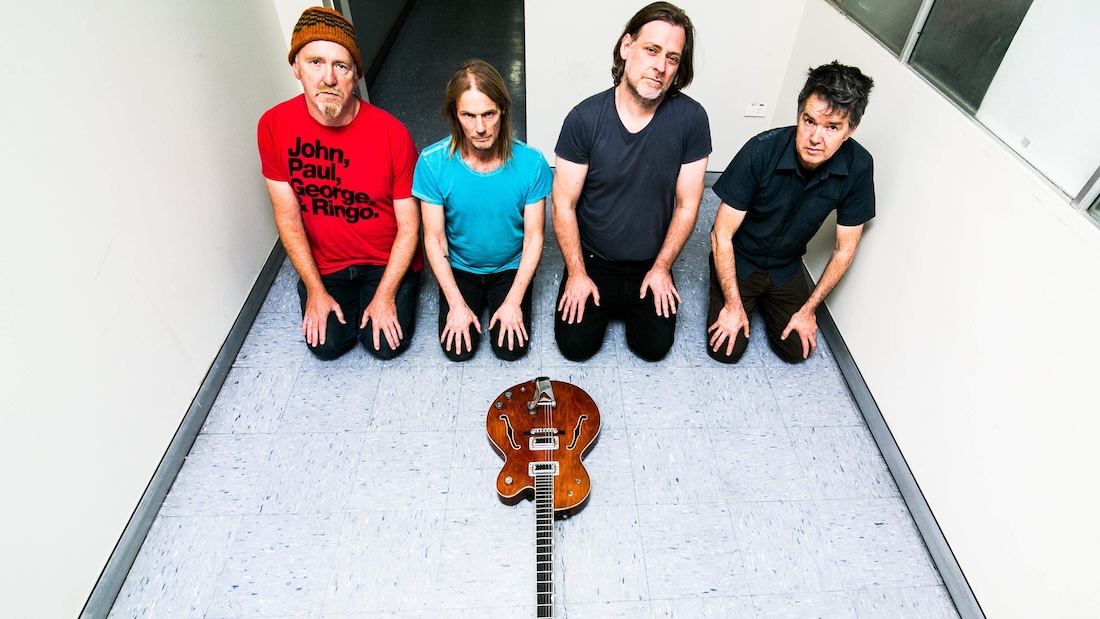
Let’s get physical with Jim Moginie & The Family Dog
As part of their national THUNK album tour, Jim Moginie (Midnight Oil) brings his band, The Family Dog—featuring Kent Steedman and Paul Larsen Loughhead (Celibate Rifles) and Tim Kevin (The Apartments)—to Amplifier Bar on Friday, May 22; The River Hotel, Margaret River, on Saturday, May 23; and Froth Craft Brewery, Bunbury, on Sunday, May 24. BOB GORDON chats with Moginie about the streaming war.
Firstly, congratulations on your portrait being an Archibald Prize finalist; that probably wasn’t necessarily on your bucket list.
No! I’m good friends with Moz (Mostafa Azimitabar), the artist, who’s a Manus Island refugee. He spent seven-and-a-half years out there and then another year in hotel detention in Melbourne, and we became friends. We did a song together; he recorded on his phone in detention, and during COVID, I sort of produced it and made a recording. So we put that out, and then we just remained friends ever since. So it’s been a lovely friendship with him, and meeting someone who’s from Iran, you know, well, now everything’s gone pear-shaped even more. He just had all sorts of terrible stories about the mistreatment in captivity and in detention. But, yeah, he’s a good friend, Moz.
I was watching the documentary about the band, This Is Modern War, in which you referred to the songwriting as ‘slicing and dicing’. What is the relationship between how you wrote over the years with Midnight Oil and how you create songs with The Family Dog?
Well, I think it’s all about getting the result. And there’s many ways to get to the result. I mean, even in the Midnight Oil years, albums like Redneck Wonderland were pretty much slice and dice in terms of them coming out of a jamming process and then sort of editing the bits together into songs. And I think that’s sort of a perfectly valid way of doing it: getting instrumental things, and then that will suggest the lyric and a sentiment. And so that is kind of how we did this one, but albums like Redneck Wonderland have been done like that, and Celibate Rifles albums were sort of done like that, too. A lot of the lyrics were inspired by the sound of the music. There’s many ways to peel an apple, I suppose you could say.
It’s just another way of doing it, really, but it seems to work with this band; the songs just come out of that sort of convoluted process of jamming it, but then you edit it together into a form that’s kind of recognisable. There’s a song in our lyrics and our melodies, so it’s just another way around, another way of doing it, really. I mean, I’ve sat down with a pen and written a song, ‘bang, bang, bang’, and we’re all capable of doing that within the band, but I think for us, it’s a more interesting exploration.
And as well, in the sound of the recording, you get this sort of unguarded quality; we’re actually using the actual things that we jam as the record. So it’s not, sort of, again, from demos; what you’re hearing is actually the raw recording of people playing in a room, not really knowing what they’re doing, and playing in a very unguarded way. So you get this quality to the sound that’s very sort of glued together… the bricks and mortar of it are very lively and full of life.
And in keeping with history, the songs have something to say.
Well, that’s right with the lyrics that are about what’s happening in the world. I think it’s an artist’s responsibility to reflect what’s going on in the world. I think we’ve come from that line of songwriting. It’s something that we do very naturally. It’s just who we are as people. Australia was in the act of becoming; it was a work in progress. That dialogue is kind of what Midnight Oil sort of dealt with along the way, and Celibate Rifles, too. So there’s commonality there, but we’re just pretty bad at writing love songs.
Thunk is available in physical form only. What’s it been like to bring it out like that in the current streaming environment?
Wow. That’s a big question. It’s been great, actually, like, we’ve decided not to put the album on the streaming services, which has been an interesting choice, because it’s sort of going the other way when everyone’s running towards it. But we’re very suspicious of the streaming services and how they’re not paying people properly, and now they’re using AI harvesting to create fake artists that sound like other real artists that are alive. And also investing in actual killing machines in Spotify’s case.
We’re very concerned about that, and it sort of encircles the way everyone can consume their music. You, I mean, you cannot make money if you’re a mid-level independent band from streaming. There’s just no way. So what we’re saying is, ‘Look, if you do stream, go and stream away. But if you really get moved by a record and you love the band, go and buy the physical copy, because that’s the only way you’re going to actually be supporting the band that you love, and then they can continue to operate.’
It’s a very harsh economic climate for bands. They have to go and play live, which is what we’re doing to survive. And all the merch and all the things you buy at gigs make all the difference to bands, to their survival and to their sort of viability with it. So it is a very tough environment with the streaming and the way some of the record labels are going on; majors are sort of on another planet. They’re more into merchandising and not even doing physical product anymore. But people do love their vinyl. People do like their CDs. People do like the cassettes. And it’s doing really well.
So there’s definitely a flow on from this: the consequences of people’s music consumption behaviour. The big companies don’t support local industries. This is a multinational corporation, Spotify, and they’re not putting anything back. They’re just taking mega profits, and so the musicians are getting screwed. People say, ‘Musicians, they love it anyway, they’ll buy for free.’ Yeah, well, they would but all the musicians I know pay rent. No one’s trying to run in Bentleys like these guys are, but it’s the same old thing over time, but now people are going along with it because they don’t think there’s a choice. But we are saying there is a choice. You can put your music up in a physical way. It doesn’t have to be digital; it doesn’t have to be online.
It’s just questioning the whole thing. It’s really just a protest, which I’m good at. I love protesting.
Yeah, we noticed! What happens live with the songs, given how they’ve been sliced and diced in recorded form?
Oh, I have to write the review as well. We kind of shoot from the hip on the guitars, so it’s very raw and both improvisational and melodic. And we skip the light fandango, really, when we play. There’s a few Oils songs, a few Rifles songs we’re playing, and there’s some from our first album, Bark Overtures. So we’re playing original material; we’re not leaning on the nostalgia thing with the music, but we do honour the Oils, especially with the death of Rob Hirst earlier this year. We’re playing a song called The Dead Heart, which he wrote, and various other songs that we’re putting in and changing round.
This is who we are: we honour the music that we play. It’s certainly in the same spirit as those bands, what we’re trying to do. So come along and check it out. Really, we’re just starting off.
Jim Moginie and The Family Dog play Amplifier Bar on Friday, May 22; The River Hotel, Margaret River, on Saturday, May 23; and Froth Craft Brewery, Bunbury, on Sunday, May 24, 2026. Jim Moginie will also appear at Planet Books Mt Lawley from 6.30pm on Thursday, May 21, to sign copies of his memoir, The Silver River.