Embark on a wild musical journey with The Pink Priestess and her Cosmic Flaps
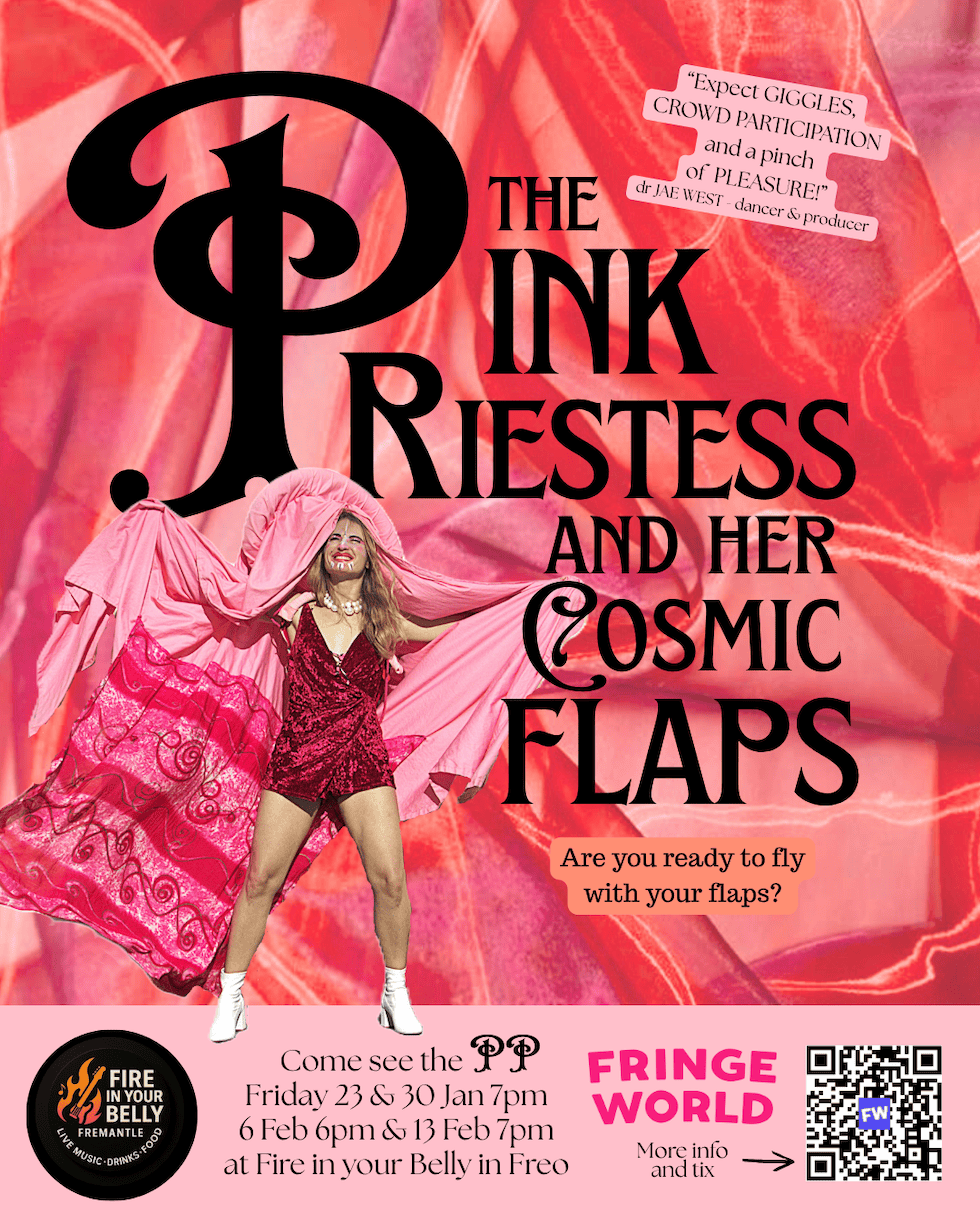
A Fringe World feature at its finest, the new show The Pink Priestess and her Cosmic Flaps offers to transport audiences on a wild musical journey of ‘mystical pussy power’. The Pink Priestess and her Cosmic Flaps will beckon audiences into the pink hood of the Belly of the Beast at Fire In Your Belly from Friday, January 23, to Friday, February 13, with tickets on sale now. BEC WELDON sat down with creator, producer and artist Marion Stietel to talk about her emotional and empowering show ahead of its debut season.
Hey Marion! Thanks for joining me to talk about The Pink Priestess and her Cosmic Flaps! It’s impossible not to be at least a little bit intrigued when a show has such an interesting title! What can Perth audiences expect from the show?
My ideal version: deep belly laughter and inspired reflections. But even without enlightenment or catharsis, audiences can expect a refreshing, funny and musically rich show—groovy songs, strong vocals, and ideas that challenge social norms, delivered by a captivating multidisciplinary performer. The show is for people who love personal growth, divine feminine energy, embodied wisdom, and intelligent humour—sapiosexuals of all countries get reunited! It especially speaks to recovering people-pleasers, ‘good girls’—most women were raised as good girls—and anyone curious about the intersection of emotions, sexuality, spirituality and healing.
This is your debut Fringe show. Congratulations! As a multidisciplinary artist and creative therapist, what drew you to create and present this show?
Everything! Everything drew me to make this show. I think very holistically, and dressing up as a giant vulva is a way to touch on many different topics all at once; my ADHD brain loves that!
This show comes from a deep desire to be seen and heard. My parents weren’t able to, but rest assured, I have done enough self-work to also perform for you, the audience, and not just me. I am sharing how important it is to take into consideration your nervous system, because this is a relatively new thing in the world of healing and understanding of the human body.
I survived life as a child and young adult thanks to people-pleasing, or fawning. This means that I would avoid conflict at all costs and typically abandon myself to ease tension and keep the peace. I couldn’t say ‘no’ or ‘goodbye’. I felt guilty to exist and to take up space. I wasn’t able to feel and express joy. Trauma robs you of your capacity to be playful and joyful.
I was raised as a good girl. Don’t ask for help, don’t show emotions, work hard. Silent and pretty. Never ugly, but never sexy either. I couldn’t handle being the centre of attention, let alone ask for it. Shame was so deep in my bones, it was hard to move my hips back and forth in public; it felt like my pelvis was stuck in a glass barrier. I couldn’t celebrate any of my achievements and many other symptoms, like crippling perfectionism, painful procrastination and constant self-doubt. And the worst part: I blamed myself for it.
Learning about nervous system responses like freeze and fawn changed everything. I realised these behaviours weren’t personal failures—they were survival intelligence. Instead of blaming myself, I began to move, dance, and reconnect with my erotic life force. That thawing process has been deeply uncomfortable but profoundly freeing. This show shares that journey—not as therapy on stage, but as an embodied invitation to feel, laugh, and reconnect.
It sounds like you’re a cycle breaker! There’s a real shift in thinking there.
I see myself as a paradigm shifter—one of many. After years of embodied research and therapy, I’m learning to set the tone in a room instead of adapting myself out of existence. That process is still vulnerable and uncomfortable, and I take audiences along for that ride.
What inspired you to feel that sense of responsibility for change?
As a child, I was deeply dissatisfied with how society relates—to emotions, to bodies, to power. I went on a long search for meaning, truth, and identity. Over time I realised I can’t save the world—I can only save myself. And paradoxically, that’s how real impact happens.
My relationship with myself is the foundation. That’s why the show holds paradox so tightly: human and divine, sacred and sexual, playful and profound. I love paradox—the closer something is to contradiction, the closer it often is to truth.
That’s interesting, and how does that manifest in the show?
The Pink Priestess and Her Cosmic Flaps feels like offering my baby to the world. It brings together edgy topics—genitalia, divinity, emotional neglect, nervous system education—and not everyone will like it. That alone makes it excellent practice for a recovering people-pleaser.
The show blends storytelling, singing, dancing, humour and improvisation. It’s raw and structured at the same time. As the Pink Priestess says, “No cringe, no growth.”
What does the show mean for you as an artist?
Looking back I can see that this show is a lot like a formal coming out as an artist and human being. I’m like, ‘Hello world, here I am: a sex clown!’ A mystical revolutionary! A bisexual woman! A flow artist who likes to flirt with the divine.
It’s a celebration of how far I have come as a recovering people-pleaser, and to inspire others to keep going, it is worth it. It is worth facing the grief, rage and confusion. I share gold from the pain of growing out of the conditioning of being a good girl raised in a home where we never expressed emotions.
This is my humble contribution to the shift we need to do to survive. And it might sound simple and easy, but really it is deep and life-changing. I want to scream on rooftops and into everybody’s living room to be gentle with yourself. Gentleness is the fastest way to grow.
In the show, you embody both Mazzamour, a recovering people-pleaser, and The Pink Priestess, a big walking vulva—can you tell me about those characters and your relationship to them both?
Mazzamour and The Pink Priestess is a physical representation of the duality that lives inside all of us. The Pink Priestess is holy and sexy, a divine mother and a whore, serious and funny, all-knowing and a nutcase. Mazzamour is the human side of me. The shitty limited human self, if you want. The side of me is bound to ‘reality’, a limited body who needs to eat, shit and sleep. Afraid, overwhelmed and overthinkingly caring. A duo representing the paradoxical duality of life: a sexual and holy goddess and a quirky, weird & insecure human, Mazzamour.
Holding both is powerful. Power only works in relationships, which means being seen—something that once felt dangerous to me. This show lets audiences witness that wrestle between visibility and fear, devotion and doubt. Laughter is a powerful form of healing: it dissolves ego and boundaries and allows us to expand our capacity for life.
The show is described as a “cry for revolution” and promotes themes of self-love and feminine power. What drew you to sing and talk about these themes, and why do you think they’re important for others to hear?
This show is my humble contribution to the shift we need to do to survive. And my message is simple but not easy. I want to scream it on rooftops and into everybody’s living room.
Be gentle with yourself. Gentleness is the fastest way to grow. We live in a society deeply phobic of emotions. Many people stay stuck because they fear bodily sensations and feelings. Yet emotions are not weaknesses—they are messengers. We are here to feel.
As systems collapse—housing, healthcare, education—even those who chose safety over freedom are being forced into uncertainty. Artists and marginalised people have lived here for a long time. Learning to feel, regulate, and trust the body is no longer optional—it’s a survival skill.
That’s a powerful take. And the feminine power?
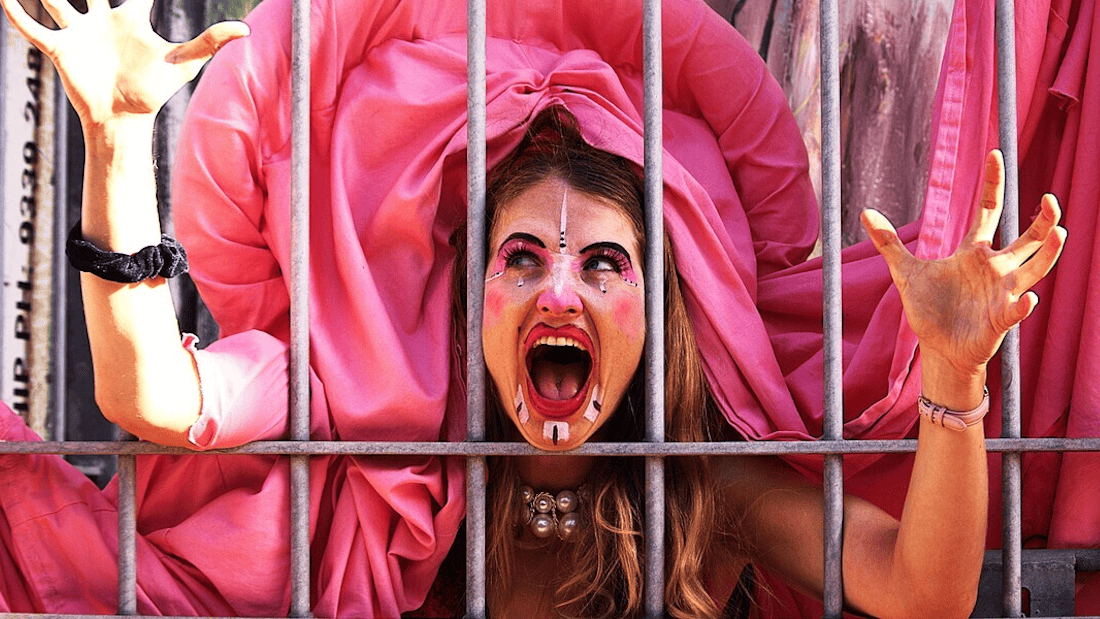
I also dress up as a giant vulva to represent the hypersexualisation of women. It feels like an accurate representation of how it feels to be a woman in this world. It represents the shock of being in a woman’s body. Like I am a walking fuckbag, a piece of flesh, simply a womb, and I can’t be both smart and sexy.
I will just be pretty, objectified and always brought back to my gender and scrutinised and observed by the male gaze. The male gaze and its use by media and marketing have shaped the way I perceive myself—massively.
The show offers itself as a form of creative therapy, which complements your own background in therapy—what impact do you hope to have on audiences who see the show?
I want to help people heal their shame of being human. There is beauty in everything. Your doubts, confusion, grief, and anger are beautiful and worthy of love, and so is your body. I want to remind my public that the body is wise. And I want to reclaim sexuality and erotic energy as a creative force, not something confined to the bedroom. We are human feelings, not human machines. We are human divine, not working, walking wallets.
How do you protect your vulnerability on stage?
I used to push myself too far—classic good-girl behaviour. Now I work at the edge, not beyond it. Sustainable growth happens there.
Improvisation helps me stay real rather than perform authenticity. I’m also deeply interested in how audiences shape the experience—how power, projection, unity and separation dance in the room. Wearing such a costume invites shock, humour, discomfort and curiosity—and I consciously hold space for that.
You describe the Pink Priestess as your ikigai.
Ikigai asks: What are you good at? What do you love? What does the world need? What can sustain you?
For me, it’s transmitting unconventional ideas through art. I’m a trained singer, a creative therapist, and a seeker. Society needs new myths and courageous artists willing to embody them. This work sits exactly at that intersection.
Why are conversations about gender, power and self-love so urgent now?
Because if we want to survive as a species, we must relearn how to coexist—with ourselves and each other. That means tolerating big emotions, conflict, repair and uncertainty.
Community is essential, yet forgotten. Even wellness culture is outdated in its understanding of the body and nervous system. Artists are courageous truth-tellers—and they need support, recognition, and funding.
Thank you so much for speaking with me! For my final question, the floor is yours; what would you say to audiences to encourage them to see the show?
Come see the show. Bring your date—it’s a perfect way to open conversations about consent, pleasure and healing. There will be laughter, tears, music, wisdom—and vulva art for sale. For $30, you’ll receive a bucket full of embodied insight and joy. All genders are welcome!
The Pink Priestess and her Cosmic Flaps hits Belly of the Beast at Fire In Your Belly from Friday, January 23, to Friday, February 13, 2026. Tickets are on sale now from fringeworld.com.au