
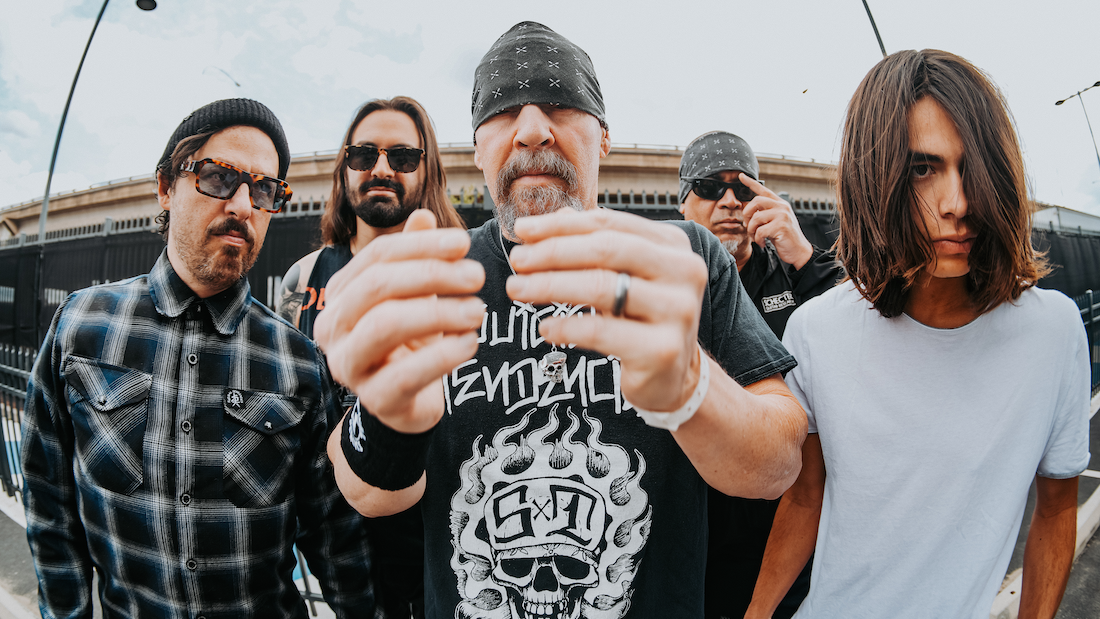
Cyco Miko on Suicidal Tendencies, skateboarding, and the next chapter
Thrash punk legends Suicidal Tendencies are coming to Perth for the first time since 2018, hitting Magnet House on Friday, October 31, before performing alongside Metallica at Optus Stadium on Saturday, November 1. Ahead of their upcoming visit, KAREN LOWE spoke to singer and founding member Cyco Miko to find out about their first song in seven years, skateboarding’s influence on the band and plans for a new album in 2026.
You guys are coming back to Australia at the end of October and will be touring with not only Metallica and Evanescence but also with Australia’s own Briggs and his new project, Big Noter. Are you looking forward to touring here again? What are some of your favourite memories of Australia?
We are, and it’s actually kinda cool. Over the years, people say things, and they say what they think people want to hear and this and that, but it’s nice because I really love Australia for so many reasons, to the point that my three boys were born in Australia. I was a permanent resident for a while. I lived down in New South Wales and then in Queensland for a bit. I still remember the first time… not to do the Perth ‘kiss ass’ thing, but the first time we got there in ‘93 and we were going to the other side of the other side of the world, which I call Perth.
We were walking down the street, and this was 22 years ago, and we were with some big people—one roadie—a black guy, 6’5”, 350 pounds, and this and that. We’re sitting there going “Okay,” and it was a lot different back then—there were a lot less people, and we were going, “Okay, when are the comics going to start?” Then some people were like, “Ah, g’day mate.”
We’re like, “Wait? Are they talking to us? They talking shit?!” and no one really gave a damn. And I realised that they went to the other side of the other side of the world because they assume you’re doing your thing and they ain’t worried about it, and I kind of like that.
I was at Scarborough Beach and sitting there and just going like, “Man, is the air different here or what?” and looking at the sky and just being there for hours thinking that this is the coolest place. And so I used to say Perth was my favourite city in the world. I think it’s definitely changed a lot because of all the minerals and resources and all that; the big boom and all that kind of stuff. But I like it. I’ve obviously gone to places like Margaret River… all those places, given that my brother was a pro skater and surfer. I love areas like that.
So it’s really cool, and it’s nice that we’re starting the tour there. Also, I don’t have to try to kiss ass to Perth. The show’s already sold out, so it’s all good! But I will bust out with, ‘It’s cool we’re starting at Perth the day before. We do a rehearsal, do our show, and then we do the Metallica show on the first.
Then on the second we go extra gangster; BIG time gangster. We go big… we go to… well, I do. Go on to see The Wiggles.
Oh, nice! Yeah, that’s going to be amazing.
Yeah, that’s right. So that’s boom, boom, boom! A 1, 2, 3 of power right there. Yeah, I’m excited. I’m not joking either.
No, no, I completely understand. Yeah, look, the adult Wiggle shows always sell out.
I’m going to the kid one. The family’s going. But yeah, I had heard about that. So it’s funny because sometimes people do the thing, and then they’ll try to do the Wiggle trivia, and I go, “Man! You can’t sneak that stuff by me. I’m old school. I know the old school. I know the controversy. I know Emma. I know it all from back then to now and stuff.
The shows that you are headlining are going to be completely different in scale from the Metallica shows. How do you prepare mentally for the different scales, or, at this point in your career, is it all second nature?
I think our shows are pretty simple. I have a good idea what’s going to happen.
We went there two years ago. We didn’t play Perth; we went last year with Infectious Grooves. We didn’t play Perth. It’s not the easiest place to get to. And then there are other issues like availability. And then with Infectious, we got offered the Blues Fest in Byron Bay, so we had to work everything around that schedule, and so you get all the things like, “Oh, why don’t you add a Perth show?” and then there’s no Perth show, “Fuck you, mate!” and all that stuff. So anyhow, you take the abuse, but we’re there.
When it was announced, it was like, “You better do your own show,” so we’re doing our own show. And then people complain because they don’t have tickets now, as it’s sold out, so there’s always something to complain about.
But there are always people there. When we went the last time, every place that I was at, I was talking to people, and they were with a whole crew of people, and a lot of them said the same thing. “I haven’t seen him in 10 years. I haven’t seen her in 14 years,” and people got in touch because of the show and got back together and had a great time, and I think that’s an amazing part of life.
So there’s definitely, the excitement level is a little bit different at our shows… Is it Optus Stadium—our shows? I guess it is like 90,000 people or whatever… It’s a completely different experience. To be able to play on those is amazing and stuff—absolutely amazing for me. But yeah, it’s definitely different. There’s a lot of people that have no idea who you are. Someone was like, “Oh, was that where they got their bass player from?” Everybody has their knowledge or lack thereof and stuff, but it’s a great opportunity to do what we do and prove that we can do it on any stage in the world. So we’re very, very thankful to be there.
On that, your music has never really fit into any specific box—punk, thrash, hardcore and even funk. What’s the driving force behind constantly evolving your sound, and how do you stay true to your vision while dealing with changing music scenes?
Well, one of the things that I realised is that what other people did with music is they put out their record. They’d have their ballad or their slow song: the hit. Then they put out the next record, and it would be the exact same thing but with just an extra ballad.
There’s always kind of a formula that was very predictive. People did good. Then the next record: “Oh, this is going to be just like the last one!” Or, if it didn’t do good… “Oh, we didn’t like that. It was the producer!” and blah blah blah.
It’s like my dad always said. When you do something, it shouldn’t matter whether you’re painting or whatever you’re doing. You look back when it’s done and go, “I’m stoked about this,” and it doesn’t matter what other people say.
We did the opposite; we changed. We wanted every record to be different. We didn’t want to try to do the exact same thing over and over. It’s not like attacking AC/DC or whatever, but I couldn’t tell you what was new and what was old. It has that sound, and that’s great. They got their sound.
But I think for me… I’m pacing. I can’t do the same thing over. I can’t sit in a movie theatre and watch the same movie twice. I’m just different. I think that when I hear music, if you can sing along with something you haven’t heard before instantly, that’s like candy! That’s like sugar frosting, and I don’t like that. I found the music that I’ve liked—that I still like; when I first heard it, I stopped, and sometimes I didn’t know what the hell it was, and it made me think, and there’s stuff I didn’t like that I was like, “What the hell is this?”
So I wanted to do something that was not a statement of what was happening at that particular time or what people were listening to but that hopefully people would be listening to 10, 20, 30 and even 40 years later and stuff. So that to me is very, very important and part of the process. I don’t want to have shag carpet music. I want to have bell-bottom music. I don’t want it to be like where you can define it and just go, “Oh, okay.”
Put it in the food analogy. If you go out to a restaurant, you may like Italian food, but you don’t want to eat it every day. There’s a lot of different kinds and stuff. When it comes to music, I’m more… I’d say… adventurous in the sense that I don’t really care what other people think, as long as I like it. That’s cool, and if other people like it, that’s great.
You guys have also released your first song in seven years this year with Nisha Star on vocals and Jay Weinberg on drums. How did that come about? And when can we expect the new album?
Well, actually, it came about because I was doing a different project with Nisha and Josh Paul, who’s our old bass player on Freedumb and Free Your Soul and Save My Mind. We were playing to a couple of people, and they’re like, “Oh dude, is that the new Suicidal?” And we’re like, no. The lyrics, I have to admit, are very Suicidal. Josh’s bass playing is very Suicidal, and then we got Jay to play on it. We had Tye (Trujillo) play bass with his fingers and stuff. Josh is slapping it, and it’s a very action-sport kind of thing. It starts off with “one life to live, and this is what you’re doing. Life isn’t fair. No one said it would be.” and it has the contrast with Nisha and me.
So when we were going, “Oh, let’s put it as a Suicidal,” and I tried to do the other parts, it just didn’t sound right. It didn’t fit. So in that sense, a lot of Suicidal stuff comes about in a backwards kind of way. Then consequently… that’s led obviously to people talking about doing a new record. And Ben Weinman has been pushing for it for a while.
Ben did phrase it in a way that really got me thinking. He was saying that when he was 13 or 14 and was skating, he remembers the first time he heard Suicidal. He goes, “I knew it was different. I always remember that moment.” He then said, “I want to do a record—a Suicidal record. I want to do something that’s like that. Not certain it sounds like this record or that record, but a Suicidal record that when someone hears it, there’ll be someone like me that’ll go, “Whoa! What is this?’”
And so to me, that is why you make records. That’s why you should. And everybody has a background where, like Tye—his dad was in Suicidal. He was the little kid going to shows when Robert was playing. And to be in there, he understands from all the… as he calls ’em ‘all the old homies’, what it means. He understands that legacy but also that responsibility.
So I think that we will do a record. We’re always recording. I think we will put out a record, and it probably will come out next year, and it probably will be different than what a lot of people would expect it to be—especially with all the names of the people in the band. Not trying to do a record to be ‘the name’. It would be something that doesn’t have a lot of sugar on it. It doesn’t have the frosting on it. Doesn’t have the icing on a brick that looks delicious, but when you bite into it, you break your fucking teeth. So that’s the Suicidal way.
A lot of the people attending the shows now would have first heard of you guys and your song Cyco-Vision through Tony Hawk’s Pro Skater, and your brother, of course, was one of the original Z-Boys and the creator of Dogtown Skateboards. How important has the skating community been to you over your career? And did you ever consider taking up pro-skating?
So it’s a beautiful skateboard story, and I’ve said it many times, but I love skating. My brother said when he first (he’s five years older) got on the skateboard, he knew that his life was changed. He didn’t know how, but he just knew that it was and that there was going to be a journey there. My brother was obviously a pro.
I was the little kid that was probably very annoying and wanted to tag along with all of the Z Boys. I got a skateboard and love it. I thought this is amazing until I fell, and I’d be like, “Ah! This shit hurts!”
I asked my brother, “Hey James, what’s the secret?” and he said, “The secret is when you fall down, get your ass back up.”
And that’s one of the things I realised when watching them. If there was a pool that they emptied and they’re sneaking in and crawling over through the alleys to get to a pool or whatever…there’s no cameras. No one had cameras back then, and they’d fall down and their blood’s coming through their Levi’s. No one had pads, and they’d just get up and wipe it off and do it again.
I think life is like that. A lot of times there’s going to be pain, but when you have purpose, that pain isn’t as bad, and when you don’t, you focus on the pain. There’s a lot of things that I learned from them. The other thing is, I go to a skate park or somewhere with them, and then people would be like, “Oh, that’s Red Dog’s little brother,” and I felt like the whole world was staring at me. Skateboarding stopped being fun because I felt like I had to be good, and if I fell, people would be like, “Ooh, he fell!”
It was probably one of the best lessons in my life because I realise now no one gave a fuck who I was. You know what I mean? I have that perspective with my kids. Everything seems so much bigger than it is, but it really isn’t. At that time, it doesn’t matter who says what because you’re going to see it that way. But ultimately, I go, “Don’t stop being you. Don’t stop something you love because you are worried about what someone else is going to say or question it.” You don’t have to be great to love something. You know what I mean? And consequently, my brother’s in the Skateboard Hall of Fame, and I’m in the Skateboard Hall of Fame.
It isn’t because I could skate, but I was involved with something. When you do something for the right reasons, people understand that. I’m very fortunate to have been around so many of the top pros that I looked up to and then, as generations changed, to be friends with and be able to appreciate the skills that they have and know that some of it’s natural and most of it is a lot of work. A lot of falls and pain and stuff, so I appreciate it, and I love it tremendously.
Then Tony Hawk, he was first sponsored by Dogtown when he was an amateur, and to the point when he was doing the video game and they asked to use a song, I’m like ‘Who’s going to play a skateboard video game?’ You know what I mean?
Then quickly, my neighbours, who were all into motocross, are like, “Dude! You’re on a track. You’re on the Tony Hawk game!” I’m like, “Why’d you get that?”
“Oh, it’s a great fucking game!”
I realised it crossed over and then it’s amazing. We’ve been in Iron Man—having a track on that; being on some of the old TV shows and all different exposures—Grand Theft Auto and things like that. So many different ways that people come up and say, “The first time I heard you was…” and so that’s amazing that so many people’s journey to Suicidal came from completely different ways.
But obviously the skateboarding community has always been huge. I was the first non-pro skater to be on the cover of Thrasher Magazine. That was a huge honour for me. Then you look at the magazine before Suicidal came out and the way people dressed and then you see how the evolution of how people dressed after Suicidal. So very cool.
Suicidal Tendencies play Magnet House on Friday, October 31, 2025. Tickets are on sale now from suicidaltendenciesofficial.com