
Coming clean with GRUB
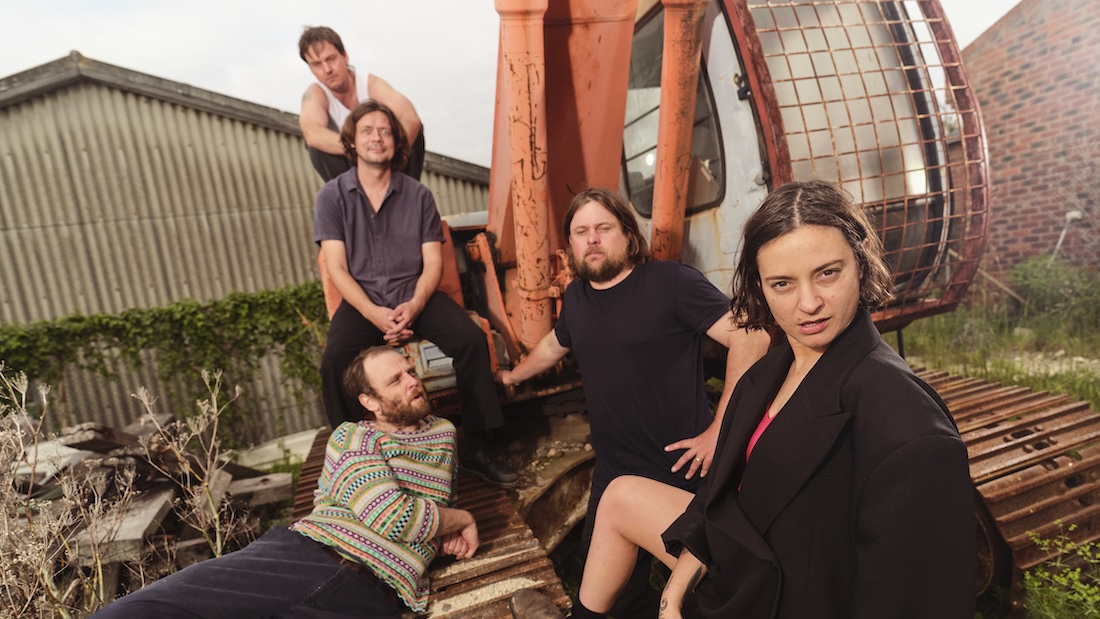
Fremantle five-piece GRUB may have found each other through Mojos, but the roots of their self-titled debut lie further inland. With their self-titled debut released through Wing Sing Records and a sold-out hometown launch at Mojos, Matilda Beales spoke to CAT LANDRO about the band’s not-so-sudden rise, the venue and community that brought them together, finding power in a voice that refuses to be ladylike, and the fragility beneath the noise.
From the outside, it feels as though GRUB have suddenly blown up. Does it feel rapid from where you’re standing?
Probably like a lot of bands, it doesn’t feel sudden in the sense that we’ve been plugging away at this for five or so years. Having more attention is definitely all moving quite fast and excitingly, and it’s wonderful. But even thinking about the record, a bunch of the songs on it I wrote at least four years ago.
The publicity likes the phrase “all-star lineup.” Who else is in GRUB, and what does each person bring to your sound?
It is a bit of an all-star lineup—and then there’s just sort of amateur me. So, the four fellas: we have Peter Bibby on drums and, obviously, no need to over-explain that one. He’s an incredible artist who has been on the scene for a long time, and I’ve been a fan of his for a long, long time.
Edo Ekic plays bass and has been in the local Perth scene for 15-plus years. The same goes for Dunc Strachan, who plays guitar. They’ve both been in lots of different projects and are incredible, well-seasoned musicians.
Then Mitch McDonald from The Love Junkies is the other guitarist. It’s obviously something that people do… brag about their band, but I’m pretty confident when I brag about mine because they’re all pretty seasoned top dogs in the field. I’m very lucky.
GRUB’s origin is closely tied to Mojos and hanging out—just one of those crucial connections that Freo musicians make. How did working, drinking and watching bands together there become the foundation for the band, and how is that ecosystem important to supporting a local band?
It’s funny: that origin story wasn’t something I had given much thought to until I started doing interviews, but it is quite fucking cool. Four out of five of us were managers of Mojos at one point. The only person who hasn’t worked there is Edo, but he has probably single-handedly financially supported the bar at one point or another from the other side of it.
It is obviously an institution and hugely important to the Perth music scene through all its chapters, and it’s still a really important venue for Perth. Spending so much time with these guys on a working and social scale—drinking together, watching bands together—I’m only really now appreciating its significance as the birthing place of GRUB.
Outside of the fact those guys have all been playing music for years, we’ve all been pretty heavy participants in the scene for a long time. It feels cool to bring all of that with us from where we’re at now.
Totally. You’re shaped by the other bands you get to hang around with and see as a punter.
We associate GRUB with Freo, but the album and your sound feels more inland than coastal—like driving through dry, hot country, getting grubby, that kind of thing. Does that description make sense to you?
That makes total sense. I love that you just described it as inland. So fucking cool. I can speak to maybe a few reasons why that is the way it is.
Although most of us live in or are Freo-based and have spent a lot of time in the Freo scene, we all grew up inland. Me, Pete and Dunc all come from the Perth Hills, which is where I grew up, with Dunc from when we were teenagers. We’re inland people. The coastal life is not really where our roots are. They’re very much bogan-y bush roots, and that hugely influences our sound. It’s really cool to be described that way. You’re spot on.
Credit to you guys—you’re making that sound. I really believe that a place can inform what your sound is like. You can sound like you’re from Perth, not just from Australia. Brad Rimmer’s photograph on the cover seems to echo that same sensibility: the fibro house, the old car, the glow and dryness of the light. How did the connection with Brad come about?
I’m really glad you asked because I haven’t had a chance yet to rant about Brad Rimmer. I came across his work maybe a year or a year and a half ago, and then Pete bought me a couple of his photo books for Christmas.
I love his work so much. Regardless of whether we got to work with him creatively, he’s just fucking incredible. It also turns out he’s our neighbour. This lovely guy who lives around the corner, who we always pass when we’re walking our dogs, turns out to be Brad Rimmer.
Pete and I were spitballing album covers one day. I had one of Brad’s books out and said, “God, imagine if we could have a Brad Rimmer photo for the album cover—because, obviously, no way.” Pete encouraged me to reach out. He said, “You’ve got nothing to lose. Why don’t you just ask him?”
I very nervously sent him an Instagram message and then an email. I said, “I know you’re so big-league, and it’s totally fine if you tell us to fuck off, but how would you feel about us using a photo for the album?” He was so lovely and said, “Totally, no worries. Which one do you want?”
After a few back-and-forths, he sent over the photo and let us choose the one we liked. He was incredible.
The other thing I find really interesting about GRUB, and about you in particular… I can’t place your voice as sounding like anyone else. It feels like this is your voice only. There is a broader appetite for loud women at present—we have figures like Amy Taylor nationally and, locally, RATSALAD. and (my fave) Skortz—bands fronted by women who are loud but also femme and funny, assertive and not afraid to sound ugly as well. How did you find your own place and your own voice inside that?
It’s wonderful to be considered part of that. It’s an honour, really. I think I’m lucky because I can pretty confidently say I’m not putting any of it on. My personality is a bit rough around the edges and raspy-voiced and, you know, whatever the antithesis of fucking ladylike is. I just happen to fit into that quite well.
To find a style and a scene where that is celebrated is wonderful. All those bands you mentioned—Skortz and RATSALAD.—are amazing and full of incredible women. I know some of them quite well, and they’re all the same as me: just genuinely themselves.
I’m also happy that I’ve found my own sense of identity within it. I’m keen to be self-deprecating and take the piss out of myself, and I hope that translates as me being genuine. There are incredible people who fly the flag in ways that I love, but what is true to my personality is the piss-taking and constantly dealing with inner turmoil and all this kind of shit. That’s how I’ve found my own place within this wonderful theme you’re talking about.
Yeah, and more of that! It totally comes through as authentic. As women, there can be an expectation that “Okay, to be taken seriously, I’ve got to be loud and ballsy,” when actually, no, we can be all these various things that are part of us and be taken seriously.
Your voice also goes to spaces that are sweet or tender. Songs like The Floor—and even Hate—have a surprisingly positive, pop sensibility. Was that range deliberate?
The voice thing is definitely intentional. In the past, I wouldn’t have felt comfortable being a bit weird and all over the place, but it now feels like part of what I do with intention.
It’s also reflective of that same inner-turmoil shit we were just talking about, or vulnerability. I’m not trying to be out here just shouting. There are lots of moments where it’s meant to reflect fear and fragility.
That contradiction runs through the whole album: anger and fragility, humour and fear, frustration and determination. Where does that duality come from?
I think that has just been how I’ve found being alive, to be honest—the human experience. I’m sure lots of women can relate to this: having a pretty rough outer shell, which I’ve used to protect myself a lot, but internally being full of fragility and needing nurturing and tenderness.
I’m glad that has translated on the record because it reflects my experience of walking the planet. I constantly feel pulled by this duality of wanting to be seen as tough and ballsy and fucking doesn’t-take-any-shit, but also knowing very much that I can be a fucking fragile flower.
I love that honesty. You have described The Floor as a motivational speech to yourself, but live it becomes communal—something the whole room can sing along to. How does that feel from the stage?
It feels wonderful. I think people also just love swearing, but it’s beautiful. It’s the most wholesome thing in the fucking world.
The last part of the song becomes much more of a discussion of everyone around me going through heavy shit. When I wrote it, that was a reality for not only me but a bunch of people in my community who were dealing with some big things.
When we play it live now and people sing it back, it feels very poetically accurate. It feels beautiful. To have people sing your songs back to you is fucking lovely.
It must be so validating. It’s not only your experience—people are connecting with it and then celebrating that.
It’s magical.
GRUB’s self-titled debut album is out now and available from wingsing.co