
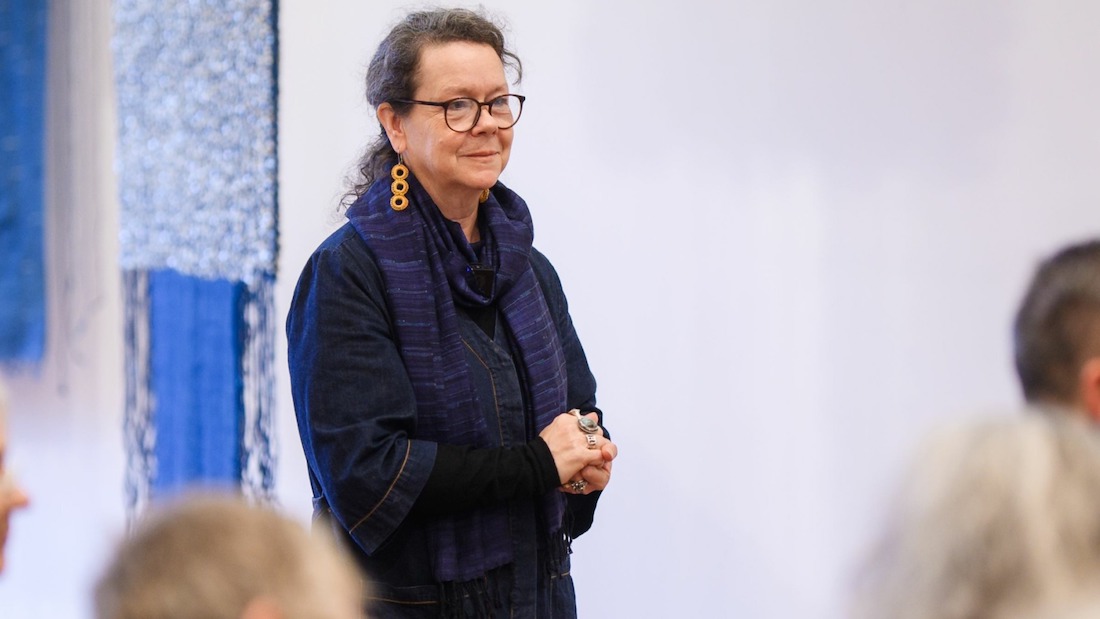
Carola Akindele-Obe expands the horizons of the Indian Ocean Craft Triennial
An international panel of curators from across the Indian Ocean region will come together to shape the theme of the next Indian Ocean Craft Triennial (IOTA27). This is the first time that such a diverse group has convened to guide the event. PRUE ACKRILL caught up with IOTA Executive Director Carola Akindele-Obe about the Curatorium, the importance of it, and its future. The Indian Ocean Craft Triennial’s Craft Co-Lab takes place at Curtin 137 on St Georges Terrace on Tuesday, November 4, 2025. Tickets are on sale now from humanitix.com
This year’s Curatorium has invited voices from across the Indian Ocean region for the first time. Has this idea been in the works for a while, and why was now the time?
Yes, absolutely, but it takes time to build. From the start, IOTA’s vision has been to build genuine exchange across the Indian Ocean region. We curated the first two editions in 2021 and 2024 almost as pilots to set the vision and the tone and establish relationships in WA and in the region. It would have been hard for us to do at the very beginning. We needed that time to find our way. Now, with foundations in place, it feels like the right moment to open the circle wider—to invite curatorial voices from across the region to help shape what the Triennial can be. As the world looks south and west again, it seems appropriate for that conversation to happen from our part of the world.
What particularly excites you about this year’s lineup of members?
I’m thrilled by the diversity of thinking and practice that this group brings. Coming from India, Indonesia, Kenya, Malaysia, Thailand, and Australia, they work in various manners and approaches at the intersection of craft, community, and contemporary art. Each with a distinct voice yet sharing a deep respect for material knowledge and social connection. What excites me most is the energy already brewing between them—you can feel the potential for new ideas and collaborations.
Of course, there are many great voices in our local arts industry, and expanding internationally, that scope seems unimaginable. How do you go about curating the Curatorium? Is there something in particular you look for?
We published an Open Call for Expressions of Interest early in 2025 and took it from there. When selecting and interviewing, we look for people who are not only great curators but great collaborators—those who are open to dialogue and exchange. It’s about finding thinkers who understand craft as more than an aesthetic—as a way of knowing, relating, and making meaning. We also try to balance geography, experience, and voice so that the discussion reflects both common ground and difference. Ultimately, it comes down to trust. and curiosity—people who bring integrity and imagination to the table. And importantly, they’re people we know we’ll enjoy working with.
The upcoming Craft-Co Lab symposium will feature conversations around topics relevant to our current arts landscape, such as the intersection of art and technology and how practices are evolving. Could you tell us a little about the importance of discussing some of these topics?
For makers, that raises questions about authorship, sustainability, and the value of time and touch. The Craft-Co Lab gives us a space to talk about these things from a position of practice, not theory—how digital processes can sit alongside ancestral knowledge and how technology can serve creativity rather than consume it. These are vital conversations for artists, craftspeople, makers, and audiences alike.
As communities and cultures connected by the Indian Ocean, what shared regional talking points stand out to you? And what do you think we can learn from coming together in this way?
Across the Indian Ocean, there are so many shared stories—of movement, trade, resilience, and adaptation, not just historically but now. Across our communities, we’re all asking similar questions—about identity, heritage, and how to live sustainably. When we gather across borders, we realise that these threads connect us—local and global knowledge and relevance. I believe there’s strength in that exchange.
What vision do you have for the Triennial more broadly? And how does the Curatorium play into its potential for the future?
The Indian Ocean Craft Triennial (IOTA) is a not-for-profit arts organisation in Western Australia that connects artists, curators, and communities across the Indian Ocean region through craft. It delivers a centrally curated international exhibition presented with major WA institutions alongside a statewide festival of partner-managed exhibitions and community projects. IOTA’s vision has always been bigger than just an exhibition. It’s about building a living network—a platform that continues to evolve between editions, uplifting the continuous importance of craft in all our lives and connecting communities across Western Australia and the Indian Ocean region.
The development and nurture of the Curatorium is central to that. It brings depth and wider dialogue to the Triennial. Over time, I’d love to see IOTA continue to reimagine its approach and how craft connects us—as I wrote in the Introduction to the IOTA24 catalogue (Part Two) … And so, the IOTA story continues to evolve—growing, shifting, and dancing with each new chapter.
The Indian Ocean Craft Triennial’s Craft Co-Lab takes place at Curtin 137 on St Georges Terrace on Tuesday, November 4, 2025. Tickets are on sale now from humanitix.com