
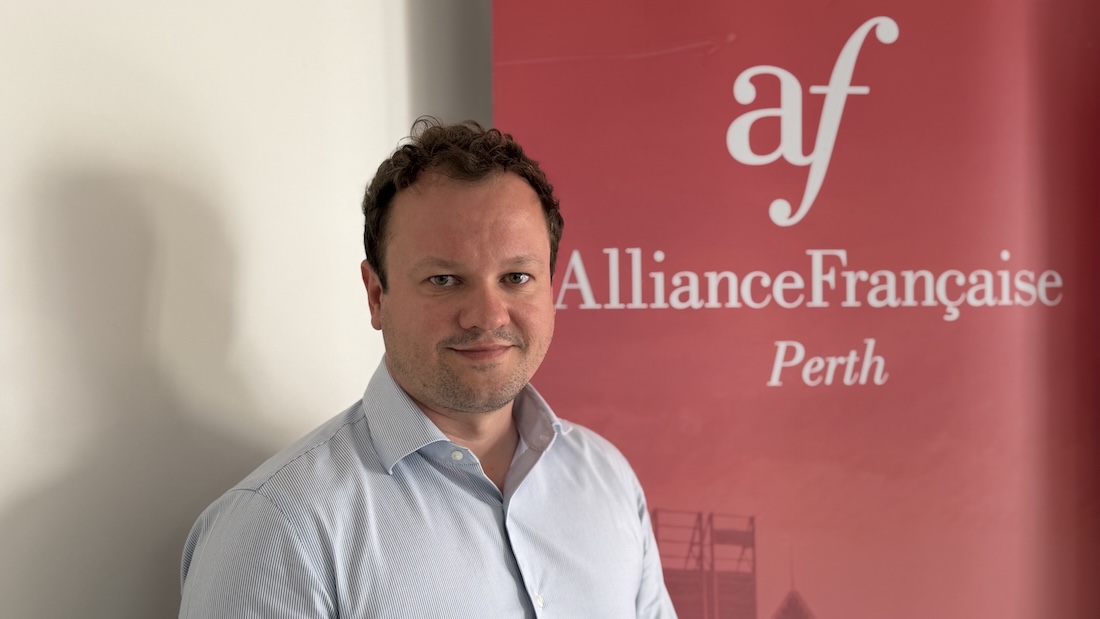
Behind the Magic of the Alliance Française French Film Festival with Alexandre Allais
Perth is set to celebrate the 37th edition of the Alliance Française French Film Festival this month, bringing the very best of contemporary French cinema to screens across the city from Thursday, March 12, until Wednesday, April 15—with tickets on sale now. NATASHA PAUL caught up with General Manager Alexandre Allais to talk about some of the highlights of this year’s program, what makes French film so unique and why the festival continues to captivate local audiences nearly four decades in.
Congratulations on bringing the Alliance Française French Film Festival back to Perth in 2026! As the largest festival dedicated to contemporary French films outside of France, why do you think it is so important that WA audiences continue to experience French cinema?
Thank you so much. We are absolutely delighted to be bringing the 37th edition of the festival to Perth. As the General Manager of the Alliance Française de Perth, who arrived in September, I have to say I’ve been genuinely amazed by the scale of this festival and the enthusiasm Perth people have for it. 22,500 admissions last year speaks for itself. It just shows how open Perth audiences are to the world and how much appetite there is here for stories that go beyond the familiar.
And I think that’s exactly why it matters. French cinema is a window onto the world. Perth has a deeply engaged cultural community with a genuine curiosity for international perspectives, which I’ve been happy to discover every day since I arrived. The Alliance Française French Film Festival taps into that in a way that very few other events can. It’s one of the few moments in the year where WA audiences can encounter stories that come from a different place, culturally and emotionally—stories that surprise you, challenge you, and sometimes stay with you for years.
For Alliance Française de Perth, which has been part of this city’s cultural life for 115 years, the festival is also deeply personal: it’s one of the most direct ways we have of saying this culture is alive, contemporary, and speaking to right now. Not the France of clichés, but a France that is arguing with itself, reinventing itself, and producing some of the most compelling cinema in the world.
And what do you think are the most distinctive attributes of French cinema? What sets it apart from films elsewhere in the world?
French cinema is one of the few cinematic traditions that has consistently resisted the gravitational pull of pure entertainment. It trusts its audience, it doesn’t over-explain, it accepts ambiguity, and it allows characters to be morally complicated without redemption arcs. There’s also a serious conversation happening between French cinema and French literature, philosophy and history that gives even commercial films a certain density. This year’s lineup makes that very visible: you have an adaptation of (Albert) Camus’ The Stranger, a body-horror drama by Palme d’Or winner Julia Ducournau, and a sharp social satire like The Party’s Over, all sitting in the same program. That range, that refusal to be one thing, is, I believe, very French.
The festival will be showcasing a wide variety of the newest and highly acclaimed French-language cinema. What are some of your highlights from this year’s festival?
There are so many, but a few stand out for me personally. Our opening film, Colours of Time by Cédric Klapisch, is a joyful, moving journey through the world of Impressionism, a beautiful way to start the festival. The Money Maker, the true story of the “Cézanne of counterfeiters”, is utterly compelling. 13 Days, 13 Nights is the kind of film that reminds you reality can be bigger than fiction. A Private Life is remarkable for a different reason—Jodie Foster in her first major role performed entirely in French, which is something quite extraordinary to witness. And Case 137, an intense investigation into police brutality, is the kind of film that stays with you long after the credits roll. That range across five films tells you everything about what this edition has to offer.
And what are some of the more bizarre or unexpected films on this year’s program?
Dog 51 is genuinely surprising, a French sci-fi thriller, which is rare enough to be noteworthy, and a box-office hit in France this year with an extraordinary cast including Adèle Exarchopoulos, Gilles Lellouche, and Romain Duris. Then there’s Alpha by Julia Ducournau, who won the Palme d’Or for Titane. It’s a bold, unsettling body-horror drama that really pushes boundaries. And The Ice Tower by Lucile Hadzihalilovic, which sits somewhere between a fairy tale and a nightmare. These are films that don’t fit neatly into a simple category!
How did you and your team select the films to be showcased at this year’s festival? Was there a particular process you went through?
Everything starts at Cannes. Our Festival CEO Frédéric Alliod makes a first selection there, not just from the Official Selection, but from Cannes as a film market, which allows him to see films early, sense audience reactions, and understand which stories will travel. From there, he brings that selection to the six Alliance Française directors across the country’s capital cities, and we decide together collegially which films make the final cut, how the program is balanced, and what the national special events will be. It’s a genuinely collaborative process, and I think that collective voice is part of what makes the festival feel both nationally coherent and locally relevant.
The festival’s lineup features ten films directed by female filmmakers. Why do you think this representation of female filmmakers is so important to spotlight?
I believe there are fantastic female filmmakers in France and all over the world who are every bit as talented and hardworking as their male counterparts, and that a festival like ours has a real role to play in giving them the visibility they deserve. This year indeed 10 of our 38 films are directed by women, representing about 26% of the program, and we genuinely hope to go further next year. Because the stories we tell, and the way we tell them, are always shaped by the people making them. And that diversity of perspective can only make cinema richer. What strikes me about this year’s selection is the range. Alpha is body horror. Cycle of Time is a sharp social comedy. Leave One Day is a musical drama. The Little Sister, a drama adapted from a novel. That breadth is precisely the point.
I also understand that you’re a former music critic! How important do you think musical scores and soundtracks are to the success of films?
I will not surprise you by saying enormously important! And I think too often underacknowledged. Just think about it—what would Hitchcock’s films be without Bernard Herrmann? Sergio Leone without Morricone? Spielberg without John Williams? These scores aren’t decoration; they’re inseparable from the films themselves. More recently I’ve been struck by the work of Trent Reznor and Atticus Ross—they have an immediately recognisable sound, and yet they manage to dissolve completely into each new film they score. That’s a remarkable skill.
For me there is a relationship of true interdependence between a film and its music, a kind of waltz where each brings out the best in the other. The film elevates the music, and the music elevates the film.
What makes it particularly meaningful is that this year we have a documentary dedicated entirely to Michel Legrand, Once Upon a Time Michel Legrand, celebrating the composer behind The Umbrellas of Cherbourg and The Young Girls of Rochefort. For anyone interested in the connection between music and cinema, that film alone makes the festival worthwhile.
Who are some of the newer, emerging talents in French cinema that excite you—whether we can catch their work at this festival or keep an eye out for them in the near future?
The lineup this year is genuinely exciting in that respect. Among the directors, Amélie Bonnin with Leave One Day is someone to watch closely: directing the Cannes opening film is quite a statement for a first or early feature. Hafsia Herzi steps behind the camera for The Little Sister after establishing herself as one of the most compelling actors of her generation, and Enya Baroux brings a real lightness of touch to Bon Voyage, Marie.
On the acting side, Nadia Melliti is a revelation in The Little Sister. I defy anyone to watch that film and not remember her name afterwards. Paul Kircher, who plays one of the leads in our opening film Colours of Time, is a name that keeps coming up in French cinema right now. Suzanne Lindon, who also stars in Colours of Time, is quietly building her own trajectory as both an actress and filmmaker, very much on her own terms. And then there’s Eloy Pohu in Enzo, a young actor carrying a Robin Campillo film, which is no small thing.
The 2026 Alliance Française French Film Festival is screening at Palace Cinemas Raine Square, Luna Leederville, Windsor Cinema and Luna on SX from Thursday, March 12, until Wednesday, April 15, 2026; and Bunbury Regional Entertainment Centre (BREC) from Wednesday, March 25 to Sunday, March 29, 2026. Tickets are on sale Thursday, February 5 from affrenchfilmfestival.org